


Hybrid Cloud Security: Architecture and Best Practices
- Hybrid cloud security protects users, data, and workloads across on-premises and cloud environments as one system.
- The biggest risks sit at the seams: identity, traffic paths, data movement, and policy drift.
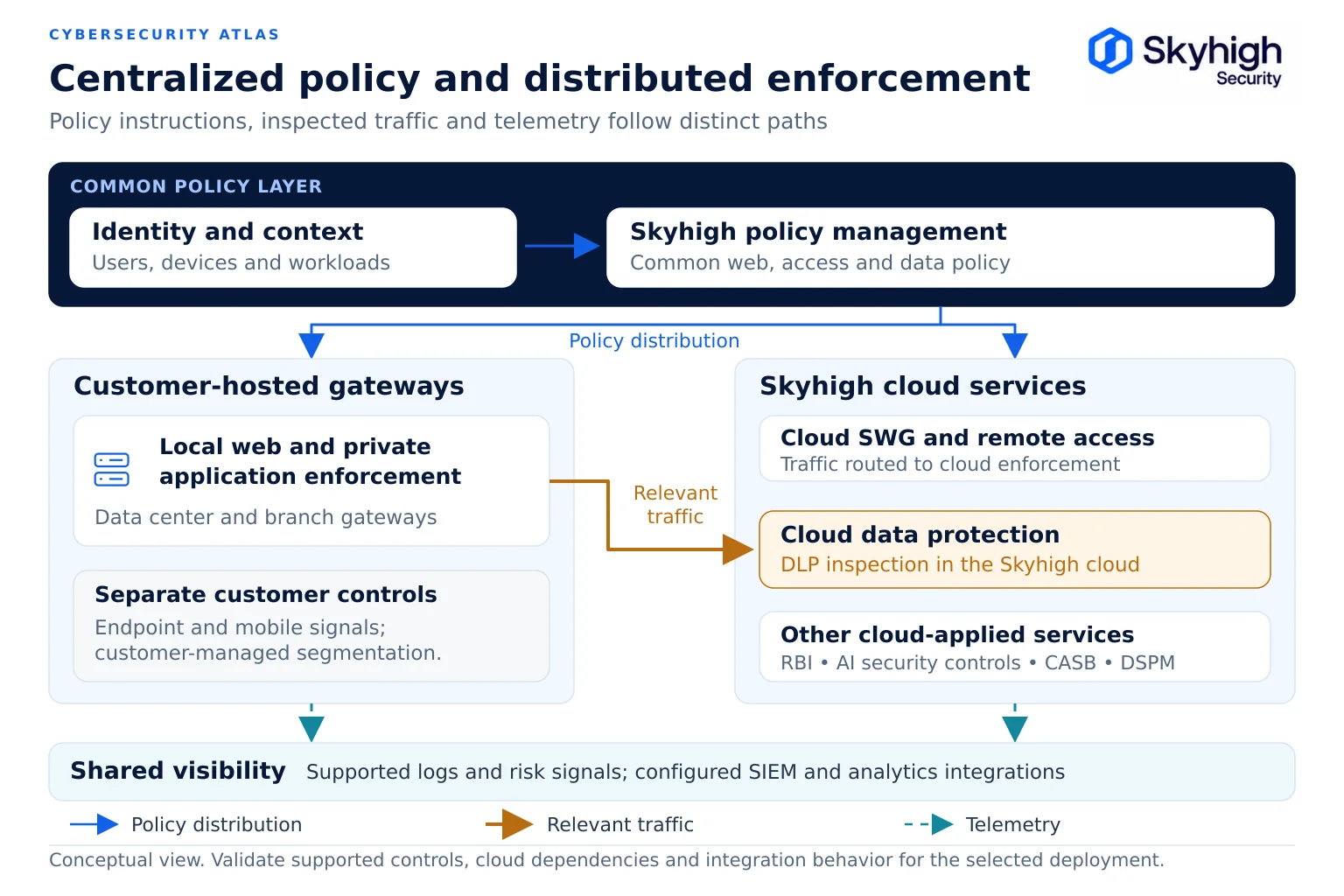
- Centralize policy decisions and distribute enforcement to wherever traffic originates and data must stay.
- Choose cloud, on-premises, or hybrid enforcement per workload based on latency, sovereignty, resilience, and cost.
- SSE secures user access to web, SaaS, and private apps, and can run in the cloud or on premises.
Hybrid cloud security architecture is the design that decides where security controls live, how policy is defined once and enforced consistently, and how data is protected as it moves between on-premises systems and cloud services. A sound architecture treats the hybrid estate as one environment with many enforcement points, not as a data center with a cloud bolted on.
Most enterprises now operate this way. Flexera’s 2026 State of the Cloud Report found that 73% of organizations run hybrid estates. This guide explains the risks that come with that model, the architecture that addresses them, the deployment and data protection decisions involved, where Security Service Edge (SSE) fits, and the best practices and compliance considerations that tie it together. Each section links to a deeper supporting article. For the broader infrastructure view, including components, deployment models, and architecture patterns, see Hybrid Cloud Architecture: Components and Deployment Models.
What is hybrid cloud security?
Hybrid cloud security is the practice of protecting users, applications, and data across a mix of on-premises infrastructure, private cloud, and public cloud, using consistent identity, policy, data protection, and monitoring across all of them.
It covers four things that single-environment security does not:
- The connections between environments, including interconnects, tunnels, and the traffic that crosses them.
- Consistency of policy, so that a user, device, or data type is treated the same regardless of where the traffic is handled.
- Split responsibilities, because each cloud service divides security duties differently between provider and customer.
- Placement decisions, because the organization must choose where inspection, decryption, and logging happen for every traffic path.
Hybrid cloud is often confused with multi-cloud, which means using more than one public cloud provider. Most large organizations are both. See Hybrid Cloud vs. Multi-Cloud Security.
Benefits of hybrid cloud security
A well-designed hybrid cloud security program gives organizations more control than a cloud-only approach and more flexibility than an on-premises-only approach.
Control over where data is processed. Regulated traffic can be decrypted and inspected on the organization’s own infrastructure, while less sensitive traffic uses cloud services. That makes sovereignty and privacy reviews simpler. See Data Sovereignty in Hybrid Cloud Security.
Operational resilience. Local enforcement of web and private application policy keeps working when a cloud provider, WAN link, or internet connection fails. Services applied in the vendor cloud, including data protection, remote browser isolation, AI security controls, CASB, and data security posture management, depend on cloud reachability and resume when the path recovers. Security does not become a single point of failure outside the organization’s control for the traffic enforced locally. See Hybrid SSE Resilience.
Performance where it matters. On-site users, plant systems, and high-volume internal traffic avoid an unnecessary round trip to a cloud point of presence, while remote users get direct-to-cloud protection without VPN backhaul.
A migration path without a forced cutover. Organizations can modernize legacy gateways, extend to cloud services, and adopt zero trust at their own pace, instead of moving all traffic at once.
Cost control at scale. Inspecting very high internal traffic volumes locally can be more economical than routing everything through a metered cloud service, while remote and SaaS traffic benefits from cloud elasticity.
Consistent protection for a distributed workforce. With one policy engine, the same rules follow users between office, branch, and home.
Hybrid cloud security risks and challenges
Hybrid cloud is harder to secure than a single environment because it multiplies the places where controls must work the same way.
NIST describes the underlying shift in SP 800-215, Guide to a Secure Enterprise Network Landscape. It identifies three security impacts of multi-cloud access, geographically spread data centers and branches, and distributed applications: the traditional network perimeter disappears, the attack surface grows with every additional compute, network, and storage component, and attackers gain more ways to move across network boundaries.
Breach data reflects the same pattern. IBM’s Cost of a Data Breach Report 2025 found that 30% of breaches involved data spread across multiple environments (public cloud, private cloud, and on premises). Those breaches were the most expensive category, averaging USD 5.05 million, and took the longest to identify and contain at 276 days. Breaches of data stored only on premises averaged USD 4.01 million. IBM’s 2026 report puts the global average cost of a breach at a record USD 4.99 million, which sits below the multi-environment figure above because it covers every breach type rather than the most expensive category.
The most common hybrid cloud security risks are:
- Inconsistent policy. The same user or data type is handled one way by an on-premises proxy and another way by a cloud service, and the gap goes unnoticed until an audit or incident.
- Visibility gaps. Logs, alerts, and data inventories live in separate tools, so no one sees an attack that crosses environments.
- Identity sprawl. Directories, service accounts, API keys, and now AI agents accumulate faster than access reviews, and each environment may have its own identity silo.
- Misconfiguration. Cloud services with permissive defaults, unreviewed changes, and differing provider models create exposure that on-premises controls never see.
- Unclear responsibility. Teams assume a provider handles something that is actually the customer’s job.
- Data sprawl. Sensitive data is copied between environments, into SaaS, and into AI tools faster than classification and governance keep up.
- Concentration and availability risk. If security enforcement depends entirely on one external service, an outage there stops work or removes protection.
The U.S. National Security Agency treats hybrid complexity as a distinct problem. Its Top Ten Cloud Security Mitigation Strategies, published with CISA in March 2024, include a dedicated strategy for the complexities introduced by hybrid and multi-cloud environments, alongside identity, key management, segmentation, data security, and logging.
Shared responsibility in a hybrid estate
In a hybrid estate, the organization runs several shared responsibility models at once, and identity and data protection always remain its own responsibility.
The NSA’s guidance on the shared responsibility model warns that customers often assume the provider covers aspects of security that are in fact the customer’s responsibility, and that misconfiguration and missing controls remain significant cloud risks.
| Layer | On premises | IaaS | SaaS |
|---|---|---|---|
| Physical facilities and hardware | Customer | Provider | Provider |
| Network and hypervisor | Customer | Provider | Provider |
| Operating system and runtime | Customer | Customer | Provider |
| Application configuration | Customer | Customer | Shared |
| Identity and access policy | Customer | Customer | Customer |
| Data classification and protection | Customer | Customer | Customer |
Two rows never move: identity and data. A hybrid security architecture should be built around those two constants.
How secure is hybrid cloud architecture?
A hybrid cloud architecture can be as secure as a single-environment architecture, and more resilient, when identity, policy, data protection, and visibility are unified across environments.
What makes hybrid environments risky is inconsistency: different policies, tools, and teams for each environment. IBM’s breach data shows the cost of that inconsistency, with multi-environment breaches costing more and lasting longer than on-premises-only breaches. Organizations that unify these layers remove most of the added risk and gain the ability to keep critical enforcement running locally when an external service fails.
Hybrid cloud security architecture: the control layers
A hybrid cloud security architecture is best structured as six control layers that apply across every environment, aligned with the pillars in CISA’s Zero Trust Maturity Model.
1. Identity and access. One authoritative identity provider, phishing-resistant MFA, and conditional access based on user, device, location, and risk. Include non-human identities: service accounts, workload identities, API tokens, and AI agents that act with user-level access.
2. Devices. Device posture (managed or unmanaged, patched, protected) should feed access decisions everywhere, not just for remote users.
3. Network and traffic. Segmentation, secure web gateway (SWG) inspection for internet-bound traffic, zero trust network access (ZTNA) for private applications, and firewall controls between segments. This layer also decides where TLS traffic is decrypted and inspected.
4. Applications and workloads. Hardened configurations, posture management for cloud infrastructure, API security, and vulnerability management that covers both data center servers and cloud instances.
5. Data. Discovery and classification (including data security posture management, or DSPM), data loss prevention (DLP) across web, SaaS, private apps, endpoints, and AI tools, encryption, and key management.
6. Visibility and operations. Centralized logging, behavioral analytics, automated response, and policy-as-code so changes are versioned and consistent.
For a diagram-level view of components, traffic flows, control boundaries, and deployment examples, see the Hybrid Cloud Security Reference Architecture.
Control plane vs. data plane
The core principle of hybrid architecture is to centralize policy decisions and distribute enforcement to wherever traffic actually flows.
NIST’s zero trust guidance, SP 800-207, separates the policy decision point (PDP), which decides whether a subject may access a resource, from the policy enforcement point (PEP), which sits in the traffic path and enables, monitors, or terminates the connection.
That separation is the key to hybrid design. Decisions should be centralized so that one set of rules applies everywhere. Enforcement should be distributed so that inspection happens in a cloud point of presence for a remote user reaching SaaS, on a branch gateway for an office user, and inside the data center for internal traffic that never touches the internet.
When decision and enforcement are fused into separate products per environment, organizations maintain two or three policy sets. Those sets drift apart, and drift becomes an audit finding or a breach path. See Consistent Security Policies Across Cloud and On Premises.
Deployment decisions: cloud, on-premises, or hybrid enforcement
There is no single right location for security controls; the right answer depends on the traffic and the data, decided per workload, site, or user group.
| Factor | Favors cloud-delivered enforcement | Favors on-premises or local enforcement |
|---|---|---|
| User location | Remote and mobile users | Users in offices, plants, and data centers |
| Destination | SaaS and internet | Internal and private applications |
| Latency sensitivity | Tolerant of a cloud hop | Real-time, high-volume, or OT traffic |
| Data sovereignty | Provider regions meet residency requirements; sovereignty additionally depends on who operates the infrastructure | Payloads, keys, or logs must stay in a jurisdiction or facility |
| Resilience | Provider SLA is acceptable | Operations must continue during a cloud or WAN outage |
| Cost at volume | Moderate inspection volume | Very high internal traffic volume |
| Legacy and OT | Few legacy dependencies | Legacy protocols or locally operated networks; confirm support for disconnected operation |
Most enterprises land on a mix. The architecture question then becomes whether cloud and on-premises enforcement share one policy engine or run as parallel stacks. See Cloud vs. On-Premises Secure Web Gateways and Private SSE Deployment.
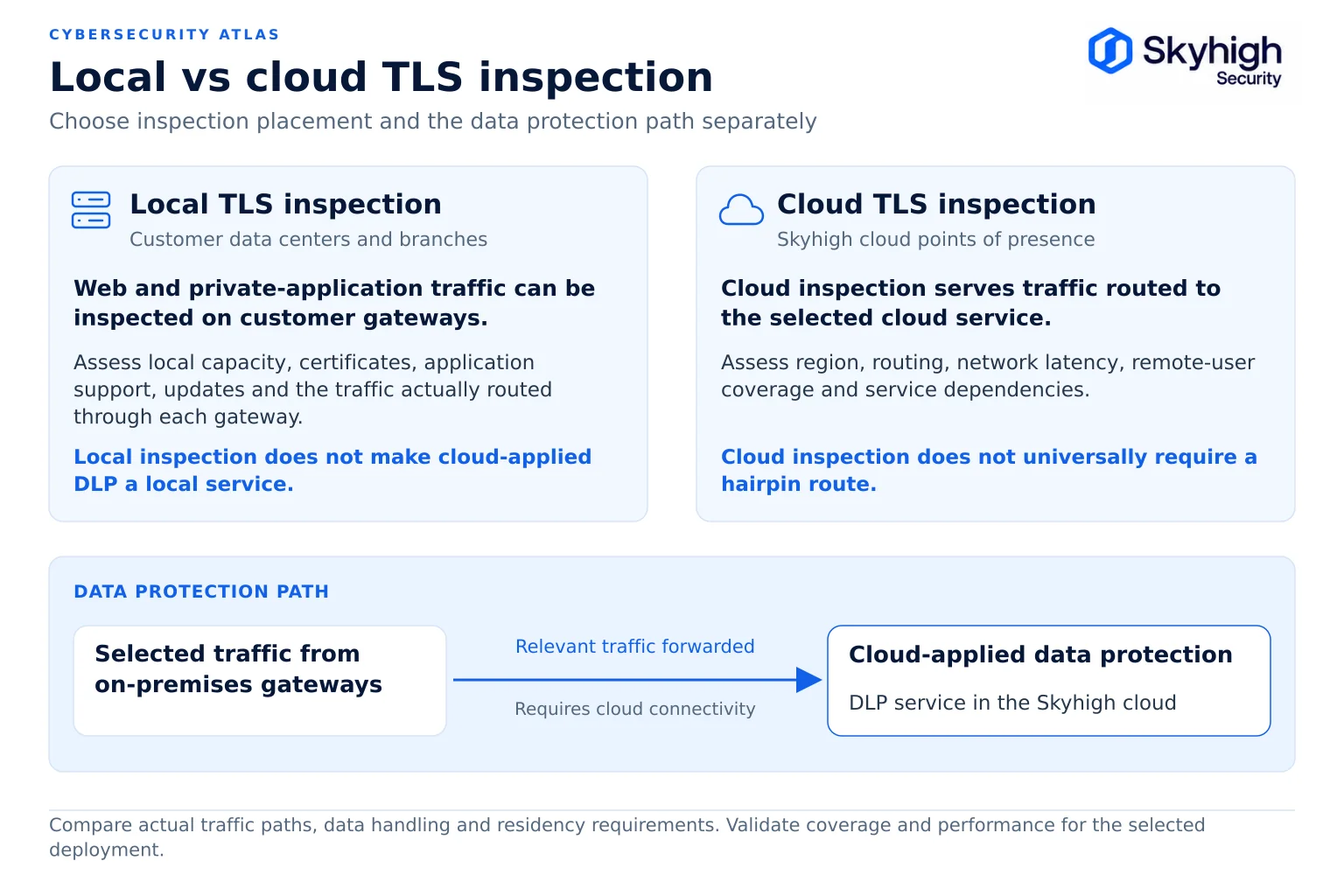
TLS inspection placement deserves special attention. NSA guidance on managing risk from TLS inspection recommends decrypting traffic once, within the enterprise network, and avoiding redundant inspection by chained proxies. In hybrid designs, that means deciding deliberately where decryption happens for each traffic path. See Local vs. Cloud TLS Inspection.
Data protection across cloud and on premises
Data protection in a hybrid estate depends on classifying data once and enforcing that classification at every point where data can leave.
- Find the data. Discover sensitive data in cloud storage, SaaS, databases, and file shares, and keep that inventory current.
- Classify once. Use one classification scheme so a confidential document is treated the same whether it is uploaded to the web, shared in SaaS, pasted into a generative AI prompt, or copied to a USB drive.
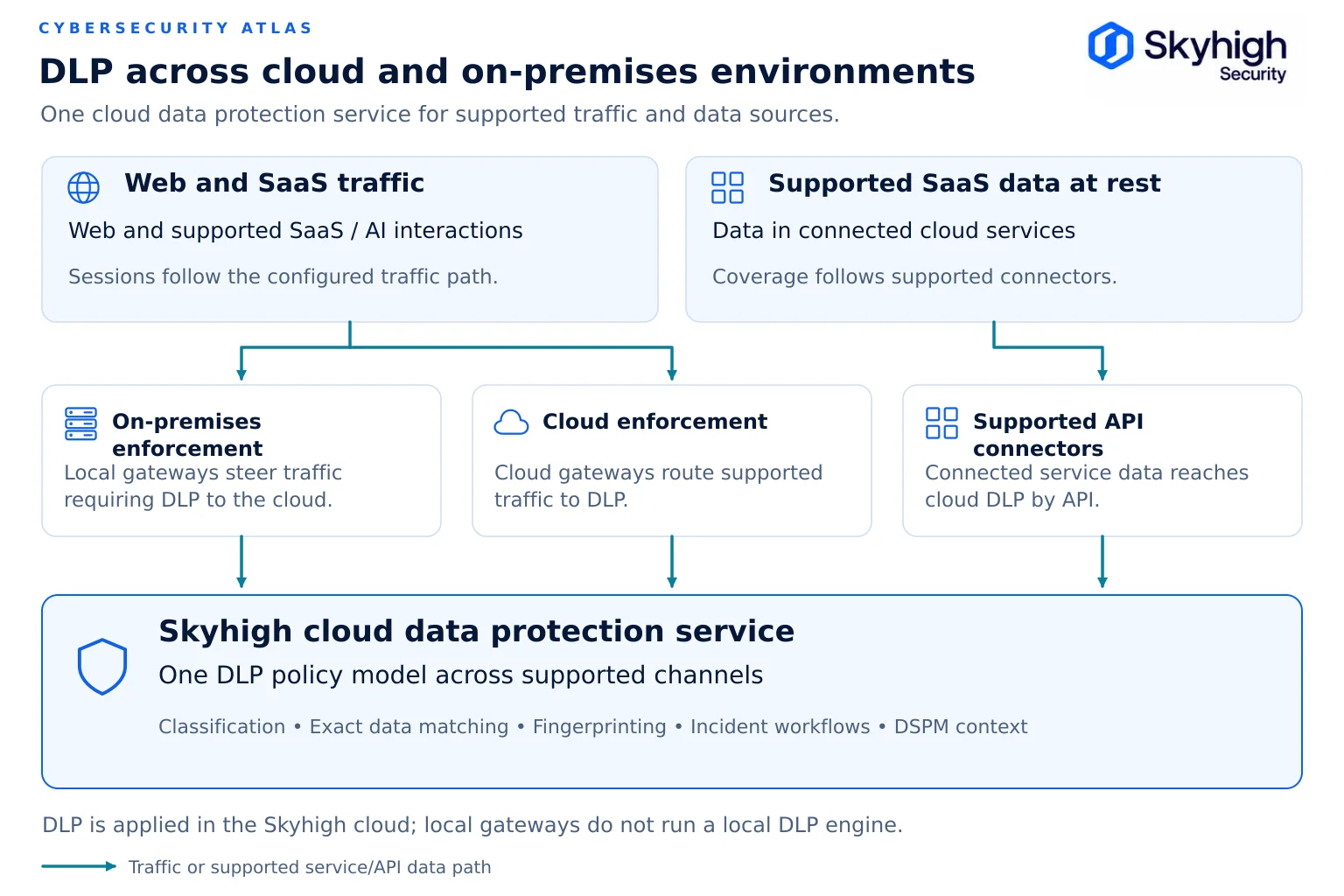
- Enforce across supported channels. Apply a common DLP policy across supported web, cloud, private application, endpoint, and AI channels, and document any channel-specific integrations. See DLP Across Cloud and On-Premises Environments.
- Connect posture to enforcement. Use DSPM findings to decide which repositories and data sets need the strictest controls. See How DSPM and SSE Work Together.
- Control where data is processed. Decide where inspection occurs, what leaves the environment, where logs are stored, and who can access decrypted content.
Where SSE fits in hybrid cloud security
Security Service Edge secures user access to the web, SaaS, and private applications, and in a hybrid architecture it can enforce both in the cloud and on premises.
Gartner defines security service edge (SSE) as securing access to the web, cloud services, and private applications, with capabilities that include access control, threat protection, data security, and security monitoring. Gartner describes SSE as primarily cloud-delivered, while noting it may include on-premises or agent-based components.
SSE typically brings together SWG, cloud access security broker (CASB), ZTNA, DLP, and remote browser isolation (RBI). It addresses the user-to-application layer of a hybrid architecture. It does not replace workload posture management, endpoint protection, or identity governance.
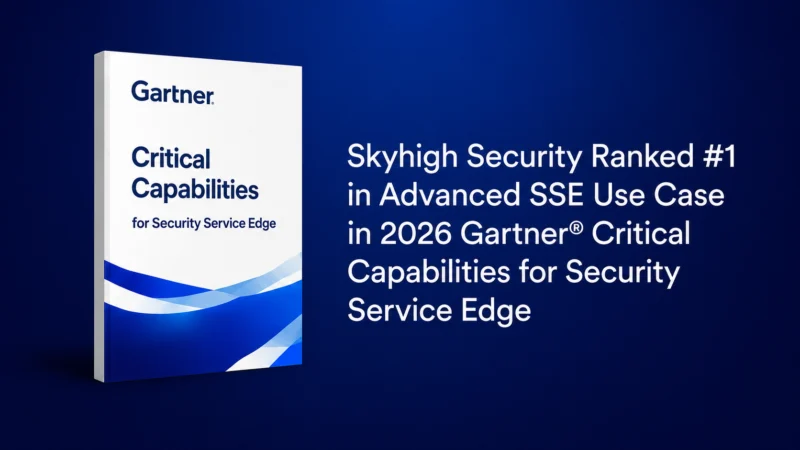
Early SSE deployments assumed all traffic would route through a vendor’s cloud. That fits remote users and SaaS well, but creates problems for regulated data, internal traffic, latency-sensitive operations, and organizations that must keep working during a cloud outage. Gartner’s 2026 SSE market analysis notes that vendors increasingly offer virtual or hardware appliances that extend the SSE data plane on premises for local traffic processing and resilience against cloud downtime, as cited in Skyhigh Security’s announcement of its 2026 Critical Capabilities results.
This is hybrid SSE: cloud points of presence and on-premises or branch enforcement working under one policy engine and one console. Skyhigh Hybrid SSE Mesh is Skyhigh Security’s implementation of that model, with an on-premises data plane for local TLS inspection and ZTNA, extended by cloud CASB, DSPM, DLP, and RBI.
Hybrid cloud security solutions
Hybrid cloud security solutions fall into several categories, and most organizations need more than one.
| Category | What it protects | Where it fits in the architecture |
|---|---|---|
| SSE and SASE platforms | User access to web, SaaS, and private apps | Network and data layers; enforcement points |
| Data security (DSPM, DLP, encryption) | Sensitive data at rest and in motion | Data layer |
| Cloud-native application protection (CNAPP) | Cloud workloads and infrastructure configuration | Applications and workloads layer |
| Network security | Traffic between zones, sites, and segments | Network layer |
| Identity security | Users, devices, service accounts, and agents | Identity layer |
| Security operations (SIEM, analytics) | Detection and response across environments | Visibility and operations layer |
When comparing hybrid cloud security vendors, the most important question is whether on-premises and cloud enforcement share one policy engine or are separate products under one brand. Evaluate deployment flexibility, data protection, policy control, integration, migration, and resilience, and validate claims in a proof of concept with your own traffic. See Hybrid Cloud Security Solutions: How to Compare Vendors.
Compliance and regulatory considerations
Most compliance frameworks do not mention hybrid cloud directly, but each expects controls that work consistently wherever regulated data and users are.
| Framework | What it expects of a hybrid architecture |
|---|---|
| NIST Cybersecurity Framework 2.0 | Governance, asset visibility, protection, detection, response, and recovery applied across every environment |
| NIST SP 800-53 Rev. 5 | Control families such as access control, boundary protection, audit, and configuration management implemented at every enforcement point |
| ISO/IEC 27001:2022 | An information security management system whose scope includes cloud services and on-premises assets, with defined supplier responsibilities |
| PCI DSS v4.0.1 | Segmentation of cardholder data environments, strong cryptography in transit, and logging, including requirements mandatory since March 31, 2025 |
| HIPAA Security Rule | Administrative, physical, and technical safeguards for electronic protected health information wherever it is stored or transmitted |
| GDPR | Lawful processing and controlled transfers of personal data, including data in security logs and inspection |
| DORA | ICT risk management, resilience testing, and third-party risk management for EU financial entities, applicable since January 17, 2025 |
Two practical implications follow. First, auditors will ask whether controls are consistent across environments, which is easier to show with one policy engine and one log pipeline. Second, security tools themselves process regulated data, so their inspection location, logs, and vendor access fall within scope. See the control mapping in the Hybrid Cloud Security Reference Architecture.
Hybrid cloud security best practices
The best practices below turn the architecture into an operating program.
- Map before you build. Inventory users, devices, applications, data stores, and traffic paths across every environment, including SaaS and shadow IT.
- Document the responsibility split. For each service, write down what the provider secures and what your team secures. Revisit it when services change tiers.
- Make identity the primary control. Consolidate identity providers, require phishing-resistant MFA, and bring service accounts, workload identities, and AI agents under the same governance as people.
- Centralize policy, distribute enforcement. Define rules once and push them to every enforcement point, cloud and on premises.
- Remove implicit network trust. Replace broad VPN access with per-application ZTNA, including for on-site users, and segment internal networks. See On-Premises ZTNA for Private Applications.
- Classify data once and enforce everywhere. One classification scheme, one DLP policy set, applied across web, SaaS, private apps, AI tools, and endpoints.
- Place TLS inspection deliberately. Decrypt once, as close to the traffic source as practical, and document exceptions for privacy-sensitive categories.
- Design for failure. Know what happens to access and inspection if a cloud service, WAN link, or identity provider is unavailable, and test it.
- Centralize visibility without ignoring residency. Aggregate logs for detection, but decide which logs can leave which jurisdiction.
- Detect drift continuously. Treat security policy and cloud configuration as code, version it, and alert on differences between intended and deployed state.
- Modernize legacy gateways deliberately. Replace end-of-life proxies with parallel deployment and phased cutover rather than a big-bang migration. See Secure Web Gateway Migration. Symantec Edge SWG (Blue Coat ProxySG) customers face a December 2026 deadline for SGOS 7.3; see Blue Coat and ProxySG End of Life, Blue Coat Alternatives, and the Blue Coat Modernization Program.
Sources
- Flexera. 2026 State of the Cloud Report. https://info.flexera.com/CM-REPORT-State-of-the-Cloud
- NIST. SP 800-215: Guide to a Secure Enterprise Network Landscape (November 2022). https://csrc.nist.gov/pubs/sp/800/215/final
- NIST. SP 800-207: Zero Trust Architecture (August 2020). https://csrc.nist.gov/pubs/sp/800/207/final
- CISA. Zero Trust Maturity Model, Version 2.0. https://www.cisa.gov/zero-trust-maturity-model
- NSA and CISA. Top Ten Cloud Security Mitigation Strategies (March 7, 2024). https://www.nsa.gov/Press-Room/Press-Releases-Statements/Press-Release-View/Article/3699169/nsa-releases-top-ten-cloud-security-mitigation-strategies/
- NSA. Managing Risk from Transport Layer Security Inspection (November 2019). https://media.defense.gov/2019/Nov/18/2002212783/-1/-1/0/MANAGING%20RISK%20FROM%20TLS%20INSPECTION_20191106.PDF
- IBM and Ponemon Institute. Cost of a Data Breach Report 2025. https://www-api.ibm.com/adobe/assets/urn:aaid:aem:607b9590-38e0-4c91-b433-aa8a17f5b5e8/original/as/cost-of-a-data-breach-2025-full-report.pdf
- IBM and Ponemon Institute. Cost of a Data Breach Report 2026. https://www.ibm.com/reports/data-breach
- Gartner. Security Service Edge (SSE), Information Technology Glossary. https://www.gartner.com/en/information-technology/glossary/security-service-edge-sse
- Skyhigh Security. “Skyhigh Security Ranked #1 in Advanced SSE Use Case in 2026 Gartner Critical Capabilities for Security Service Edge” (August 5, 2026). https://www.globenewswire.com/news-release/2026/08/05/3339504/0/en/skyhigh-security-ranked-1-in-advanced-sse-use-case-in-2026-gartner-critical-capabilities-for-security-service-edge.html
- NIST. Cybersecurity Framework 2.0. https://www.nist.gov/cyberframework
- NIST. SP 800-53 Rev. 5: Security and Privacy Controls for Information Systems and Organizations. https://csrc.nist.gov/pubs/sp/800/53/r5/upd1/final
- ISO. ISO/IEC 27001:2022 Information security management systems. https://www.iso.org/standard/27001
- PCI Security Standards Council. PCI DSS v4.0.1 (document library). https://www.pcisecuritystandards.org/document_library/
- U.S. HHS. HIPAA Security Rule. https://www.hhs.gov/hipaa/for-professionals/security/index.html
- European Union. Regulation (EU) 2016/679 (GDPR). https://eur-lex.europa.eu/eli/reg/2016/679/oj
- European Union. Regulation (EU) 2022/2554 (DORA). https://eur-lex.europa.eu/eli/reg/2022/2554/oj