


Hybrid Cloud Security Solutions: How to Compare Vendors
- Hybrid cloud security solutions span SSE, CNAPP, network, data, and identity security categories.
- Compare vendors on deployment flexibility, data protection, policy control, integration, migration, and resilience.
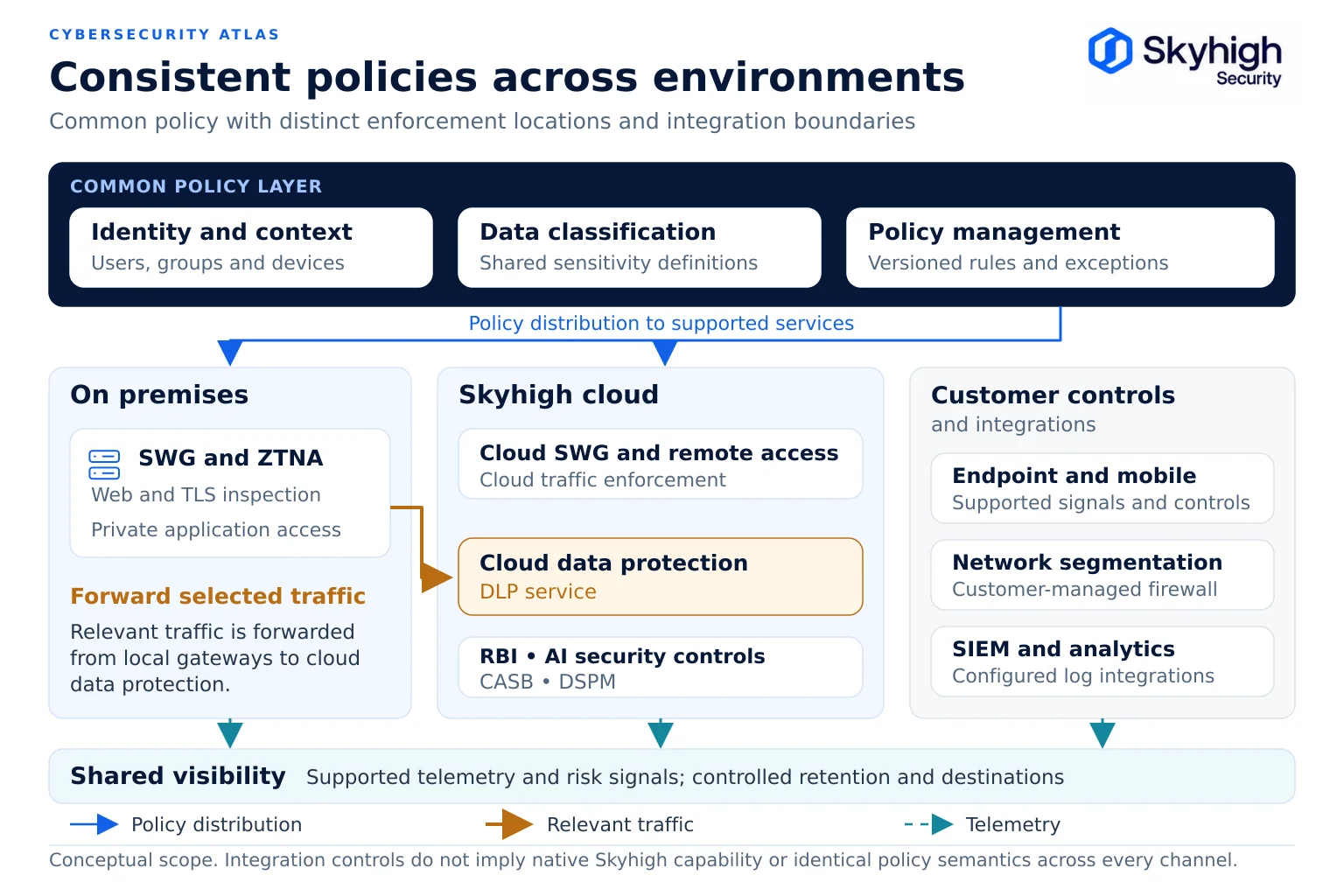
- The most important test is whether on-premises and cloud enforcement share one policy engine.
- Validate vendor claims in a proof of concept using your own traffic and failure scenarios.
- Ask where decrypted data, logs, and incident evidence are processed, stored, and accessed.
Hybrid cloud security solutions protect users, applications, and data across on-premises infrastructure and cloud services. Comparing vendors is difficult because providers use the same language for very different products. This guide explains the solution categories, the requirements that matter most, and a scoring method for evaluating hybrid cloud security vendors side by side.
This article is part of the Hybrid Cloud Security guide.
Types of hybrid cloud security solutions
Hybrid cloud security solutions fall into six main categories, and most hybrid estates need several of them.
Knowing which category a vendor actually sells prevents mismatched comparisons.
| Category | What it protects | Typical capabilities |
|---|---|---|
| Security Service Edge (SSE) and SASE platforms | User access to web, SaaS, and private apps | SWG, CASB, ZTNA, DLP, RBI; SASE adds SD-WAN |
| Cloud-native application protection (CNAPP) | Cloud workloads and infrastructure | Posture management, workload protection, IaC scanning |
| Network security | Traffic between zones and sites | Firewalls, segmentation, intrusion prevention |
| Data security | Sensitive data wherever it lives | DSPM, classification, DLP, encryption and key management |
| Identity security | Users, devices, and machine identities | Identity provider, MFA, privileged access, governance |
| Hyperscaler-native tools | Resources within one cloud provider | Provider-specific security and monitoring services |
This guide focuses on the first and fourth categories: solutions that secure how users and data move between cloud and on-premises environments. That is where hybrid architecture decisions have the most impact on day-to-day risk. For the broader architecture, see Hybrid Cloud Security: Architecture and Best Practices.
The five requirements to compare
Compare hybrid cloud security vendors on five requirements: deployment flexibility, data protection, policy control, integration, and migration.
1. Deployment flexibility
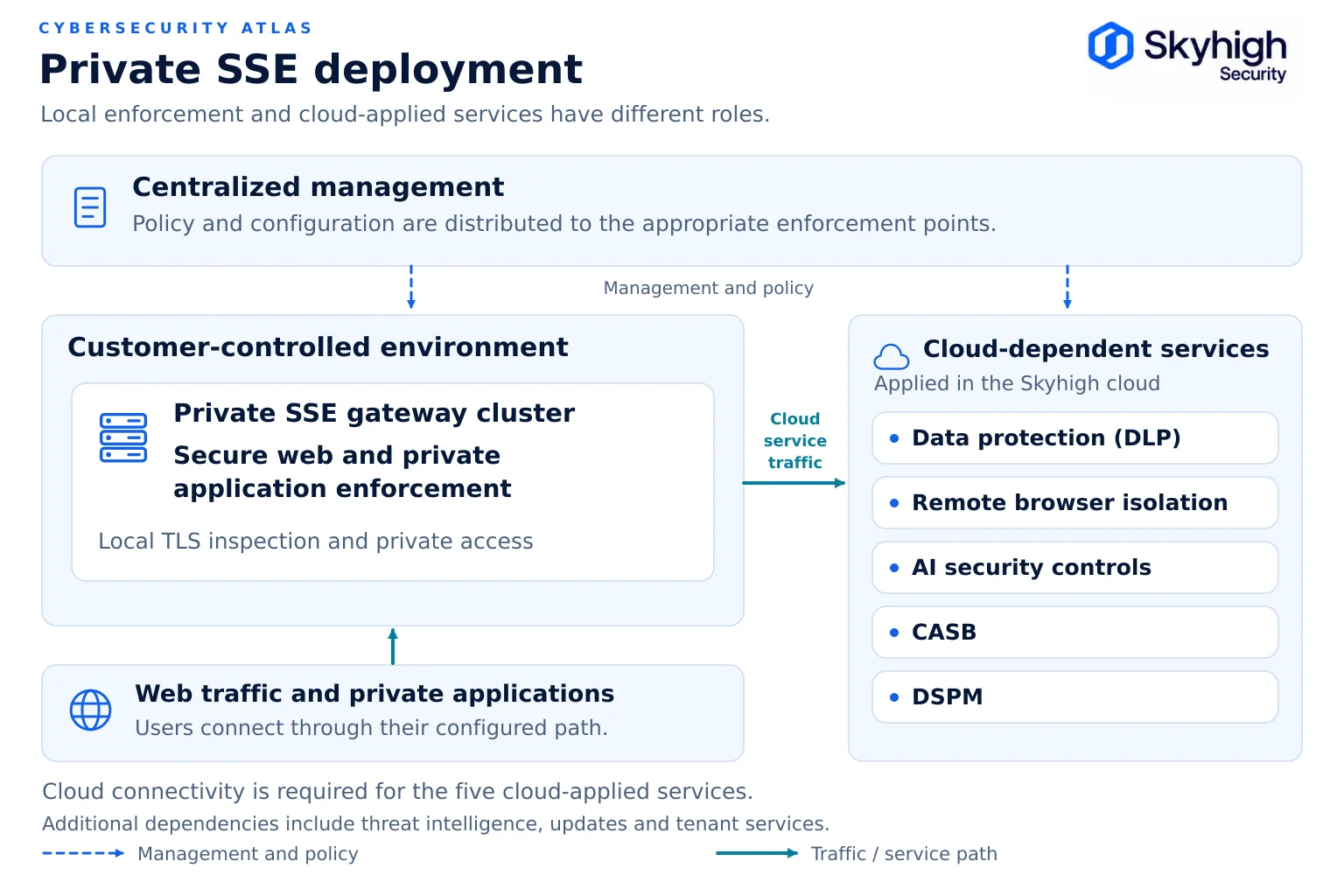
Hybrid is not a checkbox. Ask exactly where enforcement can run and what depends on the vendor’s cloud.
- Which capabilities are available in each mode, and which are delivered from the vendor cloud regardless of where traffic is inspected?
- Are on-premises components physical appliances, virtual machines, containers, or all three?
- Which functions still require connectivity to the vendor cloud when running on premises (licensing, updates, threat intelligence, management)?
- Is air-gapped or disconnected operation supported?
- Can remote users reach private apps without hairpinning through a data center, and can on-site users reach them without hairpinning through the cloud?
Gartner’s glossary definition of security service edge notes that SSE is primarily cloud-delivered but may include on-premises or agent-based components. The degree to which a vendor supports those components varies widely.
2. Data protection
Data protection is where hybrid solutions differ most.
- Does one DLP policy engine cover web, SaaS (inline and API), private applications, endpoints, email, and generative AI tools?
- Is classification shared across all channels, or configured separately per product?
- Is DSPM integrated, so discovery of data at rest informs inline policy?
- Where is traffic decrypted, and where are DLP incident copies stored?
3. Policy control
- Is there one policy engine for on-premises and cloud enforcement, or one console fronting separate engines?
- Can policy be managed as code, versioned, and rolled back?
- How are policy changes propagated to every enforcement point, and how is drift detected?
- Can policy use identity, device posture, data classification, and risk signals together?
Separate engines under one console still produce drift. Ask the vendor to change one rule during the demo and show it applied at an on-premises gateway and a cloud point of presence.
4. Integration
- Which identity providers, endpoint agents, SIEM and SOAR platforms, and ticketing systems are supported natively?
- Can logs be streamed to your SIEM in near real time, and can their destination be restricted by region?
- Does the solution integrate with existing hardware security modules and sandboxing?
- Are APIs documented and complete enough for automation?
5. Migration
Most buyers are replacing something, often a legacy proxy.
- Is there a defined method to bring existing policy forward? How much is automated, and what must be validated manually?
- Can the new solution run in parallel with the incumbent during validation?
- What professional services are included, and who owns the cutover plan?
- Are there commercial programs that offset remaining contract value on the product being replaced?
See Secure Web Gateway Migration: Cutover and Rollback Checklist.
Hybrid cloud security requirements checklist
Treat these hybrid cloud security requirements as pass-or-fail criteria before scoring any vendor:
- Enforcement available on premises and in the cloud under one policy engine
- Local TLS inspection option for regulated traffic
- Per-application private access (ZTNA) for remote and on-site users
- Unified DLP across web, SaaS, private apps, endpoints, and AI tools
- Documented behavior when the vendor cloud is unreachable
- Log and data residency controls
- Relevant certifications and authorizations (for example FedRAMP, SOC 2 Type II, ISO 27001, regional schemes)
- Parallel-run migration support
Evaluation scorecard
Weight each requirement according to your environment, then score vendors from 1 to 5.
| Criterion | Example weight | Vendor A | Vendor B | Vendor C |
|---|---|---|---|---|
| Deployment flexibility and capability coverage (on premises, cloud, hybrid) | 25% | |||
| Data protection (DLP, DSPM, classification) | 25% | |||
| Policy control (single engine, policy as code, drift detection) | 20% | |||
| Integration (identity, SIEM, APIs) | 10% | |||
| Migration (policy carry-forward, parallel run, services) | 10% | |||
| Resilience (behavior during cloud or WAN outage) | 10% |
Regulated organizations often weight data protection and deployment flexibility higher. Cloud-first organizations with no local inspection requirement may weight integration and user experience higher.
Questions to ask hybrid cloud security providers
The right questions force vendors to demonstrate policy consistency, data handling, and failure behavior rather than describe them.
- Show us one policy change applied to both an on-premises gateway and a cloud point of presence.
- Where exactly is our traffic decrypted, and who can access decrypted content?
- Which countries will our logs, incident evidence, and telemetry be stored in, and can we restrict them?
- What happens to inspection and private access if your cloud service is unreachable for four hours?
- How are on-premises components updated, and can updates be staged?
- How do you handle WebSocket and other long-lived connections used by AI tools and agents?
- What independent analyst evaluations and certifications cover the specific components we are buying?
- What does a typical migration from our current product look like, in weeks, and what do customers most often underestimate?
Running a proof of concept
A useful proof of concept tests your riskiest assumptions, not the vendor’s best features.
- Traffic: Use real traffic from a pilot group, including a site with high throughput.
- TLS inspection: Measure latency and throughput with inspection enabled at expected production volume.
- Data protection: Seed test documents with your own sensitive data patterns and confirm consistent detection across web, SaaS, and AI tool uploads.
- Failure: Simulate loss of connectivity to the vendor cloud and observe what continues to work.
- Operations: Have your administrators, not the vendor’s engineers, make policy changes and troubleshoot a blocked site.
Red flags
These red flags usually mean a vendor’s hybrid support is thinner than its marketing suggests.
- “Hybrid” means only that the vendor’s cloud can connect to your data center.
- On-premises and cloud products have separate policy syntax or separate DLP dictionaries.
- The vendor cannot say where decrypted data is processed.
- Private access for on-site users requires a round trip through the cloud.
- Migration is described as a file import with no validation step.
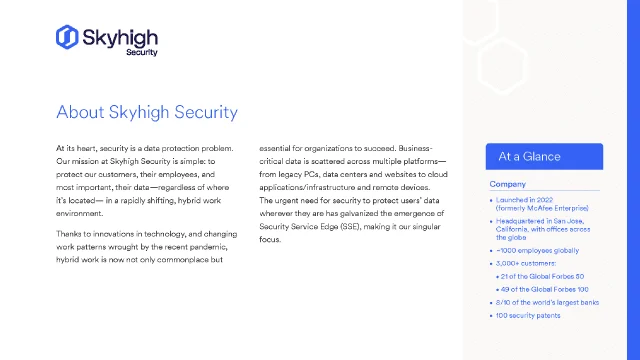
Where Skyhigh Security fits
Skyhigh Security fits organizations that need on-premises and cloud enforcement governed by one policy engine.
Skyhigh Hybrid SSE Mesh unifies on-premises SWG appliances, local ZTNA, and Secure Browser Controls with cloud CASB, DSPM, DLP, and RBI under one console and one policy engine. Local TLS inspection runs on the organization’s own infrastructure, while relevant traffic is forwarded for cloud-applied services. Policy is pushed as code to physical, virtual, and cloud enforcement points.
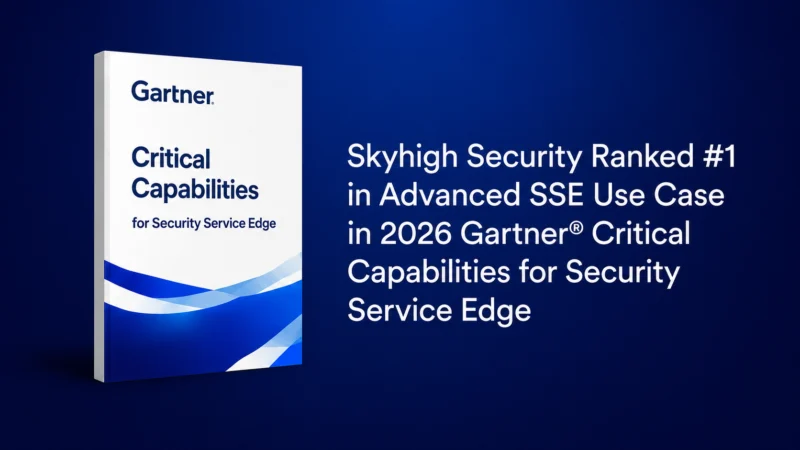
Skyhigh Security was ranked first in the Advanced SSE Use Case in the 2026 Gartner® Critical Capabilities for Security Service Edge (announcement). The platform holds FedRAMP High authorization and additional certifications including IRAP, BSI C5, SOC 2 Type II, and CSA STAR Level 2, according to Skyhigh Security.
Sources
- Gartner. Security Service Edge (SSE), Information Technology Glossary. https://www.gartner.com/en/information-technology/glossary/security-service-edge-sse
- NSA and CISA. Top Ten Cloud Security Mitigation Strategies (March 7, 2024). https://www.nsa.gov/Press-Room/Press-Releases-Statements/Press-Release-View/Article/3699169/nsa-releases-top-ten-cloud-security-mitigation-strategies/
- NIST. SP 800-215: Guide to a Secure Enterprise Network Landscape (November 2022). https://csrc.nist.gov/pubs/sp/800/215/final
- Skyhigh Security. “Skyhigh Security Ranked #1 in Advanced SSE Use Case in 2026 Gartner Critical Capabilities for Security Service Edge” (August 5, 2026). https://www.globenewswire.com/news-release/2026/08/05/3339504/0/en/skyhigh-security-ranked-1-in-advanced-sse-use-case-in-2026-gartner-critical-capabilities-for-security-service-edge.html
- Skyhigh Security. Modernize Symantec Edge SWG (Blue Coat). https://www.skyhighsecurity.com/bluecoat-modernize.html
GARTNER is a registered trademark and service mark of Gartner, Inc. and/or its affiliates in the U.S. and internationally and is used herein with permission. All rights reserved. Gartner does not endorse any vendor, product or service depicted in its research publications.