Recursos
Modernizing Your Symantec Edge Secure Web Gateway With Skyhigh Hybrid SSE Mesh
Por Sarang Warudkar - Gestor técnico sénior de marketing de productos
July 15, 2026 6 Minute Read
Organizations running Symantec Edge Secure Web Gateway (formerly Blue Coat ProxySG) are entering a compressed decision window. Broadcom ended support for on-premises Web Isolation as of January 1, 2024. SGOS 7.3 reaches end of life after December 31, 2026, with no new features delivered beyond that date. At the same time, AI agents operating inside enterprise networks have created a zero trust gap that cloud-only proxy architectures cannot close.
This is the case for modernizing now, and why Skyhigh Hybrid SSE Mesh is the path that preserves local control where compliance demands it.
Why the Decision Window Is Closing in 2026
Three pressures are converging this year for Symantec Edge SWG customers.
AI agents have created a zero trust gap inside your perimeter that neither Symantec Edge SWG nor a cloud-only SSE can close. Autonomous AI agents inherit user-level access, query internal systems, chain APIs together, and move sensitive data at machine speed. Many operate over persistent WebSocket connections that Symantec Edge SWG’s proxy architecture was never designed to inspect and that cloud proxy inspection cannot reach because the sessions originate inside the network, not at the internet edge.
Broadcom does not offer a solution to this gap. Symantec Edge SWG has no on-premises ZTNA capability and no agentless browser security for AI tool access. Moving to Broadcom’s own Symantec SSE does not help either, because it is a cloud-only architecture that still cannot enforce zero trust controls on AI agents operating inside your network.
Cloud-only SSE vendors face the same limitation. Zero trust enforcement that lives exclusively in the cloud cannot govern traffic that never leaves the building.
Skyhigh Hybrid SSE Mesh addresses this at the point where it actually occurs. Local ZTNA runs on your own on-premises and branch gateways, not through a vendor-managed cloud node, so zero trust enforcement reaches the AI agents and internal systems that cloud proxies cannot see. Agentless Secure Browser Controls add inline AI prompt inspection and WebSocket-aware coverage on any standard browser at the local network edge, with no enterprise browser rollout required. These are capabilities Broadcom cannot give you and that a move to a cloud-only SSE vendor will not deliver.
Broadcom licensing is compressing the value of the current stack. Full web, data, and cloud security on the Broadcom platform requires managing separate consoles for Edge SWG, Cloud SWG, and Symantec DLP, each with its own policy engine, licensing SKU, and renewal cycle. Policy drift between those three environments creates audit exposure. Broadcom’s per-user, per-module pricing charges the same rate whether a capability runs daily or once a year.
Broadcom’s strategic direction is cloud-only delivery. For organizations whose compliance frameworks, sovereignty requirements, or OT/SCADA environments demand local data control, the choice on the Broadcom platform is to stay on a stack being commercially wound down, or accept a pure-cloud architecture that reintroduces the problems on-premises was chosen to solve.
Skyhigh Hybrid SSE Mesh is built for the third path.
Zero Trust for On-Premises Users, Resources, and AI Agents
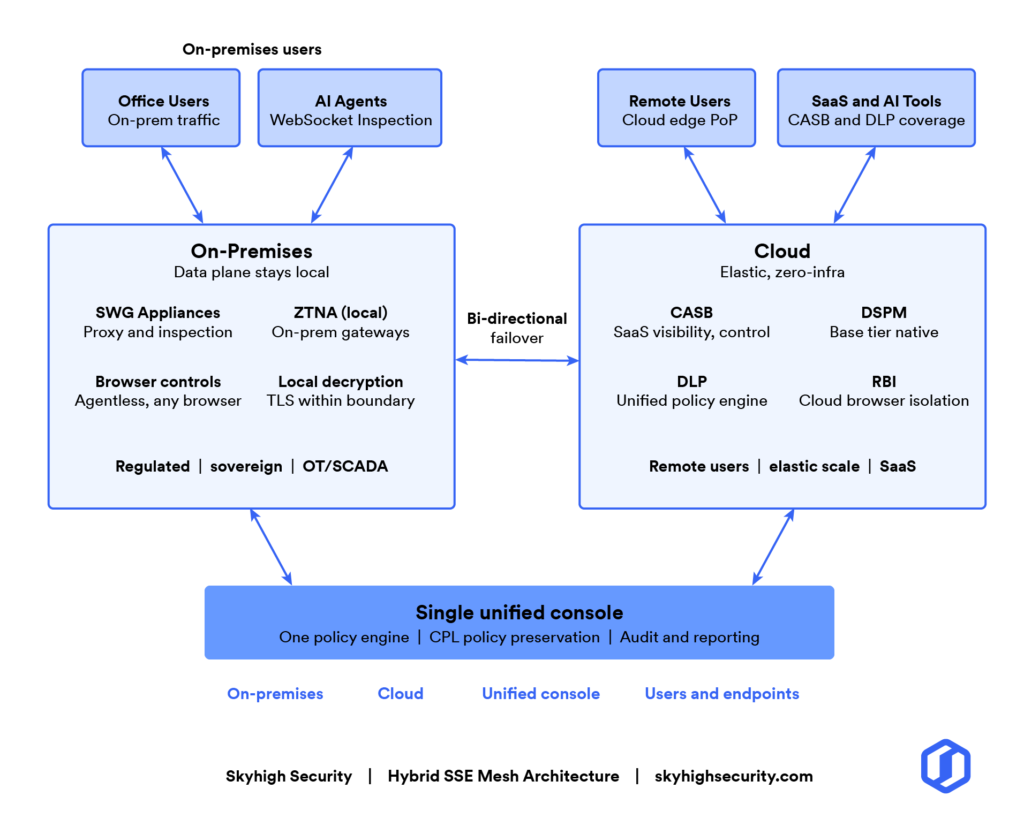
Skyhigh Hybrid SSE Mesh unifies on-premises SWG appliances with cloud-delivered security under a single console and a single policy engine. The data plane stays physically on premises where compliance and sovereignty require it. Cloud capabilities extend at the organization’s pace.
Local ZTNA runs on your own on-premises and branch gateways, enforcing zero trust controls on users, internal resources, and AI agents operating inside the network. This is the enforcement point that cloud-only architectures cannot reach. Agentless Secure Browser Controls add inline AI prompt inspection and WebSocket-aware coverage at the local network edge, on any standard browser, with no enterprise browser rollout required. Both capabilities are available the day the organization needs them through the consumption-based token model.
Broadcom does not offer these capabilities on Symantec Edge SWG, and neither Broadcom’s own Symantec SSE nor a cloud-only SSE vendor can deliver them, because the enforcement must live inside the network where the traffic originates.
Local Control For Compliance and Sovereignty
Skyhigh runs SSL/TLS decryption and inspection locally. Sensitive payloads never cross third-party or jurisdictional boundaries. Local ZTNA runs on your own on-premises and branch gateways, covering AI agents that operate over persistent WebSocket connections. Dark data center architecture with no inbound listening ports blocks external scanning and lateral movement.
For financial services teams under DORA, FCA, or MAS mandates, decrypted PII stays inside the institution’s infrastructure. For defense and government teams, the platform is FedRAMP High authorized and supports air-gap deployment. For healthcare teams, patient data stays within the physical perimeter. For manufacturing and critical infrastructure, network segmentation in OT/SCADA environments stops ransomware from propagating from corporate IT into operational systems.
Controles de seguridad del navegador
Skyhigh Secure Browser Controls deliver inline, agentless browser security at the local network edge. WebSocket-aware inspection reaches AI agent and messaging app traffic that conventional cloud proxies cannot see. Inline DLP and AI prompt-level governance apply to any standard browser without an enterprise browser replacement, no rollout project, and no user disruption. Secure Browser Controls activate through the consumption-based token model the day the organization needs them.
Preservación de la política de CPL
Existing CPL (Content Policy Language) policies carry forward through Skyhigh’s unified policy console. The rules security teams have refined over years migrate and re-express in Skyhigh’s engine through a validated import process. A policy-as-code architecture then pushes those policies automatically across physical appliances, virtual systems, and cloud nodes, with no manual reconciliation and no drift between environments.
Organizations that have invested years in Blue Coat CPL tuning start the modernization from their current policy state.
AI Security Platform: Unified Data Protection Across Every Channel
Skyhigh applies unified DLP across web, SaaS, AI tools, private apps, and endpoints from one policy engine. The same classification that governs a web upload also governs a SaaS share and a generative AI prompt. UEBA refines billions of events into a focused set of actionable anomalies. Compliance coverage spans HIPAA, GDPR, PCI DSS, FISMA, SOX, DPDPA, and GLBA.
SaaS apps, generative AI sessions, and OAuth-connected services now represent the primary channels through which sensitive data leaves the enterprise. Web proxy controls that inspect only web traffic leave those channels ungoverned. Skyhigh closes that coverage gap from the same console.
Detección de amenazas modernas
Skyhigh layers inline emulation-based sandboxing, behavioral analysis with UEBA, and Remote Browser Isolation for zero-day threats. Patient zero protection comes from layered detection at the first hop, where signature-based detection and URL reputation models catch only known threats.
Granular Cloud Risk Governance
Skyhigh’s Cloud Registry evaluates 56 attributes across six pillars covering data, identity, hosting, business, legal, and cyber-risk. Two cloud storage services that share a URL category can differ substantially on data residency, encryption at rest, GDPR compliance, and intellectual property terms. Skyhigh builds policy decisions on the actual risk profile of each service. Shadow IT discovery happens inline, and Closed Loop Remediation applies automatic policy action for noncompliant destinations.
The Modernization Path
Skyhigh Hybrid SSE Mesh deploys alongside the existing Symantec Edge SWG with zero disruption to operations. The four-phase modernization path moves at the organization’s pace.
- Phase 1: Assess and plan. Inventory existing CPL policies. Map data sovereignty zones, OT/SCADA environments, and SSL inspection performance. Identify rules to preserve and extend.
- Phase 2: Deploy in parallel. Deploy Skyhigh SWG appliances alongside the existing Symantec Edge SWG. Import and validate CPL policy baselines. Run parallel traffic with zero disruption to current operations.
- Phase 3: Adopt new unified capabilities. Enable local ZTNA and agentless Secure Browser Controls in the SWG appliances. Extend with cloud CASB, DSPM, and DLP. Retire legacy appliances on the organization’s schedule.
- Phase 4: Rationalize and optimize (ongoing). Consume token budget dynamically. Retire unused Broadcom entitlements. Apply continuous policy-as-code optimization across all environments under one console with full audit visibility.
Most organizations run Phase 2 and Phase 3 in parallel across 6 to 12 months. The Skyhigh commercial offset program applies remaining Broadcom investment toward the modernization, so the refresh budget that would have funded another appliance cycle funds the transition instead.
¿Por qué Skyhigh?
Skyhigh ranked number one in Data Protection in the Gartner Critical Capabilities for Security Service Edge 2025, ahead of Broadcom and other SSE alternatives in the same evaluation. GigaOm named Skyhigh a Leader and Outperformer in its Radar for SSE, specifically citing the unified policy framework for reducing administrative complexity across hybrid environments. More than 3,000 organizations trust Skyhigh, including 80 percent of the largest global banks and nearly half of the Fortune 100.
The platform holds FedRAMP High authorization, making it available to U.S. federal agencies and defense industrial base organizations that require modern zero trust capabilities under FedRAMP, CMMC, and related federal frameworks.
Next Steps
Request a personalized assessment of your current Symantec Edge Secure Web Gateway environment. The assessment maps your existing CPL policies, data sovereignty zones, and compliance requirements to a phased modernization plan tailored to your environment.
Sobre el autor

Sarang Warudkar
Gerente técnico sénior de marketing de productos
Sarang Warudkar es un experimentado director de marketing de productos con más de 10 años de experiencia en ciberseguridad, experto en alinear la innovación técnica con las necesidades del mercado. Aporta una profunda experiencia en soluciones como CASB, DLP y detección de amenazas basada en IA, impulsando estrategias de salida al mercado impactantes y el compromiso de los clientes. Sarang posee un MBA por el IIM de Bangalore y una licenciatura en ingeniería por la Universidad de Pune, combinando una visión técnica y estratégica.
Contenido relacionado


The Future of Security Starts with Data: Why Our Strategy Continues to Gain Momentum
Blogs de moda
AI Is Changing Your Data Risk. DSPM Puts You Back in Control.
Megha Shukla September 4, 2026
Why Customers Love Mowgli: The IKEA Effect in Cybersecurity
Thyaga Vasudevan August 13, 2026
The Future of Security Starts with Data: Why Our Strategy Continues to Gain Momentum
Sanjay Castelino August 6, 2026
Product Updates Q2 2026: Simplified Security Across Web, Cloud, Data, and AI
Thyaga Vasudevan July 21, 2026