Resources
Microsoft 365 Outage: Lessons for Cyber Resilience and Business Continuity
By Thyaga Vasudevan - EVP of Product
November 17, 2026 6 Minute Read

On November 12, 2026, a global Microsoft 365 outage disrupted Outlook, Teams and Copilot well into the following day. Downdetector logged more than 7.4 million outage reports worldwide, and one financial firm resorted to fax to confirm trades.
Microsoft attributed the outage to a technical issue stemming from an earlier network capacity upgrade that surfaced following a more recent network change, rather than a cyberattack or AI-related incident. Yet some organizations hosting Microsoft services on their own infrastructure were less affected. For CIOs and CISOs, the lesson is not to abandon the cloud. It is to ask which critical business operations can continue when a cloud service goes down.
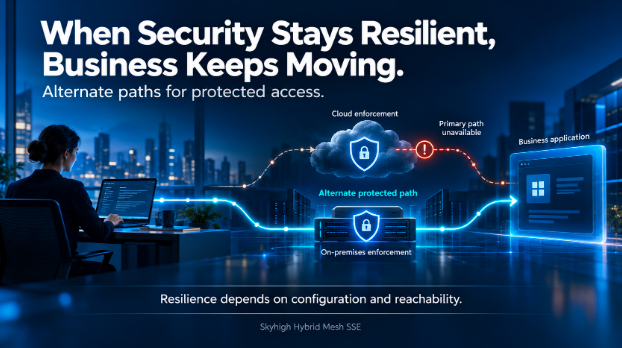
That question applies to cybersecurity itself. As enterprises rely on cloud-delivered Security Service Edge (SSE) to protect access to applications and data, the security service becomes part of the critical path for business operations. An alternate security path cannot restore an unavailable SaaS application, but it can help keep otherwise healthy applications accessible and protected. Is your security architecture designed to keep the business running when its primary enforcement path goes down?
Imagine, for example, a bank employee helping a customer complete a transaction. The employee opens an application, retrieves an account record, and begins processing the request.
Then the security service on the connection path becomes unavailable.
The application is still running. The employee’s laptop is working. But the transaction stops because access depends on a security path that can no longer be reached.
For many organizations, this is the reality of modern security: the infrastructure that protects access is also part of the infrastructure that keeps the business running.
That is why resilience needs to be designed into the security architecture.
In our introduction to Skyhigh Hybrid Mesh SSE, we described how bringing cloud and on-premises enforcement together gives IT operations and security leaders more flexibility. One of the most important benefits of that flexibility is the ability to design alternate paths for protected access.
What happens when the primary path is unavailable?
A resilient design begins with more than one available way to enforce security.
For example, an employee may normally connect through a cloud enforcement point. An organization can also have an on-premises Secure Service Gateway available as an alternate enforcement point. With supported routing and failover settings in place, the client or network can select an available path when the preferred path cannot be reached.
The sequence looks like this:
- The preferred path is available. Traffic follows the configured route to its primary enforcement point.
- The path becomes unavailable. The client or routing mechanism determines that the preferred gateway cannot be reached.
- An alternate path is selected. Where configured and supported, new connections are directed to another available enforcement point.
- Security continues on that path. The alternate gateway applies the policies and services available for that deployment.
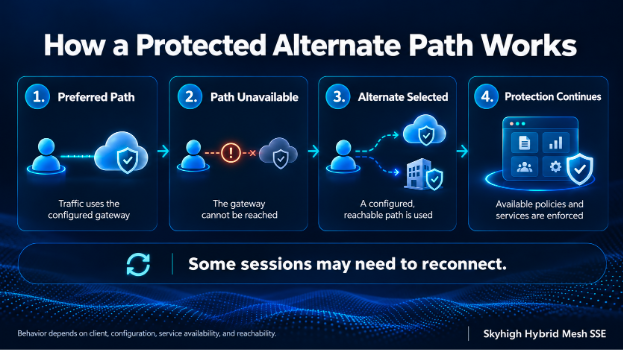
The exact behavior depends on the client, traffic type, gateway configuration, reachability, and the services the application requires. Some sessions may need to reconnect. An alternate path also needs access to the intended destination and the required security capabilities.
The goal is straightforward: give the business another protected way forward when the first path is unavailable.
A bank branch keeps serving customers
Picture a branch employee preparing documents for a customer. Their web traffic normally passes through the cloud security service (SSE), but the preferred cloud path becomes unavailable.
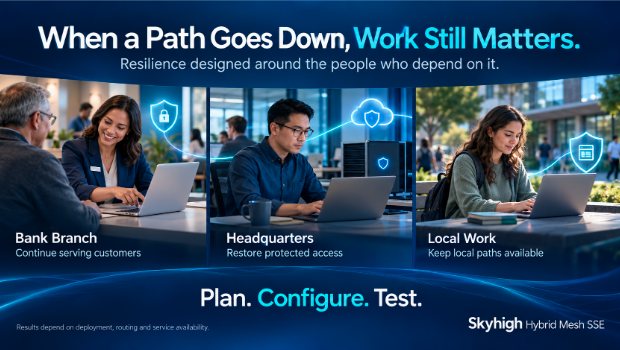
Without an alternate enforcement path, the employee may be unable to reach the applications and websites needed to complete the interaction.
Now consider a branch with a reachable on-premises gateway configured as an alternate. New connections can be directed through that gateway, where the applicable security policy is enforced.
The customer conversation can continue while the security team investigates the primary path.
This scenario depends on the branch gateway being reachable from the user’s device, the required services being available locally, and the relevant failover behavior being configured and tested.
The benefit is measured at the desk: can the employee continue serving the customer securely?
A headquarters gateway goes offline during the workday
An employee at headquarters accesses web resources through a local Secure Service Gateway. The gateway experiences an outage just as teams are preparing for an important customer meeting.
If the environment has another reachable gateway or an appropriately configured cloud path, supported new connections can be directed to that alternate.
For employees, the desired outcome is a brief reconnection followed by protected access. For IT, it is time to restore the affected gateway without requiring every user to wait for that recovery.
The important design question is whether the alternative can deliver the controls the traffic needs. If a workflow depends on a capability unavailable on the alternate path, the organization needs a defined response for that situation.
A regional cloud path is disrupted
A distributed organization has employees working from several locations. A regional cloud enforcement path becomes unavailable, affecting some users while the underlying business applications remain accessible.
Depending on the deployment, alternate gateways may provide another route for protected access. Employees at a location with a reachable local gateway may have a different continuity option from employees working remotely.
This is why resilience planning must account for where users are when the disruption occurs. An on-premises gateway can be a valuable alternative only if the affected user can actually reach it and the required application remains reachable through it.
A remote employee should not be assumed to have a usable route to a corporate gateway simply because that gateway exists.
Local work continues during a cloud disruption
Consider an employee at headquarters accessing a private application hosted in the same enterprise environment.
If the local enforcement plane and application remain available during a cloud disruption, the organization may be able to continue supporting that local access under the applicable configuration and policy.
This is different from an active failover event. The local path may already be the primary path, allowing the interaction to continue without first switching elsewhere.
The distinction matters: resilience comes both from having an alternate path and from reducing unnecessary dependencies on a remote path in the first place.
Business leaders should validate which capabilities continue during a disruption, including authentication, policy availability, logging, and any services that depend on the cloud.
What about advanced cloud services?
Some security workflows rely on cloud-delivered capabilities. If a local gateway uses a cloud service for a particular inspection
(e.g. DLP) or isolation function, the availability of that service remains relevant – even when the local gateway itself is healthy.
Organizations should identify these dependencies before an outage:
- Which controls can be enforced at each gateway?
- Which workflows depend on a cloud-delivered service?
- What happens if that service cannot be reached?
- Does the policy block the action, allow an alternate treatment, or use another configured path?
The right answer depends on the application, data sensitivity, and business requirements. The key is to make that decision deliberately and test it.
Design for continuity and verify it
Having cloud and on-premises enforcement points creates options. A resilient outcome requires those options to be configured and exercised.
Start with the business workflows that matter most: a branch employee serving a customer, an engineer accessing a critical application, or a remote worker connecting to an approved service.
For each workflow:
- Map the primary and alternate paths. Confirm the user, gateway, and destination are reachable.
- Validate the controls on each path. Check access policy, inspection, data protection, and logging requirements.
- Test the disruption. Make the primary path unavailable in a controlled exercise and observe what happens to new and existing sessions.
- Measure recovery. Record the time to restore protected access and whether users must reconnect.
- Decide what happens if no protected path is available. Set the response based on the organization’s security and continuity requirements.
These tests turn architectural flexibility into a continuity plan the business can trust.
Resilience is a business choice
Every organization has a different tolerance for disruption. A local branch, a global bank, and a manufacturing campus may make different choices about where to enforce security and which paths to use when something fails.
Hybrid Mesh SSE provides a foundation for those choices by bringing cloud and on-premises enforcement together.
The Microsoft 365 outage is a timely reminder to map those dependencies and test what happens when a critical cloud service is unavailable—before the next disruption forces the issue.
When security is essential to keeping work moving, organizations need more than one way to keep that security – and the business – running.
About the Author

Thyaga Vasudevan
Executive Vice President of Product
Thyaga Vasudevan is a high-energy software professional currently serving as the Executive Vice President, Product at Skyhigh Security, where he leads Product Management, Design, Product Marketing and GTM Strategies. With a wealth of experience, he has successfully contributed to building products in both SAAS-based Enterprise Software (Oracle, Hightail – formerly YouSendIt, WebEx, Vitalect) and Consumer Internet (Yahoo! Messenger – Voice and Video). He is dedicated to the process of identifying underlying end-user problems and use cases and takes pride in leading the specification and development of high-tech products and services to address these challenges, including helping organizations navigate the delicate balance between risks and opportunities.
Related Content
Trending Blogs
Microsoft 365 Outage: Lessons for Cyber Resilience and Business Continuity
Thyaga Vasudevan November 17, 2026
What it Means to Apply A Truly Hybrid Security Solution
Steve Tait October 29, 2026
Introducing Skyhigh Hybrid Mesh SSE: Built for the Way Modern Enterprises Work
Thyaga Vasudevan October 28, 2026
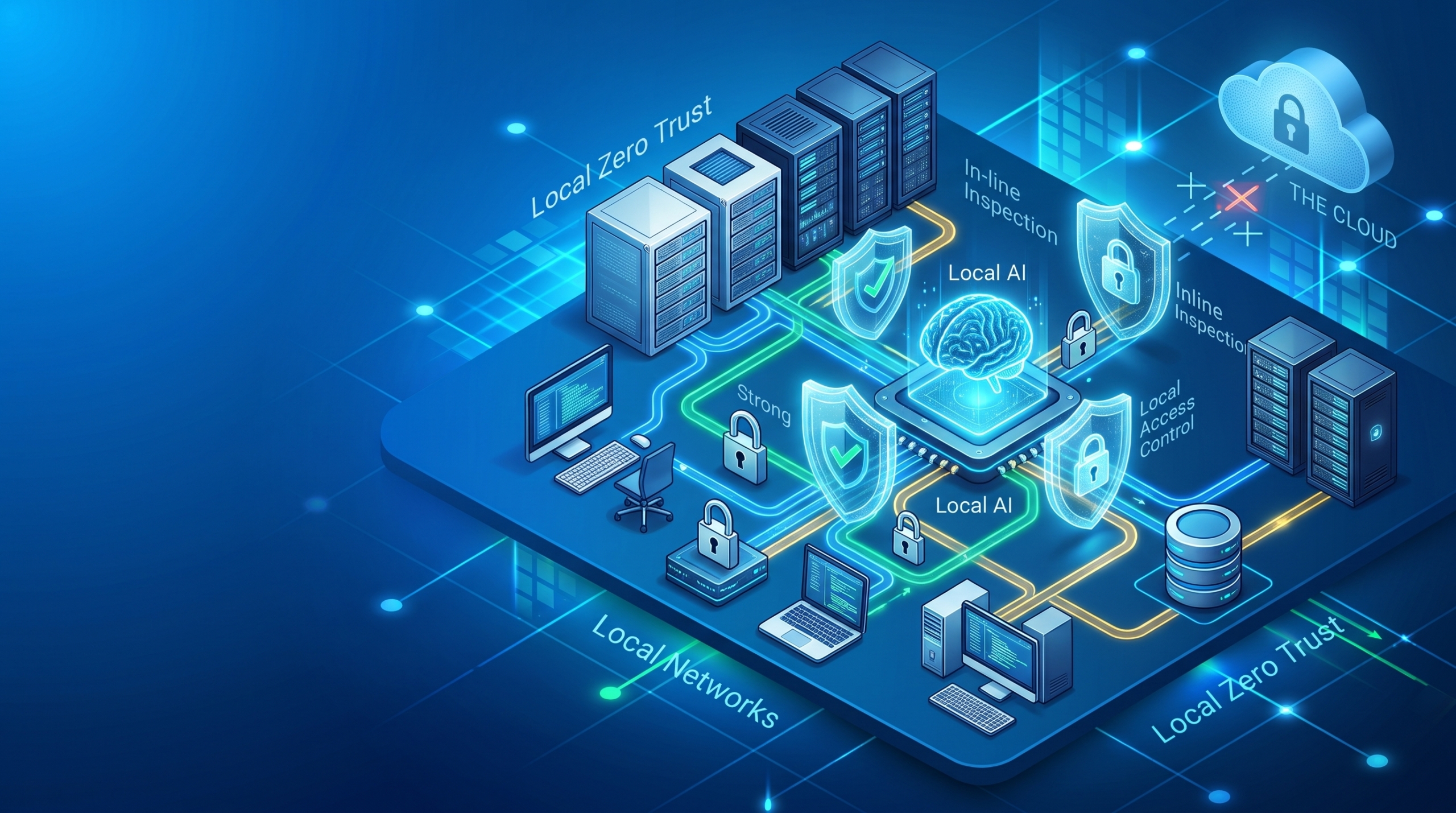
Secure Where Work Happens: Stop Paying Cloud Rates for Local AI
Mike Smart October 16, 2026