




In che modo DSPM e SSE collaborano per ridurre i rischi legati ai dati nelle aziende moderne
- DSPM and SSE unify data discovery, visibility, and enforcement across hybrid environments.
- Integrated architectures enable data-aware security aligned to real business exposure risks.
- Unified platforms deliver stronger security outcomes than disconnected point security solutions.
- Combined visibility and enforcement improve compliance readiness and audit evidence generation.
- Successful deployments require deep integration, consistent policies, and operational simplicity.
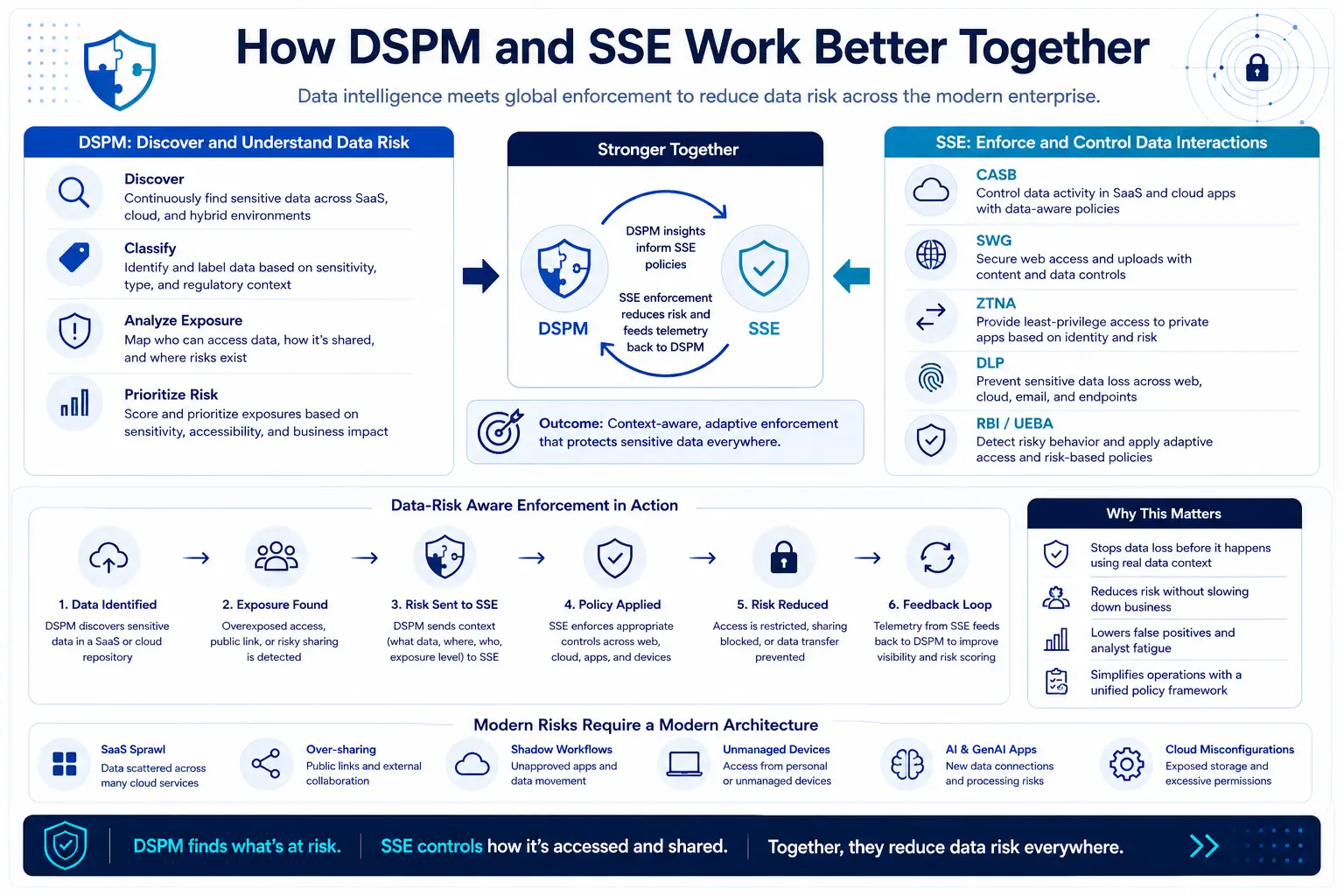
Data Security Posture Management (DSPM) identifies where critical data lives and how it's exposed, while Security Service Edge (SSE) provides the control fabric to govern how users, applications, and devices interact with that data across cloud, SaaS, and hybrid environments.
DSPM provides continuous discovery, classification, and exposure analysis across SaaS applications, cloud storage, and hybrid data environments, while SSE delivers enforcement through CASB, SWG, ZTNA, and DLP controls.
The architectural value emerges when DSPM findings inform SSE policy decisions, creating context-aware enforcement that adapts to actual data sensitivity and business risk.
Modern attack patterns exploit legitimate cloud services and valid credentials, making traditional perimeter-focused approaches insufficient for protecting distributed sensitive data.
Unified telemetry from both data posture monitoring and enforcement can improve visibility for incident investigation and support more precise policy refinement.
GenAI applications and AI copilots represent a new category of data exposure risk that requires both discovery of AI-accessible data repositories and enforcement at the point of AI interaction.
Organizations should evaluate DSPM and SSE solutions together, focusing on integration depth, policy consistency, and operational simplification rather than treating them as separate point solutions.
A mature data security architecture combines DSPM's "what data is at risk and why" intelligence with SSE's "how to control data interactions" enforcement across all user and application access paths.
What Is DSPM in the Context of SSE Architecture?
DSPM acts as the data intelligence layer that makes SSE enforcement decisions smarter and more precise.
DSPM solutions identify sensitive data across SaaS applications, cloud storage, collaboration platforms, and hybrid repositories, then provide the context that SSE controls need to make risk-appropriate policy decisions.
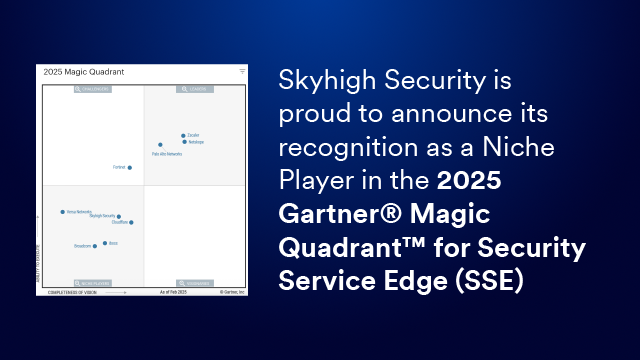
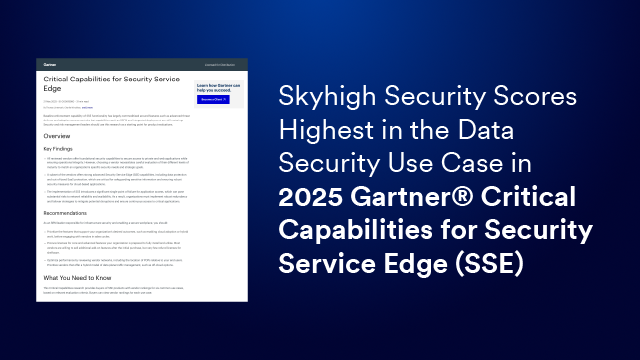
Skyhigh Security's SSE platform secures access to web resources, cloud services, SaaS applications, private applications, email, and AI workflows regardless of user location. In the context of DSPM, that matters because data-risk findings become more valuable when they can inform inline enforcement through SWG, CASB, ZTNA, RBI, and DLP from a unified policy framework. Skyhigh was recognized as a Niche Player in the 2025 Gartner Magic Quadrant for Security Service Edge and scored highest in the Data Security use case in the 2025 Gartner Critical Capabilities for SSE.
Without data context, SSE controls often make enforcement decisions based solely on user identity, device posture, application reputation, or content inspection—missing the critical question of what data is actually at risk in each transaction.
DSPM fills this gap by continuously mapping where sensitive data resides, who can access it, how it's shared, and which exposures create the highest business risk.
Together, they create a closed loop where data risk findings directly inform enforcement actions across web, cloud, SaaS, and private application access paths.
Why Traditional Data Security Approaches Miss Modern Risk
Many legacy data protection strategies were built around more centralized environments with clearer network boundaries than today's cloud- and SaaS-heavy estates.
The human element was present in 62% of breaches analyzed in Verizon's 2026 Data Breach Investigations Report, reinforcing why identity, access, and data-context controls must work together.
These attacks increasingly rely on valid credentials and legitimate cloud services rather than malware crossing network boundaries.
When attackers use stolen credentials to access sanctioned SaaS applications or upload data to legitimate cloud storage services, traditional perimeter controls see normal, authorized activity.
Modern data exposure patterns that legacy approaches miss include SaaS application sprawl where sensitive data is scattered across dozens of cloud services, collaboration oversharing through public links and external sharing, shadow data workflows that bypass IT oversight, unmanaged device access to business applications, AI-assisted data processing that connects multiple repositories, and cloud misconfigurations that make private data publicly accessible.
MITRE ATT&CK documents how adversaries abuse valid cloud accounts and exfiltrate data through legitimate web services, highlighting techniques like Cloud Application Integration where attackers leverage app-to-app connections to access sensitive data.
These attack patterns can blend into normal business activity, making them harder for network-focused security tools to identify without richer identity, data, and application context.
Without knowing what data is sensitive, where it lives, and how it's exposed, security controls cannot make appropriate risk decisions for modern hybrid work environments.
How DSPM Identifies Sensitive Data and Exposes Hidden Risk
DSPM platforms discover and classify sensitive data by connecting to SaaS applications through APIs, scanning cloud storage repositories, analyzing collaboration platforms, and identifying data flows across hybrid environments.
This discovery goes beyond simple pattern matching to provide business context about data ownership, regulatory requirements, and exposure risk.
The classification process identifies personally identifiable information, financial records, healthcare data, intellectual property, and other business-critical information wherever it resides.
Modern DSPM solutions aim to improve classification accuracy by combining content inspection with business context such as ownership, repository type, and exposure state.
Exposure analysis reveals how data becomes accessible beyond its intended audience through overpermissioned sharing, public links with no expiration, external collaborator access, dormant accounts with persistent access rights, misconfigured cloud storage buckets, and risky third-party application integrations.
DSPM platforms map these exposures to show security teams which data faces the highest risk of unauthorized access or exfiltration.
Risk prioritization helps organizations focus remediation efforts where they will have the most impact.
Rather than generating endless lists of sensitive files, DSPM solutions prioritize findings based on data sensitivity, exposure scope, business criticality, regulatory requirements, and likelihood of access by unauthorized parties.
In practice, organizations often need prioritization because discovery programs can surface more sensitive data exposure findings than teams can remediate at once.
Context-rich reporting can help security teams understand not just where sensitive data exists, but also the business and access context that affects exposure and prioritization.
Where SSE Complements DSPM With Enforcement and Control
SSE provides the enforcement infrastructure that turns DSPM insights into actionable data protection across every access path.
The NIST Zero Trust Architecture model emphasizes continuous evaluation of access decisions and policy enforcement at multiple control points, which aligns perfectly with how SSE components complement DSPM findings.
CASB controls can restrict external sharing, require additional authentication for downloads, or block uploads to unsanctioned cloud services.
API-based CASB monitoring also provides ongoing visibility into data movement and sharing patterns within sanctioned applications.
When integrated with DSPM findings, SWG can apply more data-aware decisions about uploads, downloads, and access to risky or unauthorized web destinations.
ZTNA policies about which users should have access under what conditions, enabling least-privilege access that adapts to actual data risk.
DLP enforces content-aware policies across email, web, cloud, and endpoint channels.
DSPM classification tags and risk scores help DLP policies make more precise decisions about when to block, quarantine, encrypt, or require business justification for data sharing activities.
Instead of operating as independent security tools, they function as a unified enforcement fabric informed by DSPM's continuous assessment of data posture and risk.
Protecting Sensitive SaaS and AI Data
Protecting Sensitive SaaS and AI Data: Sensitive data exposure across SaaS and AI applications is a critical use case for integrated DSPM and SSE.
OWASP's 2025 Top 10 for Large Language Model Applications identifies sensitive information disclosure as a leading AI security risk, including exposure through training data, inference workflows, and generated responses. DSPM continuously discovers exposed sensitive data and identifies repositories accessible to AI applications, while SSE enforces context-aware controls governing user interactions, data uploads, and AI query access across SaaS and AI environments.
Strengthening Compliance and Governance: Compliance efforts are strengthened when organizations can demonstrate both comprehensive data discovery and consistent policy enforcement. This combination helps address two common compliance objectives: understanding where sensitive data resides and demonstrating that protective controls are in place.
Combined visibility and enforcement along with SSE help organizations demonstrate data discovery, protection controls, and regulatory compliance readiness across distributed environments.
Reducing Security Tool Fragmentation: Unified DSPM and SSE architectures reduce policy fragmentation by centralizing data discovery, classification, access governance, and enforcement within a single security framework. Instead of relying on disconnected point tools with inconsistent policies and visibility gaps, organizations can apply standardized controls across SaaS applications, cloud services, collaboration platforms, AI workflows, and distributed data repositories.
This integrated approach improves operational consistency, simplifies policy administration, strengthens compliance alignment, and enables security teams to respond more effectively to evolving data exposure and insider risk scenarios across complex hybrid environments.
What to Look for in an SSE-Enabled DSPM Strategy
Organizations should look for DSPM solutions that can discover sensitive data across SaaS applications, public cloud storage, collaboration platforms, and hybrid data stores with centralized visibility.
This visibility must extend to understanding how data flows between environments and which integrations create exposure risk.
The SSE platform should provide inline enforcement for web traffic, API-based enforcement for SaaS applications, access controls for private applications, and content inspection for data movement across all channels.
Integration with broader security architecture can reduce the operational complexity that comes with managing multiple independent security tools.
Organizations should balance thorough coverage with manageable operational complexity.
Reference Architecture
A mature data security architecture operates as a continuous cycle where discovery feeds policy, enforcement generates telemetry, and analytics inform refinement.
DSPM provides the foundation by continuously scanning environments to identify new sensitive data, classify information by type and business importance, map exposure through permissions and sharing, and prioritize risk based on likelihood and impact.
Policy orchestration translates DSPM findings into SSE enforcement rules that are distributed across CASB, SWG, ZTNA, and DLP components.
These policies should be updated as DSPM discovers new sensitive data repositories or identifies changes in exposure risk, with automation where supported.
Telemetry and analytics from both discovery and enforcement feed into security operations centers and compliance reporting systems.
This unified visibility enables security teams to understand both what sensitive data exists and how it's being accessed, identify trends in data exposure and usage patterns, measure the effectiveness of protective controls, and provide evidence of data protection for compliance audits.
Remediation workflows can use SSE enforcement data to identify high-risk data handling behaviors, support access-control changes for overly exposed repositories, and provide compliance teams with stronger data handling evidence.
Vendor Evaluation
Architecture fit should be a key evaluation criterion because integration quality affects whether solutions work together smoothly or require additional customization.
Breadth of data discovery capabilities determines how complete your data visibility will be across diverse environments.
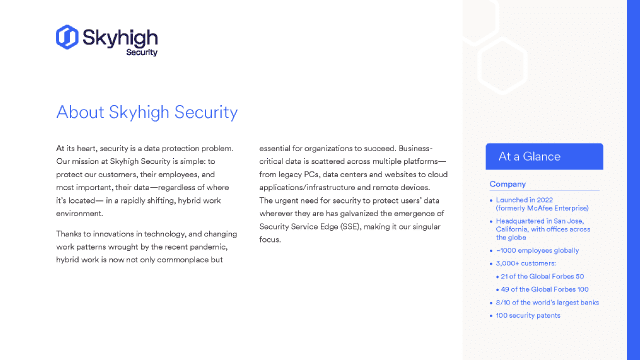
Organizations should evaluate whether an SSE platform can connect data discovery and enforcement requirements within a unified architecture. Skyhigh Security emphasizes this platform approach by combining data protection, cloud access security, web security, private access, browser isolation, and DSPM-aligned visibility in a single SSE strategy.
The global average cost of a data breach was USD 4.44 million according to IBM's Cost of a Data Breach Report 2026, making thorough evaluation of integrated data security capabilities a business imperative.