


Hybrid Cloud vs. Multi-Cloud Security
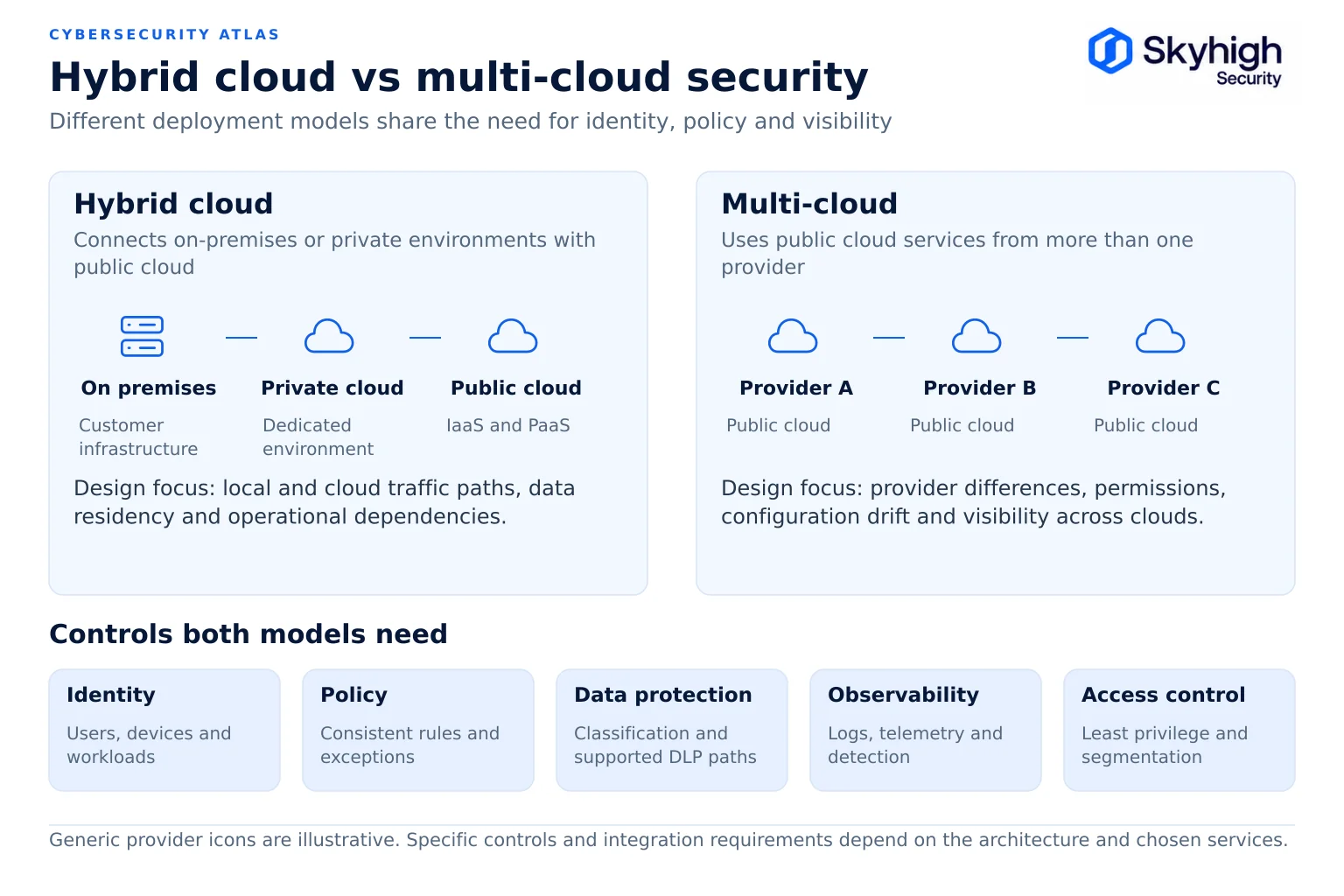
- Hybrid cloud combines owned infrastructure with public cloud; multi-cloud uses more than one public provider.
- Hybrid security centers on the on-premises-to-cloud boundary; multi-cloud security centers on provider differences.
- Identity, data classification, and access policy must stay consistent across every environment in both models.
- Flexera's 2026 research found 73% of organizations run hybrid estates, often alongside multiple clouds.
- Breaches spanning multiple environments were the costliest and slowest to contain in IBM's 2025 research.
Hybrid cloud security and multi-cloud security both deal with protecting workloads and data spread across more than one environment, but the problems are different. Hybrid cloud security focuses on keeping controls consistent between infrastructure the organization operates and infrastructure a cloud provider operates. Multi-cloud security focuses on keeping controls consistent across different public cloud providers, each with its own identity model, network constructs, and security services.
This article is part of the Hybrid Cloud Security guide.
Definitions
Hybrid cloud mixes owned and public cloud infrastructure, multi-cloud uses several public providers, and hybrid multi-cloud combines both.
Hybrid cloud. NIST’s cloud computing definition, SP 800-145, describes hybrid cloud as a composition of two or more distinct cloud infrastructures (private, community, or public) that remain unique entities but are bound together by technology that enables data and application portability. In common usage, hybrid also includes traditional on-premises data centers connected to public cloud.
Multi-cloud. The use of more than one public cloud provider, such as running workloads in two hyperscalers or combining IaaS from one provider with platform services from another. SaaS use across many vendors is a form of multi-cloud as well.
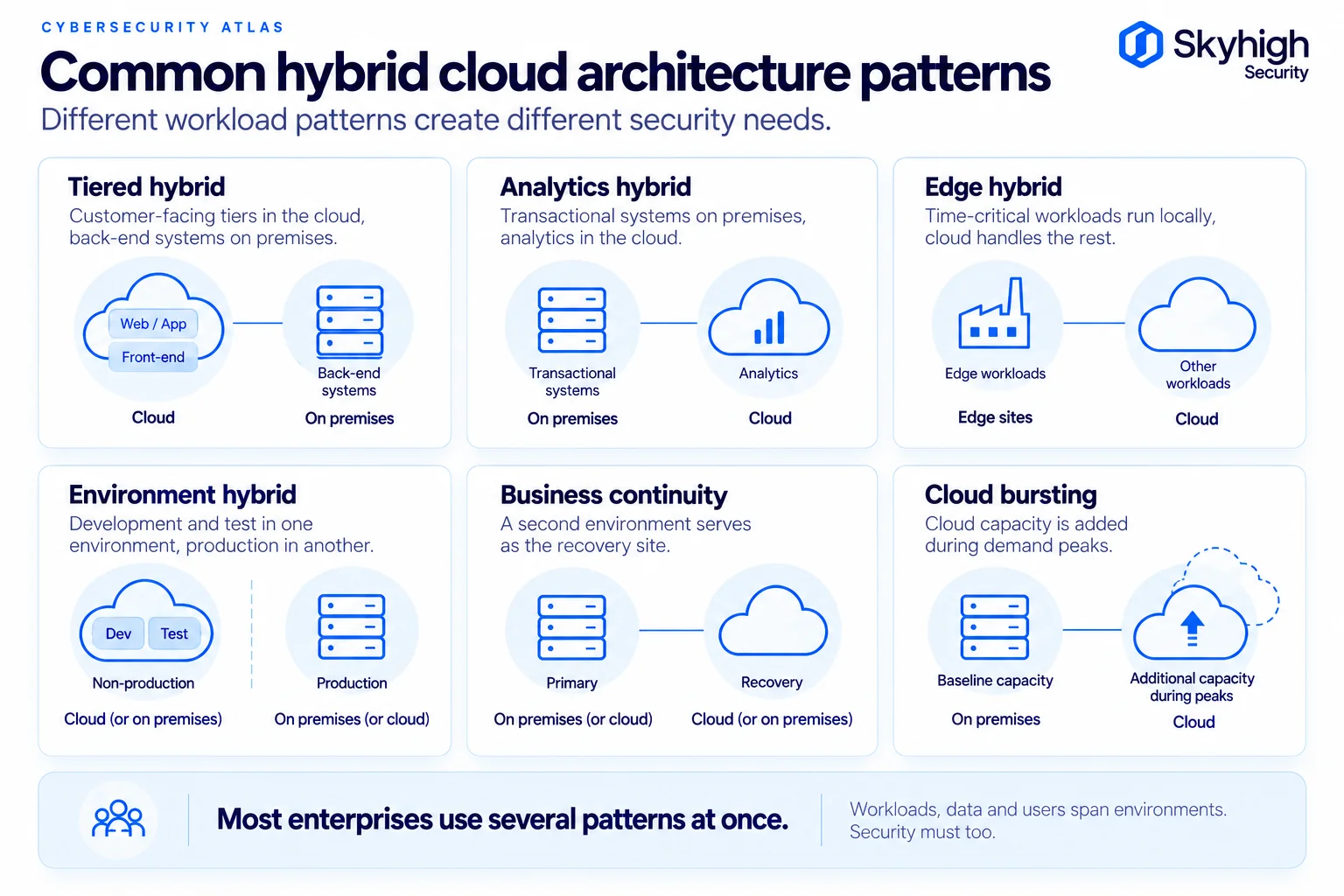
Hybrid multi-cloud. On-premises or private infrastructure combined with multiple public clouds. This describes most large enterprises.
How common each model is
Hybrid and multi-cloud estates are now the norm, and many grew by accident rather than by design.
Flexera’s 2026 State of the Cloud Report, based on a survey of 753 cloud decision-makers, found that 73% of organizations operate hybrid estates. Flexera’s press release puts multi-cloud use at 88%, and the report notes that multi-cloud growth may result from mergers or siloed applications rather than deliberate strategy. That matters for security: multi-cloud estates that grew by accident usually have inconsistent controls.
Side-by-side comparison
Hybrid and multi-cloud security differ across six dimensions: architecture, access, data handling, responsibility, policy management, and main failure mode.
| Dimension | Hybrid cloud security | Multi-cloud security |
|---|---|---|
| Architecture | Connects owned infrastructure with provider infrastructure; security spans both sides of that boundary | Spans several providers, each with different network, identity, and service models |
| Access | Users reach apps in data centers and clouds; on-site and remote paths differ | Users and workloads reach services in several clouds; each provider has its own access controls |
| Data handling | Data moves between on-premises and cloud; residency and inspection location are key decisions | Data moves between providers; each has different encryption, key management, and logging options |
| Responsibility | Customer owns everything on premises and shares responsibility in cloud | Shared responsibility splits differ by provider and service type |
| Policy management | Risk of separate policies for on-premises and cloud enforcement | Risk of separate policies per provider’s native tools |
| Main failure mode | Inconsistent policy between local and cloud enforcement | Misconfiguration from differing provider defaults and skills gaps |
Architecture
Hybrid architecture is defined by the connections between environments, while multi-cloud architecture is defined by consistency across providers.
In a hybrid architecture, the critical design points are the connections between environments: private interconnects, VPNs, and the enforcement points that inspect traffic crossing them. Decisions about where to inspect traffic and where to decrypt it shape performance, sovereignty, and resilience. See Hybrid Cloud Security Reference Architecture.
In a multi-cloud architecture, the critical design points are abstraction and consistency: a common identity layer, consistent network segmentation patterns, and security tooling that works across providers rather than only within one.
Access
Consistent access in either model depends on one identity provider and one set of per-application entitlements.
Hybrid access design must handle on-site users reaching on-site applications, remote users reaching on-site applications, and everyone reaching cloud services. Zero trust network access with both local and cloud enforcement handles all three paths under one policy. See On-Premises ZTNA for Private Applications.
Multi-cloud access design must reconcile several provider identity and access management systems. A single enterprise identity provider federated to each cloud, with consistent role definitions, reduces drift.
Data handling
Data protection in both models should rest on a cross-environment layer rather than each provider’s native tools.
Hybrid environments raise residency and inspection location questions, namely which data can move to cloud, where decrypted traffic exists, and where logs are stored. They separately raise sovereignty questions about whose infrastructure processes the traffic and who operates it. See Data Sovereignty in Hybrid Cloud Security.
Multi-cloud environments raise consistency questions: whether classification, encryption, key management, and data loss prevention work the same way in each provider. A cross-provider data security layer (DSPM for discovery and DLP for enforcement) avoids relying on each provider’s different native tools. See DLP Across Cloud and On-Premises Environments.
IBM’s Cost of a Data Breach Report 2025 found that breaches involving data distributed across multiple environments averaged USD 5.05 million and took 276 days to identify and contain, the highest cost and longest lifecycle of any storage configuration.
Responsibility
Hybrid estates have one responsibility boundary per provider, and multi-cloud estates multiply those boundaries across providers and service tiers.
The NSA and CISA Top Ten Cloud Security Mitigation Strategies lead with upholding the shared responsibility model and include a dedicated strategy for the complexities introduced by hybrid and multi-cloud environments.
In hybrid estates, the responsibility boundary is between the organization and each provider. In multi-cloud estates, there are several boundaries, and they are drawn differently by each provider and service tier. Maintain a responsibility matrix per service.
Policy management
The shared risk in both models is policy fragmentation: one policy set per enforcement stack, drifting apart over time.
For user access to web, SaaS, and private applications, a single SSE policy engine that enforces in the cloud and on premises covers both hybrid and multi-cloud estates. For workload configuration, cross-cloud posture management and policy-as-code keep infrastructure settings consistent. See Consistent Security Policies Across Cloud and On Premises.
Hybrid multi-cloud architecture: security priorities
A hybrid multi-cloud security program rests on seven priorities that keep controls consistent across every environment.
- One identity provider federated to every cloud and on-premises system.
- One data classification scheme applied by DSPM and DLP across every environment.
- One user-access policy for web, SaaS, and private apps, enforced locally and in the cloud.
- Cross-cloud posture management for infrastructure configuration.
- Centralized, residency-aware logging across every provider and site.
- A responsibility matrix for each provider and service.
- Resilience planning that assumes any single provider can fail. See Hybrid SSE Resilience: Failover and Recovery.
Which model is more secure?
Neither model is inherently more secure; the outcome depends on how consistently identity, data, and access policy are applied.
Hybrid gives organizations more control over where data is processed and how operations continue during provider outages. Multi-cloud can reduce dependence on a single provider but multiplies configuration complexity.
How Skyhigh supports hybrid and multi-cloud security
Skyhigh supports both models by enforcing one access and data policy regardless of which clouds host the applications.
Skyhigh Hybrid SSE Mesh enforces one policy for web, SaaS, private application, and AI tool access across on-premises and cloud enforcement points, independent of which cloud providers host the applications. This addresses consistent user access policy; cross-provider workload configuration is handled by posture management rather than by SSE. Skyhigh CASB applies unified policies across many cloud services, its cloud registry rates services on risk attributes including data residency, and Skyhigh DSPM discovers sensitive data across cloud and SaaS data stores.
Sources
- NIST. SP 800-145: The NIST Definition of Cloud Computing (September 2011). https://csrc.nist.gov/pubs/sp/800/145/final
- Flexera. 2026 State of the Cloud Report. https://info.flexera.com/CM-REPORT-State-of-the-Cloud
- Flexera. 2026 State of the Cloud press release (March 18, 2026; German). https://www.flexera.com/de/about-us/press-center/cloud-entwickelt-sich-vom-kostenfaktor-zum-werttreiber
- IBM and Ponemon Institute. Cost of a Data Breach Report 2025. https://www-api.ibm.com/adobe/assets/urn:aaid:aem:607b9590-38e0-4c91-b433-aa8a17f5b5e8/original/as/cost-of-a-data-breach-2025-full-report.pdf
- NSA and CISA. Top Ten Cloud Security Mitigation Strategies (March 7, 2024). https://www.nsa.gov/Press-Room/Press-Releases-Statements/Press-Release-View/Article/3699169/nsa-releases-top-ten-cloud-security-mitigation-strategies/