



Cloud vs. On-Premises Secure Web Gateways
- Cloud and on-premises secure web gateways differ mainly in where traffic is decrypted and inspected.
- Cloud SWGs suit remote users and SaaS; on-premises SWGs suit regulated, internal, and OT traffic.
- Latency, sovereignty, resilience, and cost at volume matter more than increasingly similar feature lists.
- A hybrid secure web gateway inspects each user and site at the best point under one policy.
- Running both models without a shared policy engine creates drift between office and remote users.
An on-premises secure web gateway is a proxy appliance, physical or virtual, that runs in your own data center or branch and inspects web traffic locally. A cloud secure web gateway performs the same function from the vendor’s points of presence. Many organizations now need both, which is why hybrid SWG has become a common architecture for regulated enterprises.
This article is part of the Hybrid Cloud Security guide.
What a secure web gateway does
A secure web gateway sits between users and the internet to block threats, enforce acceptable use, and prevent data loss, wherever it runs.
It typically provides:
- URL and category filtering
- TLS decryption and inspection
- Malware scanning, sandboxing, and remote browser isolation for risky sites
- Data loss prevention for uploads and form submissions
- Cloud application visibility and control
- Logging for investigations and compliance
NIST SP 800-215 lists SWGs among the point security solutions that modern enterprise networks combine with ZTNA, CASB, and other controls as the traditional perimeter disappears.
Cloud vs. on-premises SWG: side-by-side comparison
The main difference between cloud and on-premises SWGs is where inspection happens and who is responsible for running it.
| Factor | Cloud SWG | On-premises SWG |
|---|---|---|
| Inspection location | Vendor points of presence | Your data centers and branches |
| Best for | Remote and mobile users, direct-to-SaaS traffic | Office, plant, and data center users; internal traffic |
| Latency | Depends on distance to nearest point of presence | Minimal added hop for on-site users |
| Where decrypted data exists | Vendor infrastructure | Your infrastructure |
| Log location | Vendor-selected or configurable regions | Wherever you store it |
| Dependency on external connectivity | Required | Not required for supported local inspection; cloud-applied services require connectivity |
| Capacity planning | Vendor’s responsibility | Your responsibility |
| Operating effort | Lower hardware effort; policy and exceptions still yours | Hardware lifecycle, patching, and scaling are yours |
| Cost model | Per user or consumption, scales with users | Hardware and licenses, scales with throughput |
| Air-gapped networks | Not suitable | Only where explicitly supported and all dependencies are addressed |
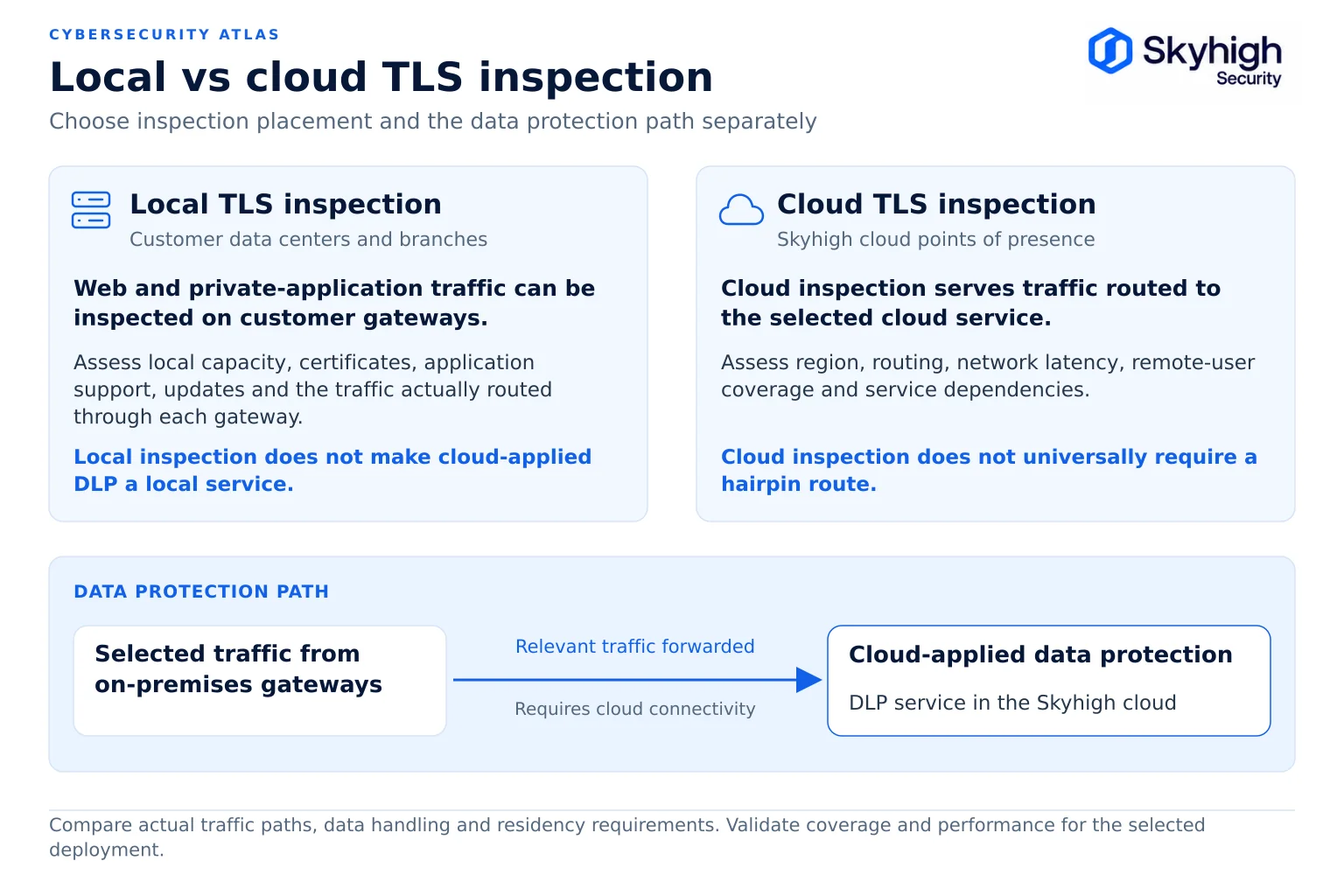
Inspection location
Inspection location decides who handles decrypted content.
For many traffic classes, a cloud SWG with appropriate controls and certifications can meet requirements. For regulated payloads, local inspection may reduce external processing, but assess forwarded services, logging, evidence, access, and the applicable requirements before choosing the inspection location.
NSA guidance on managing risk from TLS inspection recommends performing TLS inspection once, within the enterprise network, and avoiding chains of proxies that each decrypt the same traffic. Hybrid designs should make sure a given flow is decrypted by either the local gateway or the cloud gateway, not both. See Local vs. Cloud TLS Inspection: Deployment Tradeoffs.
Latency and user experience
Latency depends on actual routing, point-of-presence distance, gateway capacity, and inspection load.
For remote users, a cloud SWG can improve experience by removing VPN backhaul to headquarters. For on-site users, local inspection can avoid a cloud transit path, while cloud inspection may still suit the destination and network design. Measure the difference for:
- Real-time applications such as voice, video, and trading platforms
- Large file transfers and software updates
- Sites far from the vendor’s nearest point of presence
- OT and industrial systems with strict timing requirements
Policy control
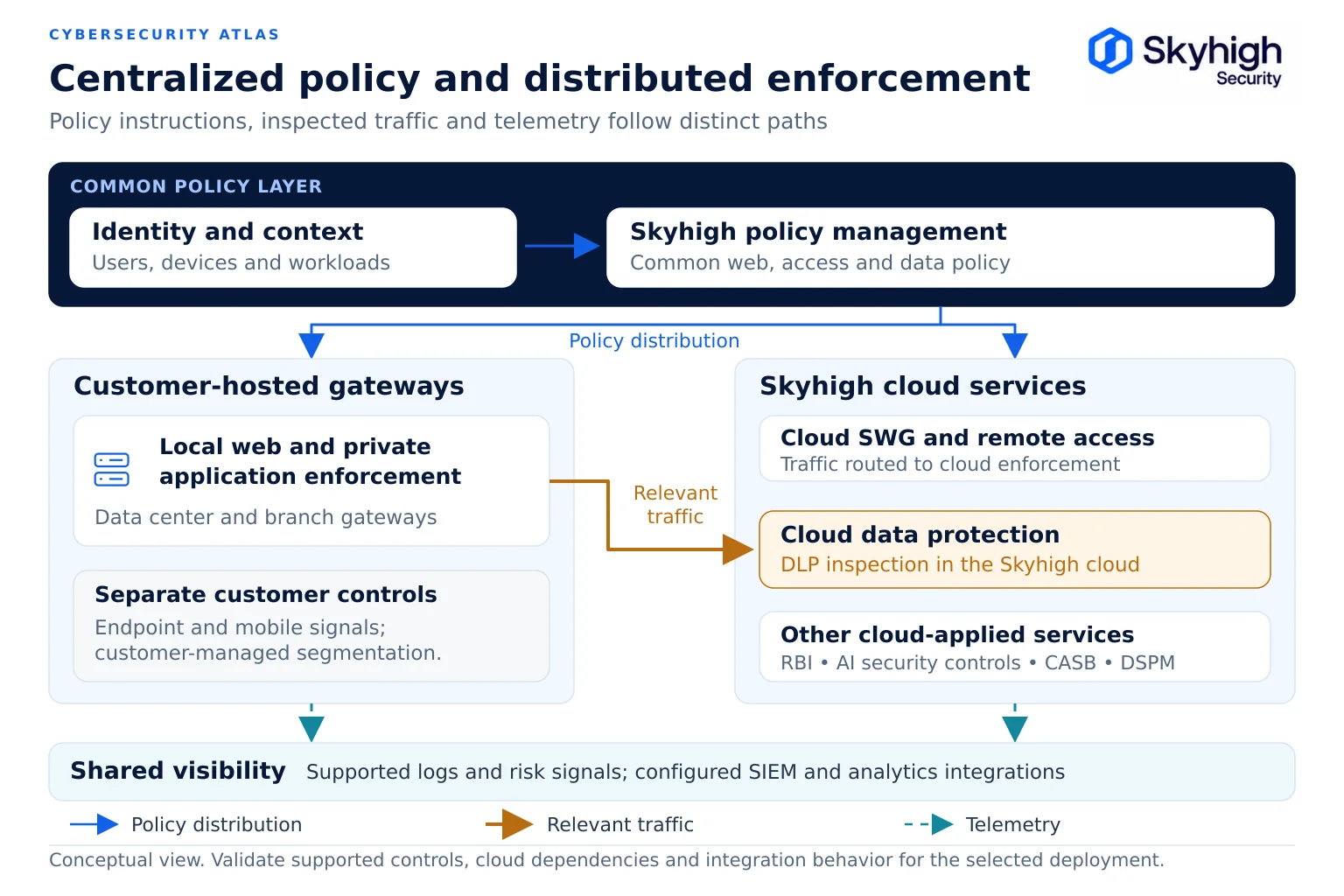
Both models enforce granular policy; the real question is whether cloud and on-premises gateways share one policy.
Organizations that run a legacy appliance fleet alongside a separate cloud service often maintain two rule sets, two sets of exceptions, and two DLP configurations. Over time, a user in the office and the same user at home are treated differently, and no one notices until an audit or incident.
A hybrid SWG with unified policy management lets teams define a rule once and apply it at every gateway. Skyhigh SWG for Hybrid, for example, supports unified policy management across on-premises and cloud enforcement points, with policy authored once in the cloud console.
Operating effort
Cloud SWGs reduce hardware work, but policy, exceptions, and certificates remain your team’s job in either model.
Cloud SWGs remove hardware procurement, capacity planning, and appliance patching. They do not remove policy design, exception handling, certificate management, or incident triage. Those remain your team’s work in either model.
On-premises SWGs require lifecycle management: hardware refreshes, OS upgrades, and scaling for traffic growth. Virtual and containerized appliances reduce some of that effort. A vendor platform change can create unplanned operating cost. Symantec Edge SWG (formerly Blue Coat ProxySG) customers, for example, face the end of SGOS 7.3 and the removal of the Java-based management console in SGOS 7.4. See Blue Coat and ProxySG End of Life: Migration Planning.
Resilience
On-premises SWGs keep inspecting when external connectivity fails, while cloud SWGs depend on the vendor and the network path to it.
A cloud SWG depends on connectivity to the vendor and on the vendor’s availability. Most organizations accept that for remote users. For a factory, hospital, trading floor, or government facility, losing web inspection or failing open during an outage may be unacceptable. On-premises gateways keep inspecting web traffic locally when external links fail. Services that depend on the vendor cloud, such as data protection and remote browser isolation, are not available until the path recovers. See Hybrid SSE Resilience: Failover and Recovery.
Migration requirements
Every SWG migration, between models or between vendors, involves the same six steps:
- Inventory current policy, exceptions, authentication realms, and integrations such as ICAP and DLP.
- Decide which users and sites move to which enforcement point.
- Re-establish traffic steering: explicit proxy or PAC files, agents, tunnels, or browser controls.
- Reissue and distribute the TLS inspection certificate authority.
- Run in parallel with a pilot group before cutover.
- Cut over in phases with a tested rollback plan.
See Secure Web Gateway Migration: Cutover and Rollback Checklist.
Which model is right for you?
Choose based on where your users, applications, and regulated data are, not on feature lists.
Choose primarily cloud if most users are remote, most applications are SaaS, and no regulation or contract requires local processing of decrypted traffic.
Choose primarily on premises when local processing or continuity is required for selected traffic. For air-gapped, classified, or OT environments, verify explicit product support and every management, identity, update, licensing, and inspection dependency.
Choose hybrid if you have a mix of office and remote users, regulated data alongside general traffic, or an existing on-premises gateway estate you want to modernize without a forced move to the cloud. This describes most large enterprises in regulated industries.
The hybrid secure web gateway
A hybrid SWG combines on-premises appliances and cloud points of presence under one policy engine, one console, and one set of logs.
Office traffic is inspected locally, remote traffic in the cloud, and regulated traffic wherever policy requires.
Skyhigh Hybrid SSE Mesh extends this model beyond web gateways, adding local ZTNA, Secure Browser Controls, and cloud CASB, DSPM, DLP, and RBI under the same policy.
Sources
- NIST. SP 800-215: Guide to a Secure Enterprise Network Landscape (November 2022). https://csrc.nist.gov/pubs/sp/800/215/final
- NSA. Managing Risk from Transport Layer Security Inspection (November 2019). https://media.defense.gov/2019/Nov/18/2002212783/-1/-1/0/MANAGING%20RISK%20FROM%20TLS%20INSPECTION_20191106.PDF
- Skyhigh Security. Secure Web Gateway for Hybrid. https://www.skyhighsecurity.com/products/secure-web-gateway-for-hybrid.html
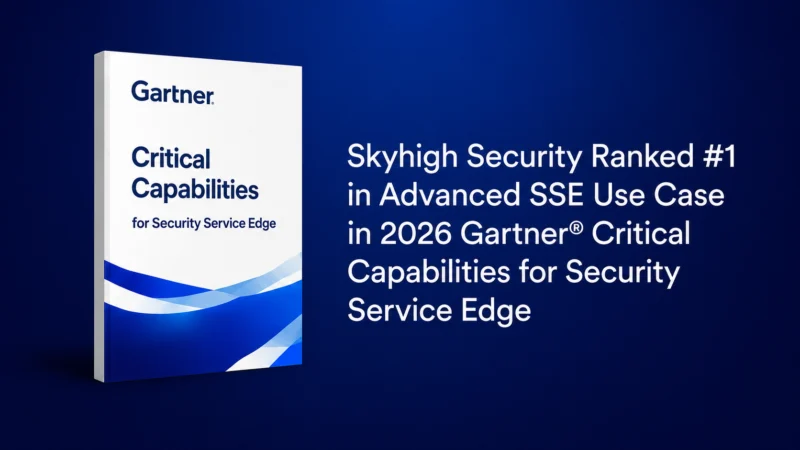
- Skyhigh Security. “Skyhigh Security Ranked #1 in Advanced SSE Use Case in 2026 Gartner Critical Capabilities for Security Service Edge” (August 5, 2026). https://www.globenewswire.com/news-release/2026/08/05/3339504/0/en/skyhigh-security-ranked-1-in-advanced-sse-use-case-in-2026-gartner-critical-capabilities-for-security-service-edge.html
- Broadcom. End of life and product lifecycle for Edge SWG (ProxySG) and Advanced Secure Gateway (KB 151102). https://knowledge.broadcom.com/external/article/151102/end-of-life-and-product-lifecycle-for-pr.html