



How DSPM and SSE Work Together to Reduce Data Risk
- DSPM finds sensitive data and its exposure; SSE controls how users and apps interact with it.
- Together, discovery informs enforcement, and enforcement telemetry refines discovery in a continuous loop.
- In hybrid environments, DSPM discovers data at rest in supported cloud and SaaS repositories, while SSE provides inline visibility and enforcement for traffic routed through supported gateways.
- A practical workflow runs discover, classify, prioritize, enforce, verify, and report.
- Governing data flows into AI tools is essential, because data in an AI pipeline cannot be recalled.
DSPM and SSE work together by connecting what data is at risk with how access to it is controlled. DSPM continuously discovers and classifies sensitive data across SaaS and cloud data stores, and maps who can access it and how it is shared. SSE enforces policy through secure web gateway (SWG), cloud access security broker (CASB), zero trust network access (ZTNA), and data loss prevention (DLP) controls. When DSPM findings inform SSE policy, enforcement becomes proportionate to real data sensitivity and exposure.
This article is part of the Hybrid Cloud Security guide.
What DSPM does in an SSE architecture
DSPM is the data intelligence layer of an SSE architecture, answering four questions about sensitive data:
- What sensitive data exists? Personal data, financial records, health data, intellectual property, source code, and AI training data.
- Where does it live? SaaS applications, cloud storage, databases, collaboration platforms, file shares, analytics pipelines, and backups.
- Who can access it? Users, groups, external collaborators, service accounts, and connected applications.
- How exposed is it? Public links, excessive permissions, dormant accounts with access, misconfigured storage, and risky integrations.
SSE is the enforcement layer. It governs data as it moves: uploads and downloads through the web gateway, sharing and activity in SaaS through CASB, access to private applications through ZTNA, and content inspection through DLP. Without DSPM, SSE decides based on identity, device, application, and content patterns. With DSPM, it also knows which repositories and data sets matter most.
Why data-blind controls miss modern risk
Data-blind controls miss modern risk because attackers increasingly use valid accounts and legitimate services that look like normal activity.
Attackers increasingly use valid accounts and legitimate services. Verizon’s 2026 Data Breach Investigations Report found the human element present in 62% of breaches and reported that 48% of breaches involved a third party. When a compromised account downloads files from a sanctioned SaaS application, a network control sees ordinary, authorized traffic. Only data context reveals that the files are the organization’s most sensitive records.
Common exposure patterns that data-blind controls miss include oversharing through public links, sensitive data scattered across dozens of SaaS services, shadow data copies in test environments and forgotten storage, unmanaged device access, and AI tools connected to repositories they should not reach.
How DSPM identifies and prioritizes risk
DSPM discovers and classifies sensitive data, maps its exposure, and ranks findings so teams fix the riskiest issues first.
DSPM connects to SaaS and cloud platforms through APIs, scans storage and databases, and classifies content by sensitivity. Classification works at the object level (files, tables, datasets) so controls can be proportionate.
Exposure analysis then shows where data is reachable beyond its intended audience. Prioritization ranks findings by sensitivity, exposure scope, business criticality, and regulatory relevance, so teams fix the riskiest exposures first rather than working through an undifferentiated list.
How SSE turns DSPM findings into control
DSPM findings can inform changes to sharing, access, upload, and DLP policies for the affected data. Implement those changes through supported integrations or a reviewed policy-change workflow.
| DSPM finding | SSE response |
|---|---|
| Regulated data shared by public link in a SaaS app | CASB removes the public link and notifies the owner |
| Sensitive repository reachable by an unsanctioned AI tool | CASB revokes the OAuth grant; web gateway blocks uploads to that AI service |
| Customer records present in a newly discovered storage bucket | Review the repository’s sensitive data for inclusion in DLP exact-match policies and apply appropriate access restrictions through supported controls |
| High-sensitivity data accessed from unmanaged devices | CASB and ZTNA require managed devices or allow view-only access |
| Source code copied to personal cloud storage | Web gateway DLP blocks uploads of code to personal destinations |
The key integration point is shared classification. DSPM labels and SSE DLP policies must use the same definitions, or findings cannot drive enforcement. Confirm which handoffs are automated and which require an approved policy change.
Data protection workflows
An effective DSPM and SSE workflow runs as a six-step loop that repeats as data is created and moved.
1. Discover. Continuously scan cloud and SaaS data stores, and observe data in motion through gateways.
2. Classify. Apply one classification scheme across all sources.
3. Prioritize. Rank exposures by sensitivity, reach, and business impact.
4. Enforce. Translate priorities into SSE policies: sharing restrictions, upload blocks, access conditions, DLP rules.
5. Verify. Use enforcement telemetry to confirm that exposure decreased and that policies are not blocking legitimate work.
6. Report. Produce evidence for auditors: where regulated data lives, what controls apply, and how exposure changed over time.
The loop repeats as data is created and moved.
Protecting sensitive SaaS and AI data
DSPM shows which sensitive repositories AI tools can reach, and SSE controls what users and apps send to AI services.
Generative AI connects to more repositories and processes more data than any previous application category. OWASP ranks sensitive information disclosure among the top risks for large language model applications. Verizon’s 2026 DBIR found that 67% of users accessing AI services on corporate devices use non-corporate accounts.
DSPM identifies which repositories AI tools can reach and where sensitive data is exposed to them. SSE enforces what users can send to AI services, which AI services are allowed, and whether connected AI applications keep their access. Skyhigh notes that once sensitive data enters an AI pipeline, it cannot be reversed, which is why governing data flows into AI systems is a core DSPM use case (Skyhigh DSPM data sheet).
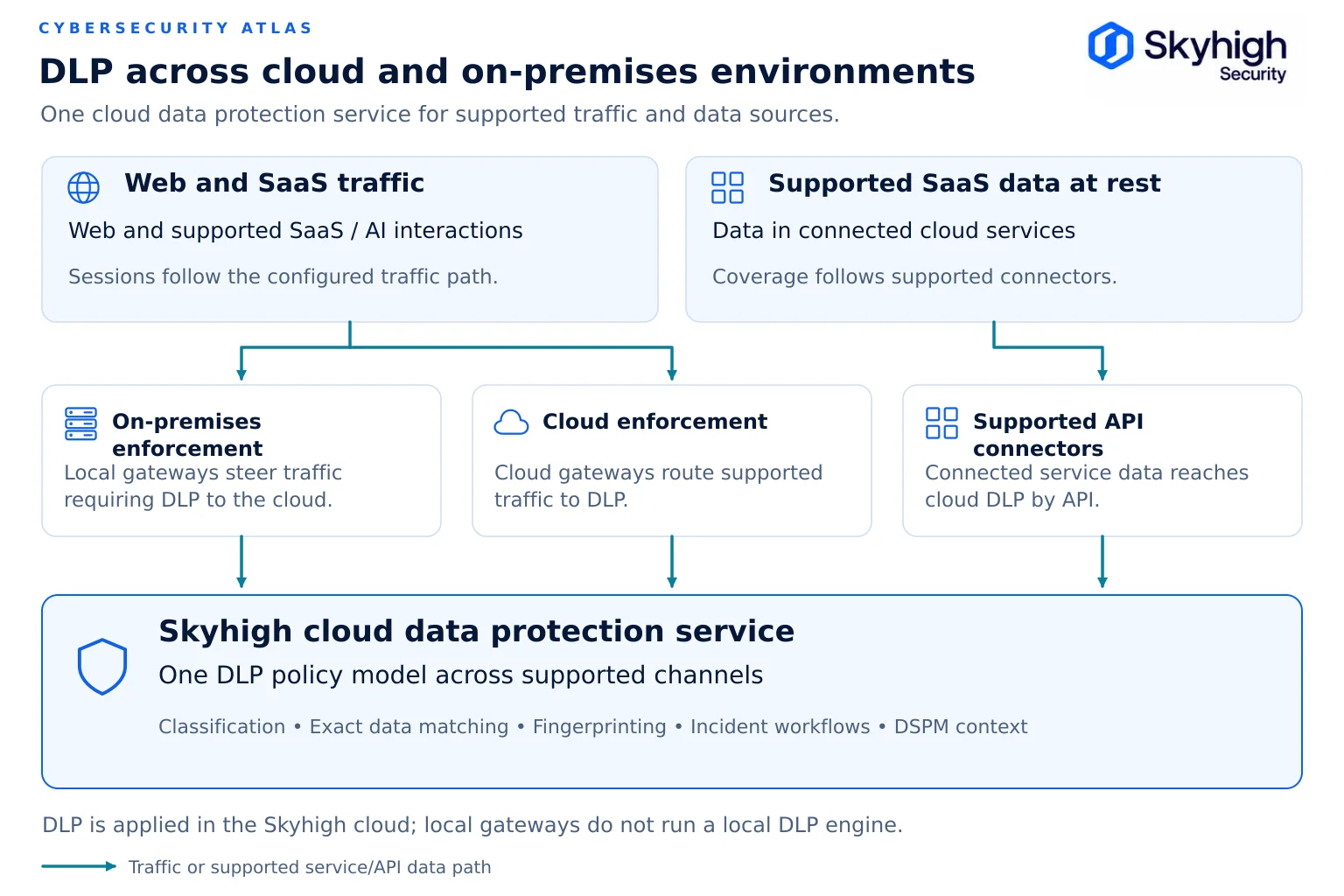
DSPM and SSE in a hybrid environment
Hybrid estates need complementary coverage: DSPM discovery for supported cloud and SaaS repositories, and SSE visibility and enforcement for data in motion through local and cloud gateways.
Separate at-rest discovery from inline visibility. On-premises file shares and databases are outside the DSPM at-rest discovery scope described here; traffic from those systems can still be observed when it passes through supported gateways, including integrated third-party proxies.
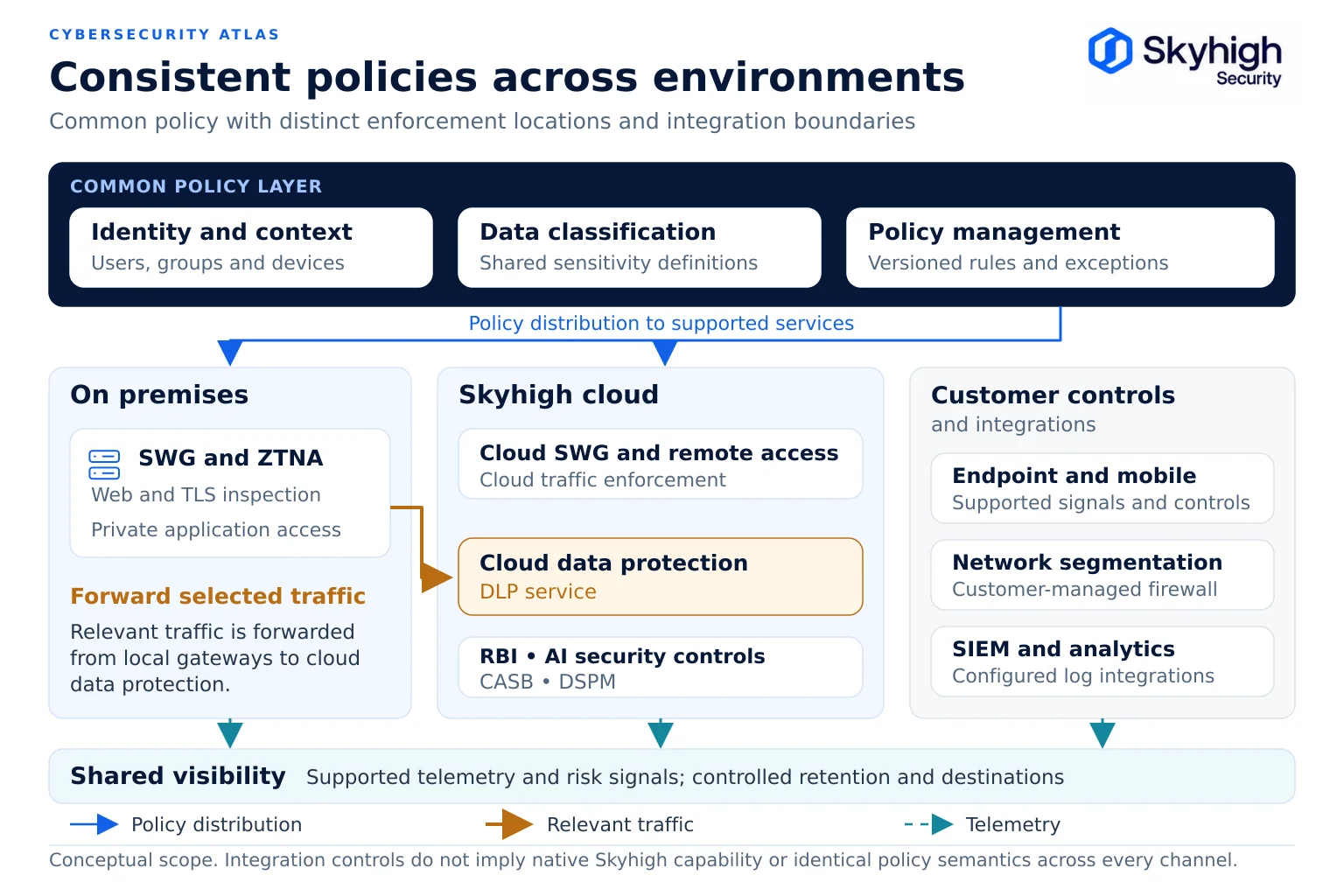
Apply the same data-policy definitions across supported paths. In the Skyhigh deployment described here, web and private application policy is enforced locally, while traffic requiring DLP inspection is forwarded to the Skyhigh cloud.
Example: a regulated financial institution in transition
A bank runs on-premises web gateways at headquarters and branches, is partway through replacing a legacy proxy, and uses cloud CASB for SaaS.
- DSPM scans SaaS tenants and cloud storage through APIs and discovers customer records in several collaboration sites shared with external partners.
- Discovery across cloud collaboration sites reveals duplicate customer extracts shared outside the approved group.
- The legacy proxy that still serves some branches is connected to DSPM over ICAP, so data in motion through that proxy is visible alongside traffic through the new gateways.
- Findings are ranked. External sharing of customer records is the top priority.
- CASB removes external shares and restricts downloads to managed devices. DLP adds the customer database to exact-match policies, and the same policy applies to traffic from on-premises gateways and from cloud points of presence, because the gateway forwards that traffic to the Skyhigh cloud for inspection.
- Web and private application policy is enforced locally on bank infrastructure. Traffic requiring data protection, CASB, or AI controls is forwarded to the Skyhigh cloud under the same policy.
- Quarterly reports show auditors which repositories hold regulated data, which controls apply, and how exposure has changed.
For a public example of hybrid SSE in financial services, see Sicredi’s deployment of Skyhigh’s hybrid SSE across on-premises, cloud, and remote environments.
What to look for in an SSE-enabled DSPM strategy
Look for DSPM and SSE capabilities that share classification, cover every environment, and turn findings into enforcement.
- Discovery of data at rest across SaaS, IaaS, and cloud databases
- Visibility into data in motion through the organization’s own gateways, including third-party proxies
- One classification scheme shared by DSPM and DLP
- Findings that can trigger SSE policy changes directly, with automation where appropriate
- Enforcement across web, SaaS, private apps, endpoints, and AI tools
- Local and cloud enforcement under one policy for hybrid estates
- Audit-ready reporting and relevant authorizations for regulated sectors
How Skyhigh combines DSPM and SSE
Skyhigh combines cloud and SaaS data discovery with inline visibility through Skyhigh enforcement points and supported third-party proxies.
Skyhigh DSPM discovers data at rest across cloud storage, cloud databases, and SaaS, and monitors data in motion through Skyhigh enforcement points, including networks, cloud traffic, and SaaS flows. It integrates with Skyhigh Advanced DLP and SSE so that posture findings guide enforcement, and it can connect to third-party proxy solutions over ICAP to extend visibility to inline platforms not yet on Skyhigh (Skyhigh DSPM data sheet). Skyhigh DSPM achieved FedRAMP High authorization in March 2026.
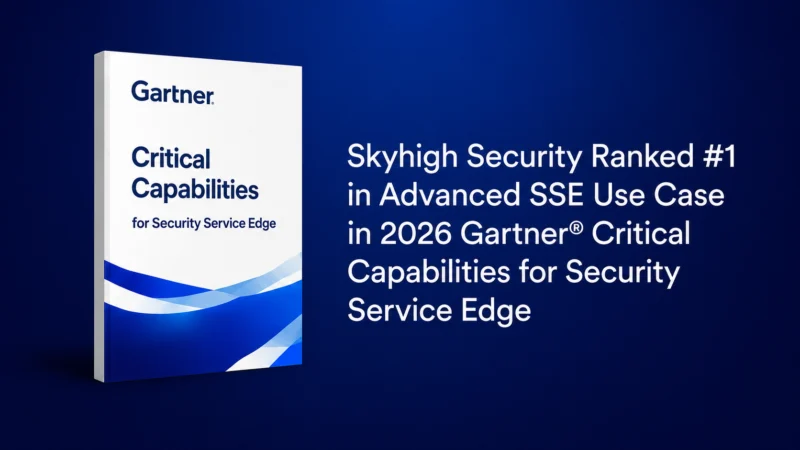
Skyhigh’s March 2026 platform update extended DSPM visibility across third-party secure web gateways to create a unified view of data risk in multi-vendor environments (Skyhigh Security). Through Skyhigh Hybrid SSE Mesh, the same policies apply at on-premises and cloud enforcement points. Skyhigh was ranked first in the Advanced SSE Use Case in the 2026 Gartner® Critical Capabilities for Security Service Edge.
Sources
- Verizon. 2026 Data Breach Investigations Report. https://www.verizon.com/business/resources/reports/dbir/
- OWASP. LLM02:2025 Sensitive Information Disclosure. https://genai.owasp.org/llmrisk/llm022025-sensitive-information-disclosure/
- Skyhigh Security. Skyhigh Data Security Posture Management data sheet (June 2026). https://www.skyhighsecurity.com/wp-content/uploads/2026/06/ds-dspm.pdf
- Skyhigh Security. “Skyhigh Security Achieves FedRAMP High Authorization for Skyhigh DSPM.” https://www.skyhighsecurity.com/about/newsroom/newswire/skyhigh-security-achieves-fedramp-high-authorization-for-skyhigh-dspm.html
- Skyhigh Security. “Skyhigh Security Announces New Solutions to Strengthen Disruptive Universal SSE Platform” (March 24, 2026). https://www.skyhighsecurity.com/about/newsroom/newswire/skyhigh-security-announces-new-solutions-to-strengthen-disruptive-universal-sse-platform.html
- Skyhigh Security. “Sicredi Partners with Skyhigh Security to Secure Hybrid Work and AI Adoption” (January 15, 2026). https://www.skyhighsecurity.com/about/newsroom/newswire/sicredi-partners-with-skyhigh-security-to-secure-hybrid-work-and-ai-adoption.html
- Skyhigh Security. “Skyhigh Security Ranked #1 in Advanced SSE Use Case in 2026 Gartner Critical Capabilities for Security Service Edge” (August 5, 2026). https://www.globenewswire.com/news-release/2026/08/05/3339504/0/en/skyhigh-security-ranked-1-in-advanced-sse-use-case-in-2026-gartner-critical-capabilities-for-security-service-edge.html
GARTNER is a registered trademark and service mark of Gartner, Inc. and/or its affiliates in the U.S. and internationally and is used herein with permission. All rights reserved. Gartner does not endorse any vendor, product or service depicted in its research publications.