



DSPM vs. DLP: What’s the Difference, and Do You Need Both?

Quick Summary
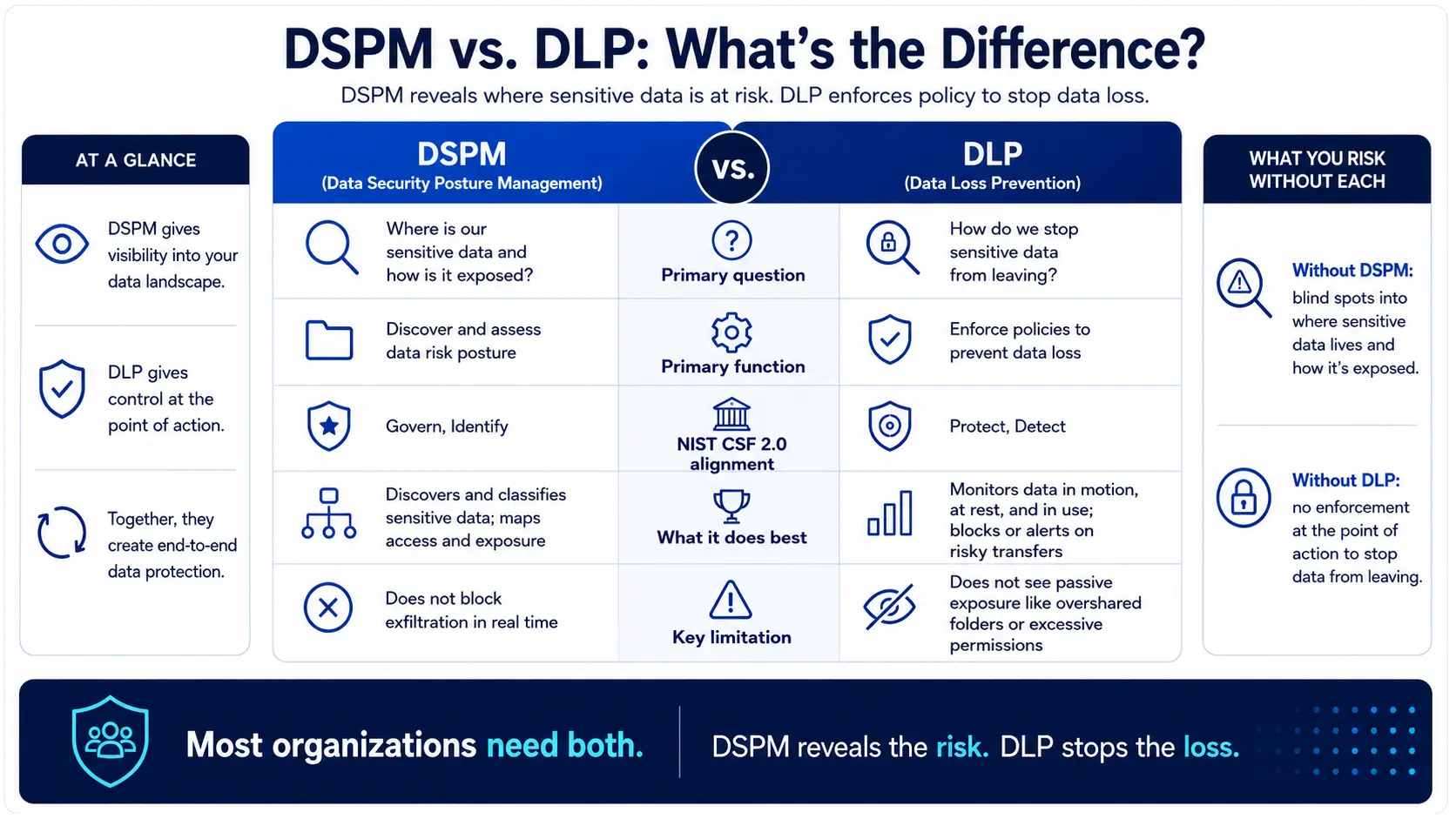
  • DSPM maps to NIST CSF 2.0 Govern and Identify — discovers, classifies, and maps access to sensitive data.
  • DLP maps to Protect and Detect — enforces policies in real time to block unauthorized data movement.
  • DSPM without DLP gives visibility with no enforcement. DLP without DSPM gives enforcement with blind spots.
  • DLP cannot detect passive exposure like overshared folders or misconfigured permissions — DSPM can.
  • DSPM cannot stop real-time exfiltration by a user with legitimate access — that requires DLP enforcement.
  • The strongest architecture feeds DSPM classification and risk data into DLP's policy engine as a closed loop.
  • Most regulated enterprises need both. The question is which gap to close first based on current risk posture.

Security leaders don’t need another tool that solves half the problem. Yet that’s exactly what happens when organizations treat Data Security Posture Management (DSPM) and Data Loss Prevention (DLP) as interchangeable — or worse, assume one can replace the other.

The confusion is understandable. Both technologies claim to protect sensitive data. Both vendors pitch them as essential. And both show up on the same analyst shortlists. But DSPM and DLP answer fundamentally different questions about your data, and understanding where each one operates is the difference between a security program with full coverage and one with blind spots large enough to drive a breach through.

This guide breaks down what each technology does, where they overlap, and — most importantly — how to decide which investment to make first based on your actual risk profile.

A Framework for Thinking About DSPM and DLP

Before comparing feature lists, it helps to anchor the conversation in something vendor-neutral. The NIST Cybersecurity Framework (CSF) 2.0 organizes cybersecurity into six core functions: Govern, Identify, Protect, Detect, Respond, and Recover. Mapping DSPM and DLP against these functions clarifies why they’re complementary rather than competitive.

DSPM maps primarily to the Govern and Identify functions. Govern establishes cybersecurity strategy, risk tolerance, and oversight — the organizational context that determines what “sensitive” means in your environment. Identify focuses on understanding your assets, data flows, and risk landscape. DSPM answers the foundational questions these functions demand: Where is our sensitive data? Who can access it? Is that access appropriate? What’s our current exposure?

DLP maps primarily to the Protect and Detect functions. Protect implements safeguards that prevent sensitive data from leaving approved channels. Detect identifies cybersecurity events — like an employee forwarding a spreadsheet full of Social Security numbers to a personal Gmail account — as they happen or shortly after. DLP operates at the point of action, enforcing policies that stop data from moving where it shouldn’t.

This mapping reveals the core asymmetry: DSPM tells you what you have and where you’re exposed. DLP prevents what you know about from leaving. Neither function is optional, but the order in which you invest depends on which gap is creating more risk right now.

What DSPM Actually Does

Data Security Posture Management is a data-centric approach to understanding and managing risk across cloud, SaaS, hybrid, and on-premises environments. Rather than securing the perimeter or monitoring endpoints, DSPM puts the spotlight on the data itself.

Side-by-side comparison of DSPM and DLP showing primary questions, functions, NIST CSF 2.0 alignment, strengths, and key limitations

A DSPM platform continuously discovers sensitive data wherever it lives — cloud storage buckets, SaaS applications, data warehouses, file shares, collaboration platforms, and increasingly, AI training pipelines. It then classifies that data by sensitivity and regulatory relevance (PII, PHI, PCI, intellectual property), maps who has access and whether that access is appropriate, and surfaces posture risks like misconfigured repositories, overly permissive sharing links, unencrypted storage, or data sitting in locations it was never intended to reach.

The key capabilities of DSPM include automated data discovery across all environments, AI-driven classification that understands context rather than just pattern-matching keywords, access governance that maps permissions and identifies excessive or orphaned access, risk scoring that prioritizes exposures by business impact, compliance mapping against frameworks like HIPAA, GDPR, PCI DSS, and CCPA, and shadow data detection that finds information created or stored outside of governed systems.

DSPM is the reconnaissance layer. It builds the map of your data landscape that every other security control depends on. Without it, you’re enforcing policies against a terrain you can’t fully see.

What DLP Actually Does

Data Loss Prevention is a policy-driven enforcement technology designed to prevent sensitive data from being transmitted, shared, or accessed by unauthorized parties. DLP has been a staple of enterprise security for over a decade, and for good reason — it operates at the point of action where data actually leaves the organization.

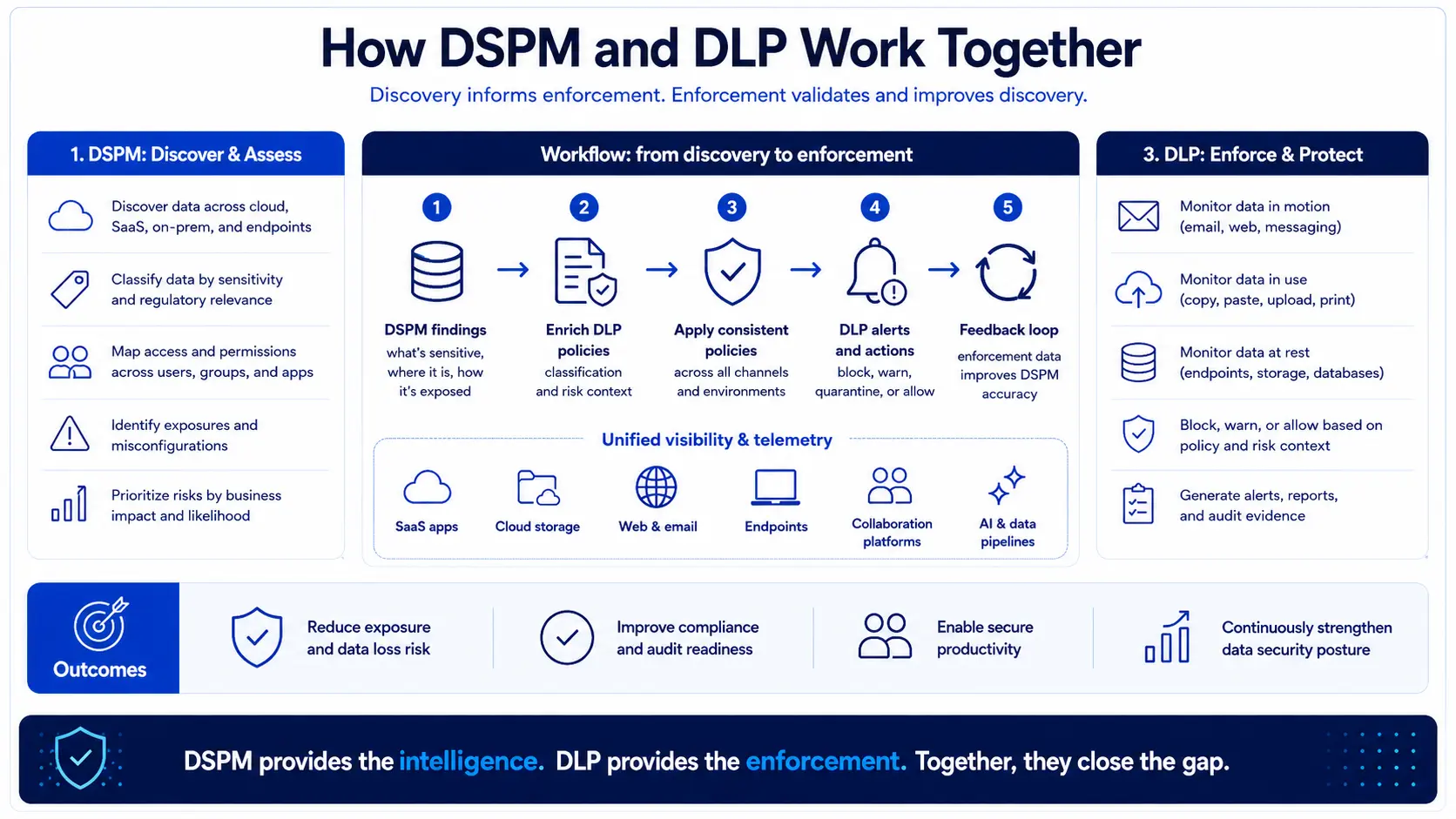
Workflow diagram showing how DSPM and DLP work together: DSPM discovers and assesses while DLP enforces and protects, connected through unified visibility and telemetry

A DLP platform monitors data- in- motion (email, web uploads, cloud sync, messaging), data- at- rest (file servers, databases, endpoints), and data- in- use (clipboard operations, screen capture, printing). When it detects content that matches predefined policies — a credit card number in an outbound email, source code being uploaded to an unsanctioned cloud service, a patient record being copied to a USB drive — it can block the action, quarantine the file, alert the security team, or coach the user with a policy reminder.

The key capabilities of DLP include real-time content inspection across email, web, endpoint, and cloud channels, policy enforcement that blocks, quarantines, or encrypts data based on rules, user behavior monitoring that identifies risky patterns before they become incidents, incident management workflows for investigating and remediating violations, regulatory compliance enforcement for data handling requirements, and integration with CASB and secure web gateway infrastructure for consistent policy across cloud and web traffic.

DLP is the enforcement layer. It acts on what it knows about, applying rules in real time to prevent exfiltration. Its limitation is that it’s only as effective as the classification and policy definitions driving it — which is precisely where DSPM fills the gap.

DSPM vs. DLP: Capabilities Compared

The table makes the relationship clear: DSPM provides the intelligence, DLP provides the enforcement. Running DLP without DSPM means enforcing policies against a data landscape you don’t fully understand. Running DSPM without DLP means seeing risks you can’t actively prevent.

Scenario: Healthcare Organization Discovers What DLP Can’t See

Regional Memorial Health System runs a mature DLP deployment. Email DLP catches PHI in outbound messages. Endpoint DLP prevents USB transfers of patient data. Their compliance team considers data loss prevention a solved problem.

Then a DSPM deployment scans their Microsoft 365 environment for the first time.

The platform discovers a shared OneDrive folder — created 18 months ago by a billing coordinator for a short-term project with an external insurance auditor — containing 2,300 patient intake forms with names, dates of birth, diagnoses, and insurance policy numbers. The folder’s permissions were set to “Anyone with the link” during the original collaboration. The external auditor’s project ended a year ago. The link was never revoked.

DLP never flagged this exposure. The data wasn’t being transmitted through a monitored channel. No one was emailing these files or downloading them to a USB drive. The data was simply sitting in an overshared cloud folder, accessible to anyone with the URL, completely invisible to the enforcement layer.

DSPM classified the contents as PHI, flagged the “Anyone with the link” permission as a critical exposure, identified that the external access had been dormant for over a year, and generated a remediation recommendation: revoke the public link, restrict access to the billing team, and apply a HIPAA sensitivity label.

For a healthcare organization subject to HIPAA, this kind of passive exposure is just as dangerous as active exfiltration — and arguably harder to detect. The data was never “lost” in the DLP sense. It was simply exposed in a location that DLP wasn’t watching. Without DSPM’s discovery and access governance capabilities, this folder could have remained open indefinitely, a compliance violation waiting for an OCR audit or a threat actor with the right URL.

Scenario: Financial Services Firm Needs What DSPM Can’t Do

Meridian Capital Partners runs a proprietary trading desk. Their intellectual property isn’t just customer data — it’s the trading algorithms, position data, and market analysis that give them a competitive edge. A single leaked strategy document could cost millions in lost advantage before anyone even knows it happened.

Their security team deploys DSPM and gets valuable results: they discover trading models stored in an S3 bucket with overly broad IAM permissions, find copies of portfolio data in a Snowflake warehouse that the data engineering team created for a now-abandoned analytics project, and identify three Confluence pages containing position summaries that are accessible to the entire engineering organization rather than just the trading desk.

DSPM surfaces all of this. The team remediates the permissions, cleans up the stale data, and tightens access. Their posture improves significantly.

But DSPM can’t help with what happens next. A junior analyst, frustrated about a compensation dispute, decides to forward a spreadsheet containing current trading positions and pending orders to a personal email account. The data is properly classified, stored in the right location, with appropriate permissions — the analyst has legitimate access. The posture is clean. There’s nothing for DSPM to flag.

This is where DLP is irreplaceable. The email DLP policy catches the outbound message, identifies the content as proprietary trading data based on classification tags and content patterns, blocks the transmission, and escalates an incident to the security operations team. The analyst’s manager is notified. The data never leaves the organization.

No amount of posture visibility prevents a motivated insider with legitimate access from attempting exfiltration. That requires real-time enforcement at the point of action — exactly what DLP was built for.

Decision Framework: Where to Start

The “you need both” answer is true but unhelpful when you have budget for one initiative this quarter. Here’s how to prioritize based on your current situation.

Start with DSPM if your organization has undergone rapid cloud migration and you don’t have a current, comprehensive inventory of where sensitive data lives. If your compliance team can’t confidently answer “where is all of our regulated data and who can access it?” during an audit, DSPM addresses the foundational visibility gap that everything else depends on. This is also the right starting point if you’re preparing for AI adoption — deploying Microsoft Copilot or similar tools without first understanding what data those tools can access creates a risk amplification problem that only DSPM can surface.

Start with DLP if you already have reasonable visibility into your data landscape but lack enforcement controls on egress channels. If your primary concern is insider threat, accidental data sharing through email or messaging, or regulatory requirements that mandate active controls on data transmission (such as PCI DSS requirements for cardholder data or SEC rules for trading information), DLP addresses the immediate enforcement gap. This is also the right starting point if you’ve recently experienced a data exfiltration incident and need to close the door before you audit the house.

Invest in both simultaneously if you’re a regulated enterprise (financial services, healthcare, government) where both posture gaps and enforcement gaps create compliance risk. In these environments, an auditor will ask both “do you know where your regulated data is?” and “what controls prevent it from leaving?” — and you need confident answers to both questions.

The integration play matters. When DSPM and DLP operate as disconnected tools, you get a visibility layer that can’t enforce and an enforcement layer that can’t see. The strongest architecture feeds DSPM’s continuously updated classification and risk data into DLP’s policy engine, creating a closed loop where discovery informs enforcement and enforcement data feeds back into posture assessment. Look for platforms that offer this integration natively or through well-documented APIs rather than buying two tools and hoping they’ll talk to each other.

Protect Your Data Everywhere
Skyhigh Security delivers unified data protection with industry-leading DLP, CASB, and DSPM — all in a single converged SSE platform.

Frequently Asked Questions

No. DSPM and DLP serve different functions in the data security lifecycle. DSPM discovers and assesses — it builds the map of where sensitive data lives, who can access it, and where exposure exists. DLP enforces and prevents — it blocks sensitive data from leaving through unauthorized channels in real time. Replacing DLP with DSPM would leave you with excellent visibility but no ability to stop exfiltration as it happens.
Traditional DLP performs limited discovery on the channels it monitors — it can identify sensitive content in emails, endpoint file systems, and cloud apps within its scope. However, DLP was not designed for comprehensive cross-environment discovery. It won’t find shadow data in ungoverned cloud storage, map access permissions across SaaS platforms, or identify sensitive data in locations it isn’t configured to watch. DSPM’s discovery capability is broader, more continuous, and contextually richer.
DSPM addresses GenAI risk at the data layer by discovering what sensitive information AI tools could potentially access or surface. When an organization deploys Microsoft Copilot, for example, the tool can index and retrieve anything the user has permission to see. DSPM identifies overshared or misclassified data that could be surfaced through AI queries, allowing teams to remediate access before Copilot amplifies the exposure. DLP complements this by blocking sensitive data from being pasted into external AI tools like ChatGPT.
DSPM platforms are generally agentless and API-based, connecting to cloud services and SaaS applications through integrations. Initial data inventory and classification results typically appear within days to a few weeks, though comprehensive coverage across a large enterprise may take longer. DLP deployments are more operationally intensive, requiring agent rollouts on endpoints, policy configuration, integration with email and web gateways, and an extended tuning period to reduce false positives. A realistic DLP deployment timeline for a mid-to-large enterprise is three to six months before policies are tuned enough to enforce without excessive noise.
In regulated environments, the integration creates a continuous compliance loop. DSPM discovers and classifies regulated data (PHI, PCI, PII) across all environments and surfaces posture risks like misconfigurations or excessive access. That classification data feeds into DLP policies, ensuring enforcement rules are based on current, accurate understanding of where sensitive data lives and how it’s categorized. DLP then prevents regulated data from leaving approved channels and generates incident data that feeds back into DSPM’s risk assessment.
Early DSPM solutions focused primarily on cloud and SaaS environments, which is where the most acute visibility gaps existed. However, modern DSPM platforms have expanded to cover hybrid and on-premises environments as well, including file servers, databases, and endpoints. The strongest platforms provide a unified view across cloud, SaaS, on-premises, and hybrid infrastructure.
Classification is the foundation that makes both DSPM and DLP effective, but they approach it differently. DSPM uses AI-driven classification that analyzes content in context — understanding that a spreadsheet containing patient names alongside diagnosis codes in a healthcare environment is PHI, not just a generic data file. DLP has traditionally relied on pattern matching and regular expressions to identify sensitive content in transit. When classification is inaccurate or incomplete, DSPM can’t prioritize the right risks and DLP can’t enforce the right policies. This is why the integration between the two matters: DSPM’s richer classification can feed directly into DLP’s enforcement engine, improving policy accuracy and reducing false positives.
DSPM and DLP aren’t competing technologies — they’re complementary layers in a data security architecture. DSPM provides the strategic visibility that Govern and Identify demand: a continuously updated understanding of where sensitive data lives, who can access it, and where your posture is weak. DLP provides the tactical enforcement that Protect and Detect require: real-time controls that prevent sensitive data from leaving through unauthorized channels. Organizations that invest in only one will always have a gap. DSPM without DLP is a map without defenses. DLP without DSPM is a guard standing watch over a building whose floor plan you’ve never seen. The question isn’t whether you need both — it’s which gap to close first. Ready to strengthen your data security posture? Discover how Skyhigh Security’s SSE platform combines data intelligence with comprehensive cloud security to help you identify, classify, and protect sensitive data across your entire digital ecosystem.
See How Skyhigh Security Can Help
Learn how Skyhigh Security protects your sensitive data across cloud, web, and private applications.
Request a Demo
DSPM vs. DLP: What’s the Difference, and Do You Need Both? 0% read