




Clasificación de datos en la nube: la base de la protección de datos confidenciales en las empresas modernas
- Classification identifies, categorizes, and labels sensitive data across SaaS, cloud storage, and hybrid environments.
- Manual classification cannot keep pace with cloud data sprawl — automated discovery with ML-driven labeling is essential.
- Classification is the prerequisite for effective DLP, access controls, sharing restrictions, and compliance reporting.
- The human element was present in 62% of breaches (Verizon 2026 DBIR), reinforcing why automated classification matters.
- Classification should extend into continuous posture management, connecting discovery to ongoing risk monitoring.
- Unmanaged data, shadow IT, and AI tools create governance risks that classification helps surface (IBM Cost of a Breach 2025).
- Effective classification combines pattern matching, exact data matching, contextual signals, and sensitivity taxonomies.
Cloud data classification has evolved from a compliance checkbox into the operational foundation for enterprise data security. Organizations may discover sensitive data across cloud environments, but classification transforms discovery into actionable protection by assigning meaning and sensitivity context that drives policy enforcement.
What Is Cloud Data Classification?
Cloud data classification is the systematic process of discovering, identifying, and categorizing sensitive information across cloud environments to enable consistent security policies and controls.
Unlike simple data discovery that tells you where files exist, classification determines what protection each piece of data actually needs. This forms the foundation of effective data security posture management strategies.
The process involves three distinct layers. Discovery finds data repositories and objects. Identification detects whether content contains sensitive elements. Classification then assigns meaning and sensitivity levels that can guide access, sharing, retention, and monitoring decisions.
Sensitive data typically includes several categories that require different handling. Personal information may be governed by laws such as GDPR or CCPA. Healthcare records may fall under HIPAA, while payment card data is subject to PCI DSS requirements. Intellectual property, source code, credentials, customer records, and regulated business documents also require careful treatment.
Why Sensitive Data Classification Matters in the Cloud
Cloud architectures fundamentally change the data security equation because information moves across boundaries that traditional perimeter controls cannot monitor or protect.
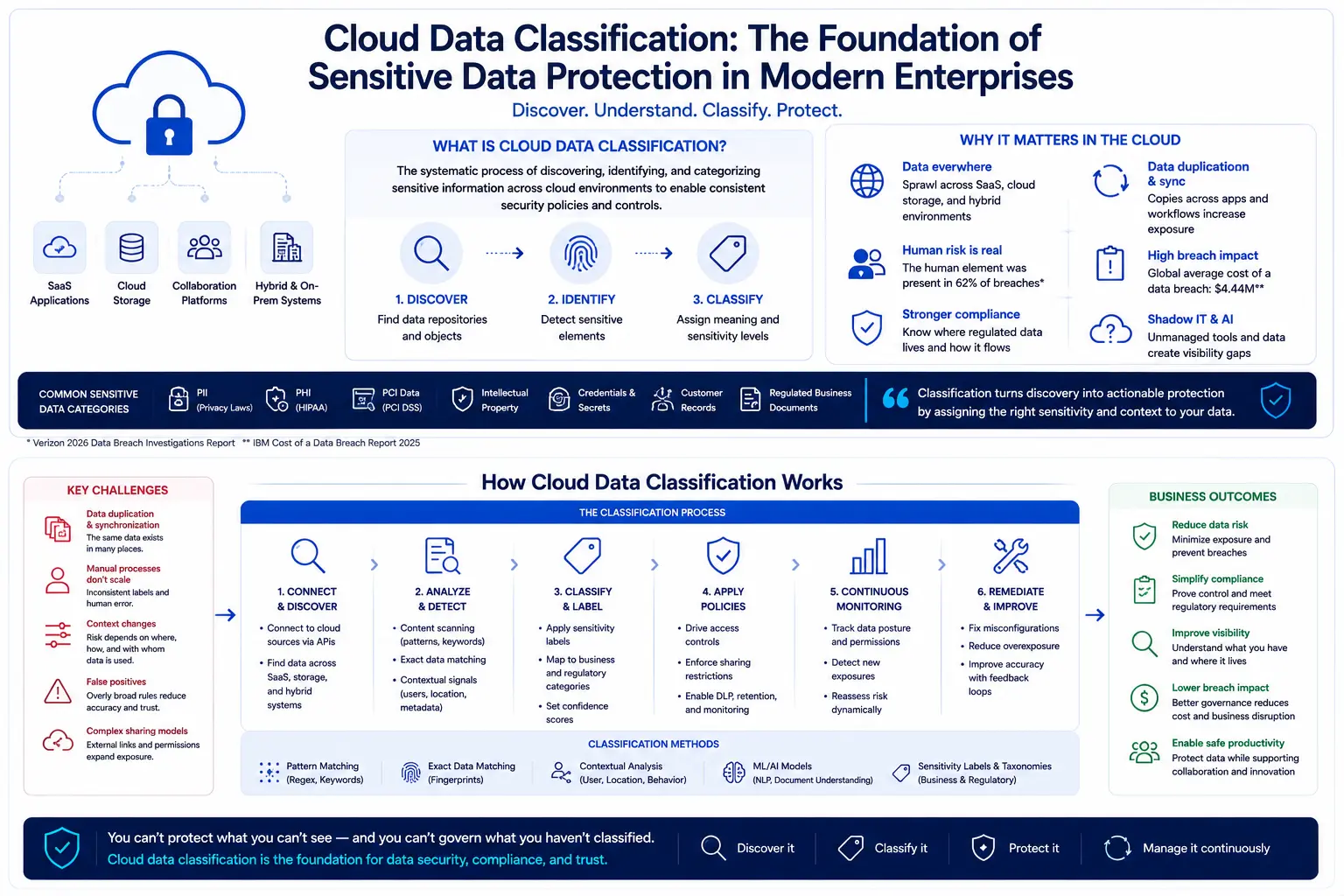
The global average cost of a data breach was USD 4.44 million according to IBM’s Cost of a Data Breach Report 2025, making prevention and early detection more critical than ever.
In cloud environments, data is often copied and synchronized across multiple services and workflows, making manual tracking difficult. Collaboration platforms can increase data duplication and sharing across services. SaaS integrations can move data between systems in ways that complicate visibility and governance.
In browser-based and hybrid work environments, sensitive data may be accessed through unmanaged devices and personal browsers, which adds complexity to protection. For example, data accessed through a web app may be exposed through downloads, local storage, or oversharing in collaboration workflows.
Organizations struggle with compliance audits when they cannot demonstrate where regulated data resides or how it flows between systems. Incident response becomes slower when security teams cannot quickly identify what sensitive information was potentially compromised. Data retention and deletion requirements become impossible to enforce without knowing where personal data exists across cloud environments.
Shadow IT complicates the picture further. Employees adopt cloud services and tools that IT departments do not manage or monitor, which increases the likelihood of shadow data and unknown exposure.
The Biggest Challenges in Cloud Data Classification
Data duplication and synchronization create the most immediate complexity. A single file may exist in multiple SaaS platforms, be copied into shared folders, or be exported into local storage. Each copy may require a different protection decision depending on context and business use.
Manual classification processes break down quickly in cloud environments. Without standardized policies, labeling can become inconsistent across teams and systems. The scale of cloud data growth outpaces human classification capabilities.
Context changes create additional classification challenges. The same document may be low risk in one system but high risk if shared externally, synced to an unmanaged device, or combined with other sensitive records.
False positives undermine classification accuracy and user adoption. Overly broad pattern matching might flag common terms or formats that appear in both sensitive and non-sensitive contexts. High false-positive rates can reduce confidence in classification outcomes and make policy enforcement harder to sustain.
Cloud-specific sharing models add complexity that traditional classification approaches were not designed to handle.
How Cloud Data Classification Works
Effective cloud data classification often combines multiple detection methods to broaden coverage and reduce reliance on manual review.
- Pattern matching is a common method for identifying structured data such as Social Security numbers or payment card numbers. This approach works well for regulated data types with consistent formats but can generate false positives when the same pattern appears in non-sensitive content.
- Exact data matching uses digital fingerprints of known sensitive datasets to identify exact or near-exact matches. This method is often used for known high-value datasets and may require maintenance as reference data changes.
- Contextual classification analyzes multiple signals beyond content patterns. These signals may include location, ownership, permissions, application risk levels, and user behavior.
- Some modern classification systems use machine learning to analyze document structure, language, and content relationships, particularly for unstructured data.
- Sensitivity labels provide policy-driven classification that connects business requirements to technical controls. Sensitivity labels can help organizations apply more consistent policies across supported services and workflows.
- Organizations may also use predefined dictionaries of sensitive terms or concepts to supplement other detection methods.
The most effective cloud data classification systems combine multiple methods through unified policies.
What Happens After You Classify Sensitive Data?
Classification becomes valuable only when organizations connect it to actionable protection controls and ongoing risk management.
Modern data security programs use classification insights to drive policy enforcement, access controls, sharing restrictions, and continuous monitoring across cloud environments. Leading security service edge platforms integrate classification directly into enforcement workflows.
- Data loss prevention systems use sensitivity context to apply more appropriate controls.
- Access control systems use sensitivity classifications to enforce principle of least privilege across cloud applications.
- Classification can support more risk-aware access decisions by adding data sensitivity context to identity-based controls.
- Sharing and collaboration controls automatically restrict external sharing for classified data or require additional approvals before distribution.
- Compliance monitoring and reporting depend on classification to demonstrate regulatory compliance and support audit requirements.
- Data security posture management extends classification into continuous risk assessment and remediation.
- DSPM solutions use classification insights to identify misconfigurations, inappropriate access permissions, and policy violations.
- Incident response processes use classification metadata to prioritize investigation efforts and determine notification requirements.
- Retention and deletion policies apply different rules based on data sensitivity and regulatory requirements.
Best Practices for Cloud Data Classification
Successful cloud data classification programs require a systematic approach that balances accuracy, scalability, and user adoption. Organizations should begin with data inventory and discovery before attempting to classify sensitive information. Without a clear understanding of where data resides, who owns it, how it is used, and where it moves, classification efforts can become inconsistent or incomplete.
Rather than trying to classify all data at once, teams should prioritize classification efforts based on business impact, regulatory exposure, and the sensitivity of the information involved. This helps organizations focus first on the data that creates the greatest risk, such as regulated records, intellectual property, customer information, financial data, and other high-value assets.
Automation is essential for scaling classification across cloud environments, but it should not remove human oversight entirely. Automated discovery and classification tools can reduce manual workload, improve consistency, and identify sensitive data across large volumes of structured and unstructured content. However, security, privacy, governance, and legal teams should still guide policy decisions, review edge cases, and ensure that classification rules reflect business requirements.
Organizations should also align classification taxonomies across governance, privacy, and security stakeholders. If different teams use different labels, definitions, or handling requirements, sensitive data may be treated inconsistently across applications and workflows. A shared taxonomy helps ensure that classification labels are understandable, enforceable, and connected to the right protection policies.
Cloud data classification should be treated as an ongoing process, not a one-time project. Data changes constantly as users create, copy, share, move, and modify files across SaaS applications, cloud storage, endpoints, and collaboration tools. Regular rescans, policy updates, and continuous reassessment help maintain classification accuracy as data context evolves.
Classification policies should also fit naturally into user workflows and existing business processes. If classification creates too much friction, users may avoid it, override it, or apply labels inconsistently. Effective programs connect classification to the way employees already work while applying protection rules in the background wherever possible.
Finally, organizations should design classification policies with enforcement in mind from the beginning. Classification is most valuable when it directly informs access controls, data loss prevention, sharing restrictions, retention policies, incident response, and broader data security workflows. The goal is not simply to label data, but to use classification as the foundation for stronger and more consistent protection.
From Classification to Continuous Protection
Cloud data classification provides the foundation for a comprehensive data security program. By identifying sensitive information and applying meaningful context to it, organizations can make more informed decisions about how data should be accessed, shared, monitored, retained, and protected.
Modern data security platforms extend classification beyond static labeling by combining it with ongoing posture assessment and risk analysis. This helps security teams identify issues that traditional policies may miss, such as excessive permissions, risky sharing settings, unmanaged data movement, or sensitive information exposed in unexpected locations.
In broader cloud security architectures, classification metadata can inform policy decisions as data moves across applications, users, devices, and access channels. When organizations understand the sensitivity of the data involved, they can apply more precise controls instead of relying only on broad allow-or-block decisions.
Artificial intelligence and machine learning may also help improve classification workflows, especially for unstructured data such as documents, presentations, messages, and collaboration content. These technologies can assist with pattern recognition, context analysis, and large-scale review, although their effectiveness depends on implementation quality, training, validation, and policy design.
A unified approach to classification and protection can help organizations apply more consistent controls across cloud applications, web traffic, endpoints, and collaboration workflows. As cloud usage expands and regulatory expectations remain high, classification becomes an important way to improve risk management, operational consistency, and security decision-making.
Cloud data classification is no longer just a compliance exercise. It is the foundation for identifying sensitive information, applying the right controls, and maintaining continuous protection across modern enterprise cloud environments.
Ready to strengthen your data protection strategy? Discover how Skyhigh Security’s comprehensive cloud security platform can help you implement effective data classification and protection across your cloud environment. Contact our team today to learn more about our data-centric security solutions.