


Data Sovereignty in Hybrid Cloud Security
- Cloud data sovereignty covers which laws govern data and who can access it, not just location.
- Security tools create sovereignty exposure because they decrypt traffic, copy evidence, and export logs.
- Ask where inspection occurs, what leaves, where logs reside, and who can access decrypted data.
- Local inspection, residency-aware logging, and customer-controlled keys can support sovereignty requirements; validate each processing and access path.
- The EU Cloud Sovereignty Framework and DORA make sovereignty a measurable procurement and compliance requirement.
Data sovereignty in hybrid cloud security is the discipline of ensuring that sensitive data, including the copies and metadata created by security controls, is processed, stored, and accessed only in ways that the owning organization and its regulators accept. In a hybrid environment, that requires deciding deliberately which security functions run locally and which can run in a provider’s cloud.
This article is part of the Hybrid Cloud Security guide. It is general information, not legal advice. Confirm requirements with your legal and compliance teams.
Data residency vs. data sovereignty vs. data localization
Data residency is where data is stored, data localization is a legal requirement to keep it in-country, and data sovereignty is which laws govern it and who can access it.
| Term | What it means | Example question |
|---|---|---|
| Data residency | Where data is physically stored | Is our customer database in an EU region? |
| Data localization | A legal requirement that certain data stay in a country | Must this category of data remain in-country? |
| Data sovereignty | Which laws govern the data and who can compel or gain access | Can a foreign authority or provider employee access it? |
Residency is necessary but not sufficient. Data stored in-region can still be accessed by provider personnel elsewhere, compelled under foreign law, or copied into logs and support systems in other countries.
Why security tools create sovereignty exposure
Security tools create sovereignty exposure because they handle an organization’s most sensitive data, often in decrypted form, and copy it into logs and evidence.
The main exposure points are:
- Inspection. A secure web gateway decrypts TLS traffic to scan it. For that moment, credentials, personal data, and confidential documents exist in plaintext wherever the gateway runs.
- Evidence copies. DLP engines may store copies or excerpts of content that triggered a policy for investigators to review.
- Logs and telemetry. URLs, file names, user identities, and device details flow to logging and analytics platforms, often in a vendor’s central region.
- Threat analysis. Suspicious files may be sent to cloud sandboxes for detonation.
- Support access. Vendor engineers may be able to view tenant data during troubleshooting.
A cloud-only security architecture can therefore move data across borders even when the organization’s own applications and storage never do.
The four sovereignty questions for any security architecture
Four questions define the sovereignty posture of any security architecture: where inspection occurs, what leaves the environment, where logs reside, and who can access sensitive data.
1. Where does inspection occur?
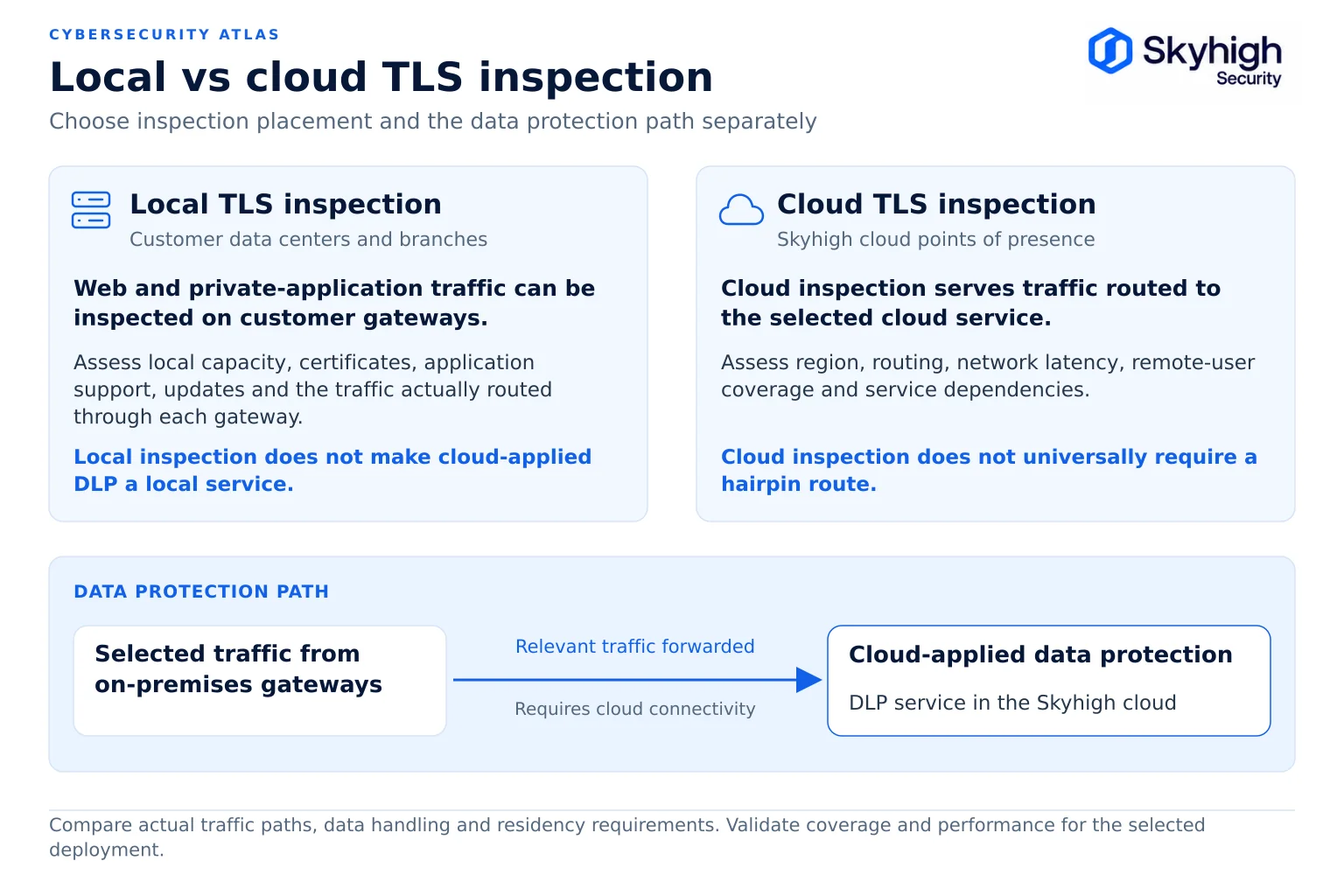
Identify every point where traffic is decrypted: local appliances, cloud points of presence, browser controls, and endpoint agents. Local inspection can keep the locally enforced portion of a regulated flow on the organization’s own infrastructure. Separately assess any forwarding to cloud services and the location of incident evidence. NSA guidance on TLS inspection recommends inspecting once, within the enterprise network, to limit where plaintext exists.
2. What leaves the environment?
List what the security stack sends outside your infrastructure: full payloads, file samples for sandboxing, DLP incident evidence, metadata, or nothing but policy updates. Each can be controlled differently.
3. Where do logs reside?
Logs are data. Access logs tie identities to activity, and DLP logs may contain the sensitive content itself. Decide which logs may leave which jurisdiction, and whether logs can be stored locally and forwarded selectively to a central SIEM.
4. Who can access sensitive data?
Map who can view decrypted content or incident evidence: your administrators, your managed service provider, the security vendor’s support staff, or the cloud provider. Then consider which legal regimes could compel any of them to disclose it. The U.S. CLOUD Act, for example, clarifies that U.S. authorities can require U.S.-based providers to produce data in their possession or control regardless of where it is stored.
Regulatory and procurement drivers
GDPR transfer rules, the EU Cloud Sovereignty Framework, DORA, and sector rules are turning sovereignty from a preference into a requirement.
GDPR transfer rules. Under Chapter V of the GDPR, transfers of personal data outside the European Economic Area require an adequacy decision, appropriate safeguards such as standard contractual clauses, or a specific derogation. Security telemetry that includes personal data is subject to the same rules.
EU Cloud Sovereignty Framework. The European Commission’s Cloud Sovereignty Framework, first presented in October 2025, scores cloud providers on eight objectives: strategic, legal and jurisdictional, data and AI, operational, supply chain, technological, security and compliance, and environmental sustainability. Providers receive a Sovereignty Effectiveness Assurance Level (SEAL) from 0 to 4. In April 2026, the Commission awarded a sovereign cloud contract worth up to €180 million to four providers, requiring at least SEAL-2, the data sovereignty level. The framework is written for EU institutions, but it gives every buyer a practical vocabulary for sovereignty requirements.
DORA for financial entities. The Digital Operational Resilience Act has applied since January 17, 2025. It requires in-scope financial entities to manage ICT third-party risk, maintain a register of ICT service arrangements, and plan for exit and concentration risk. Security services that process a bank’s traffic are ICT services under that regime.
Sector and national rules. Healthcare, defense, public sector, and critical infrastructure organizations often face additional localization or accreditation requirements.
Hybrid cloud architecture for banking
Banks typically keep decryption and logs on their own infrastructure while using region-restricted cloud services for remote staff and SaaS.
Banks illustrate the sovereignty problem clearly. They need cloud SaaS and remote work, but they also hold customer financial data under strict supervisory expectations. A typical hybrid pattern:
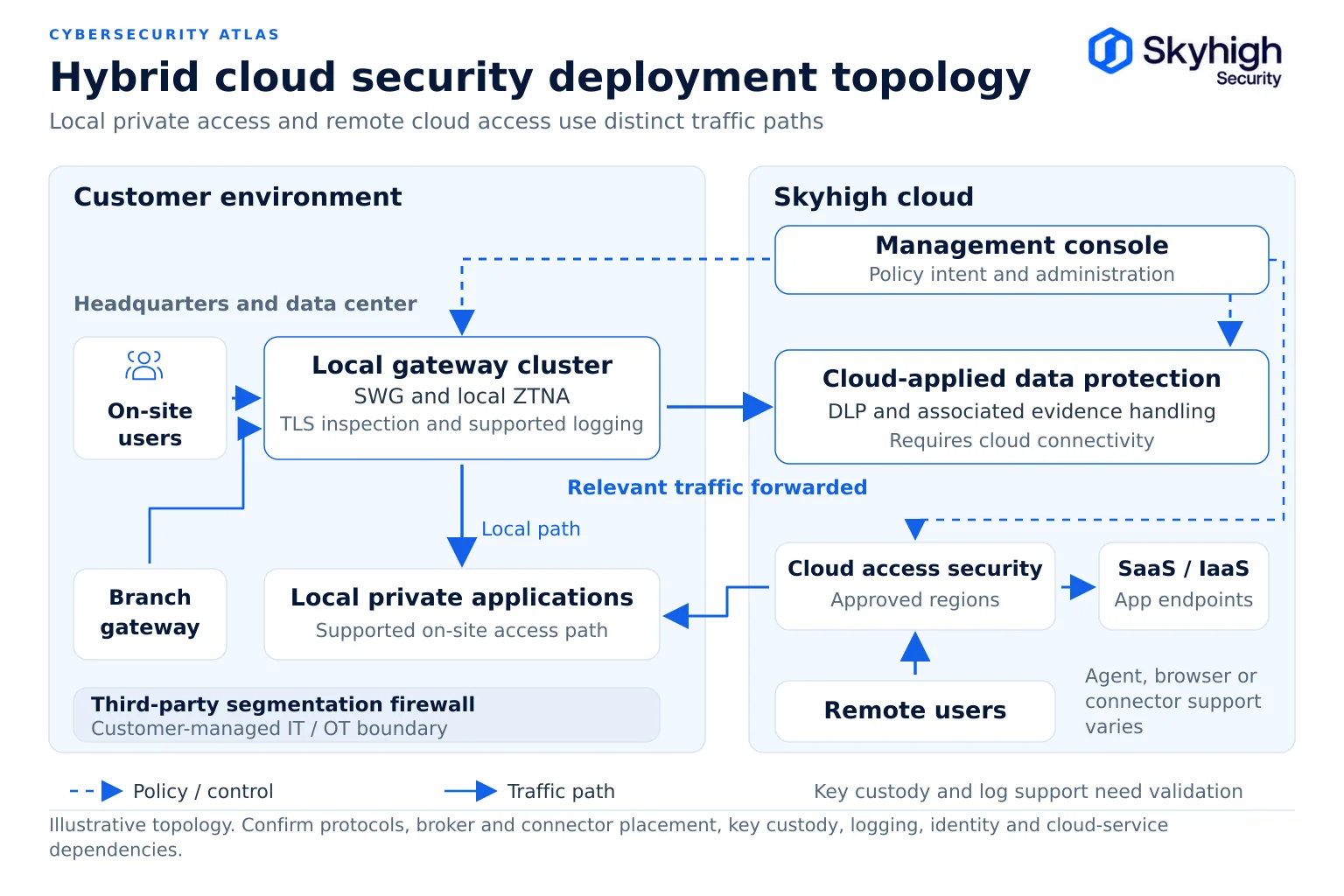
- Keep regulated branch and headquarters flows on bank-controlled enforcement when local processing is required, and separately assess any cloud-applied services and evidence storage.
- Use cloud points of presence restricted to approved regions for remote staff.
- Store inspection logs and DLP evidence in-country, forwarding only what the SOC needs.
- Use customer-controlled keys and hardware security modules for the inspection certificate authority.
- Maintain one policy set so local and cloud enforcement stay consistent for auditors.
- Document the security vendor in the DORA register of information, including exit planning.
The same pattern applies to insurers, payment institutions, and investment firms.
Architecture patterns that support sovereignty
Seven architecture patterns address most sovereignty requirements without giving up cloud services.
| Pattern | What it addresses |
|---|---|
| Local security inspection | Decrypted web payloads stay on your infrastructure; traffic forwarded for cloud-applied services does not |
| Regional or in-country points of presence | Cloud inspection limited to approved jurisdictions |
| Residency-aware logging | Logs stored locally; selective forwarding |
| Customer-managed keys and HSM integration | Control over inspection certificates and encryption |
| Dedicated egress IPs | Traffic leaves from organization-owned addresses, supporting jurisdiction and IP reputation requirements |
| On-premises sandboxing | Suspicious files analyzed without leaving the environment |
| Single policy engine | Consistent treatment of data regardless of enforcement point |
Sovereignty checklist for security vendors
Use this checklist to test any security vendor’s sovereignty claims before shortlisting.
- Can all inspection for a given traffic class run on our infrastructure?
- Which data elements leave our environment by default, and can each be disabled?
- In which countries are logs, evidence, and telemetry stored?
- Which vendor personnel can access tenant data, from where, and under what approval?
- Which jurisdictions’ laws apply to the vendor and its subprocessors?
- Can we use our own HSM or key management?
- What continues to work if the vendor’s cloud is unreachable?
- Which certifications apply (for example FedRAMP, IRAP, BSI C5, SOC 2 Type II, CSA STAR)?
How Skyhigh supports data sovereignty
Skyhigh supports data sovereignty by keeping web inspection and inspection keys on customer infrastructure where required. Data protection incident evidence is held in the Skyhigh cloud, which is a separate question to answer against your sovereignty requirements.
Skyhigh Hybrid SSE Mesh keeps the data plane physically on premises where compliance requires it. SSL/TLS decryption and web inspection run locally on the Secure Service Gateway, so web payloads are decrypted inside your own infrastructure. Services applied through the Skyhigh cloud, including data protection, remote browser isolation, AI security controls, CASB, and data security posture management, receive the relevant traffic from the gateway, so scope those flows against your residency and sovereignty requirements. Local ZTNA runs on the organization’s own gateways. Confirm inspection-key protection, any HSM integration, and on-premises sandboxing support for the selected products and versions. Dedicated egress IP and source IP anchoring help control egress for cloud-inspected traffic, but do not alone establish where content is processed (Skyhigh Security). The platform’s cloud registry also rates cloud services on data residency, legal terms, and other attributes, so policy can steer users toward compliant services.
Sources
- European Union. Regulation (EU) 2016/679 (General Data Protection Regulation), Chapter V. https://eur-lex.europa.eu/eli/reg/2016/679/oj
- European Union. Regulation (EU) 2022/2554 (Digital Operational Resilience Act). https://eur-lex.europa.eu/eli/reg/2022/2554/oj
- European Commission. “Sovereign Cloud Framework explained” (June 1, 2026). https://commission.europa.eu/news-and-media/news/sovereign-cloud-framework-explained-2026-06-01_en
- European Commission. “Commission advances cloud sovereignty through strategic procurement” (April 17, 2026). https://commission.europa.eu/news-and-media/news/commission-advances-cloud-sovereignty-through-strategic-procurement-2026-04-17_en
- U.S. Department of Justice. CLOUD Act Resources. https://www.justice.gov/criminal/cloud-act-resources
- NSA. Managing Risk from Transport Layer Security Inspection (November 2019). https://media.defense.gov/2019/Nov/18/2002212783/-1/-1/0/MANAGING%20RISK%20FROM%20TLS%20INSPECTION_20191106.PDF
- Skyhigh Security. “Modernizing Your Symantec Edge Secure Web Gateway With Skyhigh Hybrid SSE Mesh” (July 15, 2026). https://www.skyhighsecurity.com/industry-perspectives/modernizing-your-symantec-edge-secure-web-gateway-with-skyhigh-hybrid-sse-mesh.html
- Skyhigh Security. “Adopting Hybrid Just Got Easier With Skyhigh SSE Platform” (October 3, 2024). https://www.skyhighsecurity.com/cloud-security/adopting-hybrid-just-got-easier-with-skyhigh-sse-platform.html