




How Remote Browser Isolation Supports Zero Trust Architecture
- Verify explicitly: RBI treats every web session as untrusted by default, rendering content in an isolated cloud container before.
- Least privilege for web content: Users interact with a visual stream of the page, never with raw HTML, JavaScript, or executable.
- Assume breach: Even if a site is fully compromised, the attack surface is the ephemeral container—not the endpoint, not the.
- CISA ZTMM alignment: RBI supports multiple CISA pillars—Devices (protecting unmanaged endpoints), Applications and Workloads.
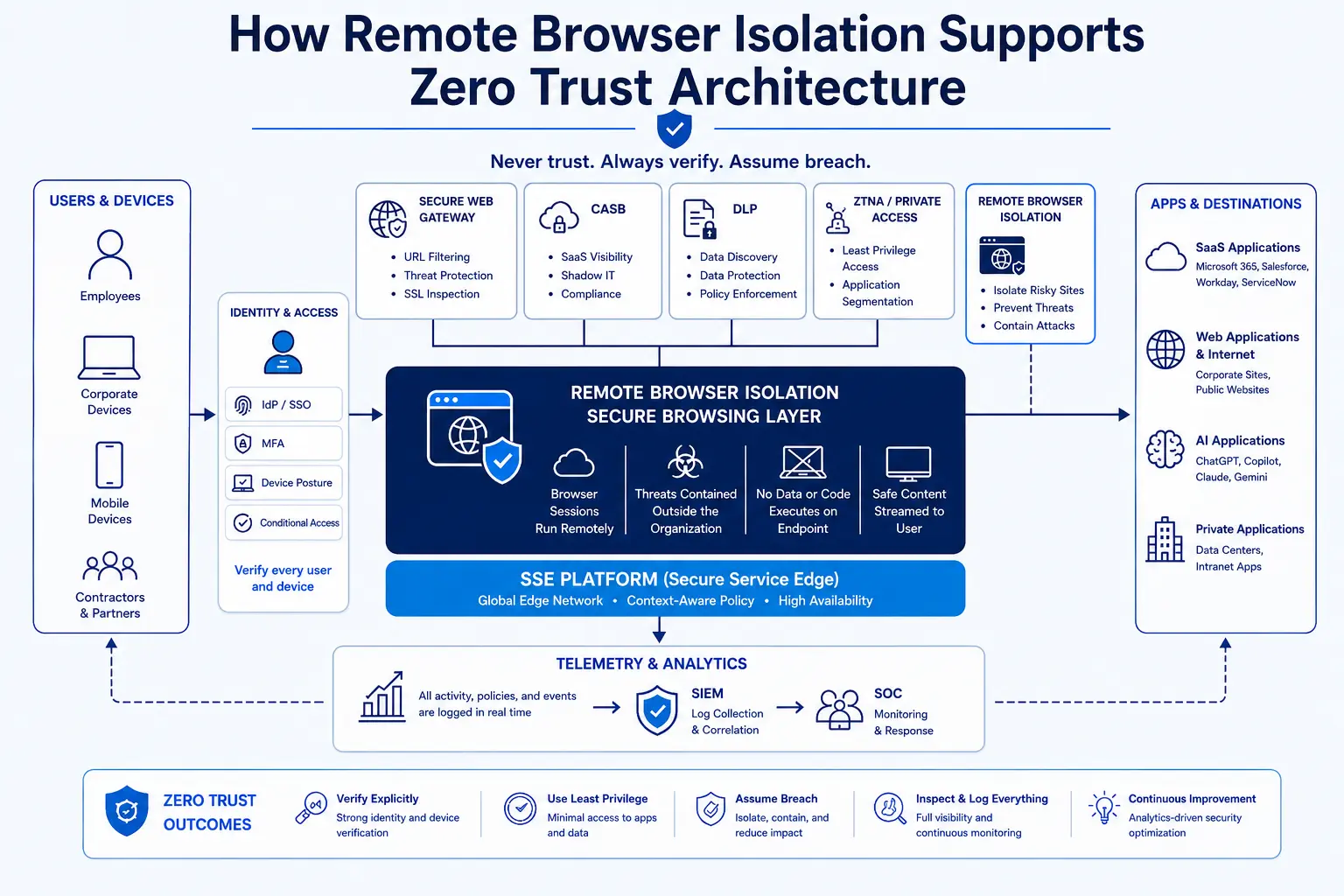
- SSE integration is essential: RBI delivers the strongest zero trust value when integrated with SWG, CASB, ZTNA, and DLP in a.
- Adoption gap remains real: Most enterprises are still early in their zero trust maturity journey, and browser layer controls are.
Remote browser isolation (RBI) is one of the most direct technical expressions of zero trust's core mandate: never grant implicit trust to any content, any session, or any device. For security architects mapping controls to NIST SP 800 207 principles and the CISA Zero Trust Maturity Model, RBI closes a gap that SWG URL filtering and endpoint detection alone cannot—browser borne threats that execute before a verdict is reached. This article explains exactly how RBI maps to zero trust's verify explicitly, least privilege, and assume breach tenets, and where it fits alongside ZTNA, SWG, CASB, and DLP within a modern SSE stack.
What Is Remote Browser Isolation?
Remote browser isolation is a security technology that executes web browsing sessions in a cloud hosted container, physically separating all web code from the user's endpoint. The local device never processes active web code directly; instead it receives only a pixel stream or a sanitized, reconstructed DOM.
Picture a procurement analyst at a mid size manufacturer receiving a link from a new supplier. The domain was registered last week, has no URL reputation, and sits in the "uncategorized" gray zone where a legacy SWG would either block it (frustrating the analyst) or allow it (trusting the unknown). With RBI, the page loads inside a disposable cloud container. The analyst sees a fully interactive page—fills out a form, downloads a PDF—but no JavaScript, no ActiveX, no embedded exploit ever touches her laptop. If the page harbored a zero day exploit, it detonates harmlessly inside a container that is wiped the moment she closes the tab.
This model matters more than ever. Google Threat Intelligence Group (GTIG) tracked 75 zero day vulnerabilities exploited in the wild in 2024, and 44% of those exploits targeted enterprise technologies (GTIG, April 2025). Browser based attack chains remain a persistent vector, and RBI provides defense in depth regardless of whether the threat is known.
Why RBI Matters for Zero Trust
Zero trust is not a product you buy—it is a set of design principles. NIST SP 800 207 (2020) states that zero trust assumes there is no implicit trust granted to assets or user accounts based solely on their physical or network location or based on asset ownership. The browser, however, has traditionally operated on implicit trust: if a URL passes the SWG allow list or a domain has a valid certificate, the endpoint loads and executes all code the server delivers. That is a perimeter trust model applied to a session level interaction.
The maturity gap is still clear. In Gartner’s 2024 zero-trust adoption survey, 63% of organizations said they had fully or partially implemented a zero-trust strategy, but Gartner noted that for most organizations, zero trust still covers half or less of the environment and mitigates one-quarter or less of overall enterprise risk. One of the most important remaining gaps is the browser session: Gartner says browsers are the primary access method for most modern corporate applications, yet less than 10% of organizations have adopted a secure enterprise browser today, even as Gartner predicts adoption will rise to 25% by 2028. The browser is where employees interact with SaaS applications, AI tools, and external sites every day, but many organizations still treat it with a simple allow/block model instead of applying granular visibility, policy, and data protection controls.
Consider a financial services compliance officer who accesses a regulatory portal hosted by a third party vendor. The SWG categorizes the domain as "government" and allows it. But the vendor's portal runs a vulnerable plugin, and an attacker has injected a malicious iframe. Without RBI, the officer's endpoint is now the attack surface. With RBI, the iframe loads inside an isolated container, the malicious payload never reaches the endpoint, and the officer finishes her task unaware that the threat existed.
How RBI Maps to the Three Zero Trust Principles
Verify explicitly
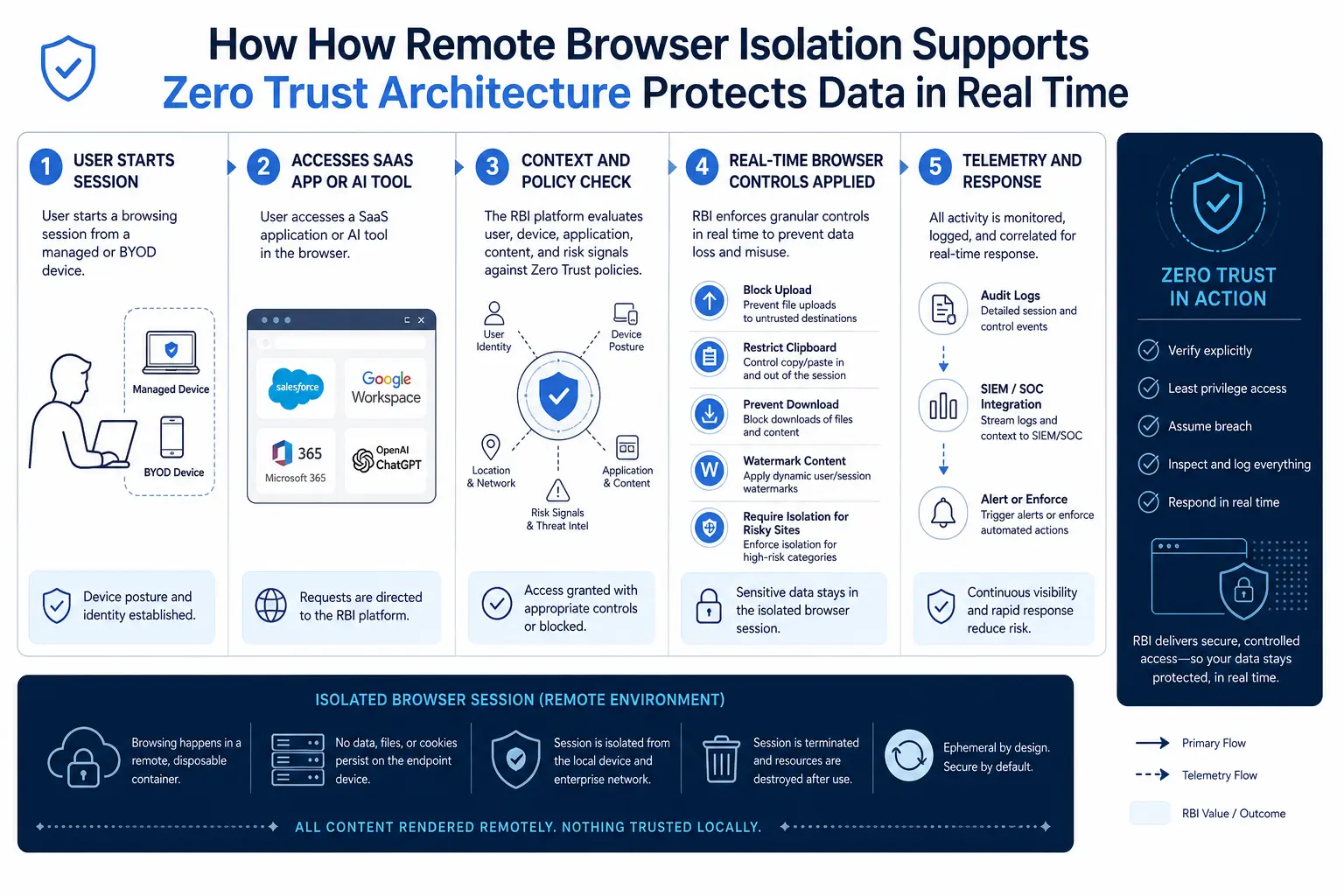
NIST SP 800 207 requires that no asset is inherently trusted—the enterprise must evaluate the security posture of the asset when evaluating every resource request. RBI operationalizes this tenet at the web session layer. Instead of making a binary trust decision based on URL reputation, RBI renders every qualifying session in isolation and evaluates the content by its behavior within the container. This shifts verification from a one time gate (URL check) to a continuous containment model where even "trusted" domains are not given raw code execution privileges on endpoints.
When a healthcare claims processor opens a partner portal and navigates to a page that triggers a drive by download, traditional verify explicitly controls—MFA, device compliance, URL reputation—have already passed. The user is authenticated, the device is managed, and the URL is categorized as safe. RBI adds an additional verification layer: even after all prior checks pass, the web content itself is not trusted to execute on the endpoint.
Least privilege
NIST SP 800 207 specifies that least privilege principles are applied to restrict both visibility and accessibility. RBI applies least privilege to web content delivery. Users receive only what they need to do their job: a rendered visual representation of the page. They do not receive raw JavaScript, CSS, or executable objects. DLP controls integrated with RBI can further restrict clipboard operations, printing, file uploads, and downloads based on the sensitivity of the session.
A concrete example: a managed services provider grants contractors access to the company's ticketing system via ZTNA. The contractors authenticate, pass device compliance checks, and reach the application. But the security architect also enforces an RBI policy: contractor sessions render in isolation with copy/paste disabled and downloads restricted to flattened PDFs. The contractors can read and update tickets, but they cannot extract raw data. That is least privilege applied not just to network access but to what users can do inside the session.
Assume breach
NIST SP 800 207 assumes that the network is always hostile and that external and internal threats exist at all times. RBI embodies this principle by design: it assumes every web page could be compromised and builds an air gap between web content and the endpoint. As the Cloud Security Alliance notes, RBI executes high risk web sessions in isolated, ephemeral cloud containers where the user's local endpoint never interacts with active web code directly (CSA, January 2026).
If a sales representative visits a compromised SaaS vendor's marketing page that delivers a fileless malware payload via a weaponized JavaScript library, the payload executes inside the container and is destroyed when the session ends. There is no persistence mechanism, no lateral movement opportunity, and no endpoint artifact. The assume breach posture is maintained even though the threat bypassed every other control in the stack.
How RBI Fits into the CISA Zero Trust Maturity Model
The CISA Zero Trust Maturity Model v2.0 (2023) organizes zero trust across five pillars—Identity, Devices, Networks, Applications and Workloads, and Data—with three cross cutting capabilities: Visibility and Analytics, Automation and Orchestration, and Governance. RBI contributes to multiple pillars simultaneously:
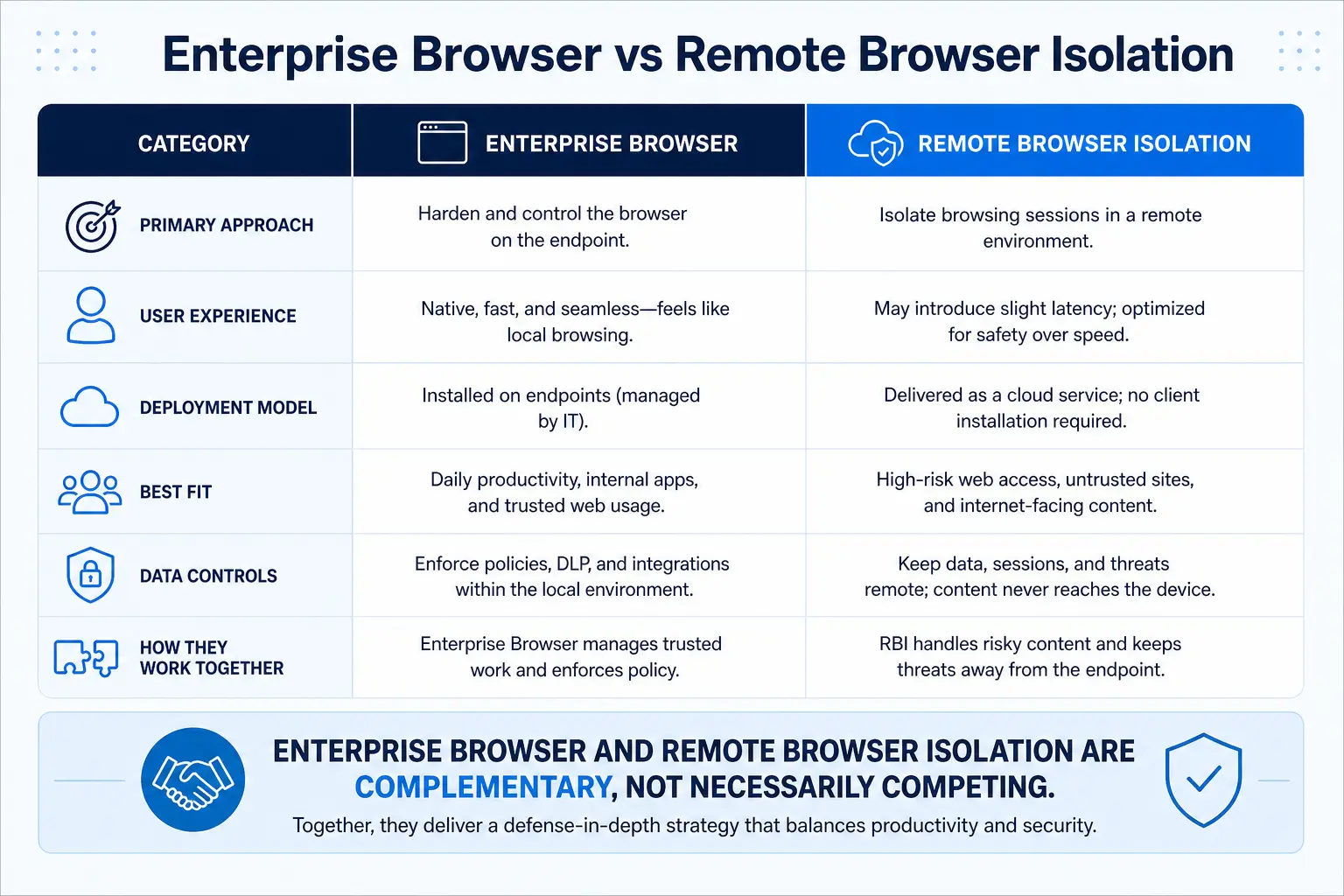
CISA ZTMM Pillar: RBI Contribution and Maturity Progression
NIST SP 800 207 defines the architectural triad of policy engine (PE), policy administrator (PA), and policy enforcement point (PEP). Within this model, RBI acts as a PEP at the browser session layer. The PE evaluates the request context—user identity, device posture, URL risk, data sensitivity—and the PA instructs the RBI service to isolate the session and apply the appropriate data controls. This aligns with CISA's per request verification posture requirements as described by the Cloud Security Alliance (CSA, January 2026).
RBI Within the SSE Stack: Integration with ZTNA, SWG, CASB, and DLP
RBI in isolation is useful but limited. Its full zero trust value emerges when it operates as an integrated component within a Security Service Edge (SSE) platform that includes SWG, CASB, ZTNA, and DLP.
Consider the workflow when an employee on a managed device accesses a generative AI tool through a browser. The SWG inspects the request, classifies the destination, and determines the URL risk. The CASB identifies the AI application and checks whether it is sanctioned. The DLP engine scans the prompt text for sensitive data. And the RBI session—triggered by SWG policy because the AI tool is categorized as "monitor"—ensures the employee can use the tool but cannot paste customer PII, download responses containing sensitive content, or upload files with regulated data. All of this happens within a single policy engine, not across four discrete products with separate consoles.
This integration pattern is why Gartner estimates the SASE market will grow at a 26% CAGR, reaching $28.5 billion by 2028 (Gartner, February 2025). Enterprises are converging access, threat protection, and data security into unified platforms because the alternative—stitching together standalone RBI, SWG, CASB, and DLP products—creates policy gaps, inconsistent enforcement, and operational overhead that undermines the zero trust model.
Skyhigh Private Access integrates ZTNA with DLP scanning and seamless RBI so that private application sessions are isolated when policy requires it, without routing traffic through a separate product.
Where the browser becomes the workspace
The browser is the primary workspace for SaaS access, AI tool usage, file downloads, credential entry, and third party collaboration. A security architect who deploys ZTNA to protect private applications but ignores the browser session where employees interact with those applications has an enforcement gap. RBI fills that gap—not by replacing the browser users already know (Chrome, Edge, Firefox, Safari), but by wrapping the session in a cloud based isolation layer that SSE policy controls.
An unmanaged contractor opens a company's CRM application through a reverse proxy CASB. The CASB authenticates the contractor, applies session controls, and triggers an RBI policy because the device is unmanaged. The contractor sees and uses the CRM normally, but under the hood the session runs in isolation with clipboard restrictions and download blocking. The company secures the data without forcing the contractor to install an agent, enroll a device, or use a proprietary browser.
Evaluation Criteria: What to Look For in Zero Trust RBI
Not every RBI implementation delivers equal zero trust value. Security architects evaluating browser isolation should assess these criteria:
1. SSE native integration. RBI must be part of the same policy engine as SWG, CASB, ZTNA, and DLP. If RBI requires a separate console, separate policies, or separate traffic steering, it creates operational gaps and policy inconsistencies.
2. Granular data controls within isolation sessions. Zero trust demands least privilege enforcement at the session level. RBI should support disabling clipboard, print, upload, download, and screen capture independently per policy, per user group, and per application category.
3. Unmanaged device support. A solution that requires an endpoint agent to enable isolation contradicts one of RBI's primary use cases: protecting access from devices the enterprise does not control.
4. Performance and user experience. If RBI introduces perceptible latency, users will circumvent it—opening links on personal devices, using mobile hotspots, or simply complaining until IT creates exceptions. The isolation layer must render pages at near native speed.
5. Rendering fidelity. Modern SaaS applications are complex JavaScript heavy single page applications. RBI must handle them without breaking functionality, missing interactive elements, or degrading the experience.
6. Scalable policy based activation. Zero trust does not require isolating every session. The best implementations let security teams define risk based triggers: isolate uncategorized URLs, isolate all sessions for high risk users, isolate specific SaaS categories, or isolate all traffic from unmanaged devices.
7. Visibility and analytics. RBI should feed session telemetry into the broader SSE analytics layer, contributing to the CISA ZTMM's Visibility and Analytics cross cutting capability. That means knowing who accessed what, when, from where, using what device—and whether that behavior deviates from baseline.
The Cost of the Browsing Blind Spot
Leaving browser sessions outside zero trust controls has a measurable cost. According to the IBM Cost of a Data Breach Report 2024 (July 2024), the global average cost of a data breach reached USD 4.88 million in 2024. Compromised credentials were the most common attack vector, representing 16% of all breaches.
Browser based phishing is one of the primary delivery mechanisms for credential theft. A payroll administrator receives a link to what appears to be a benefits portal login page. The domain is freshly registered, passes DMARC checks, and looks legitimate. Without RBI, the administrator enters credentials on the attacker's page, and the credential theft is complete. With RBI enforcing an isolation policy on uncategorized domains, the phishing page loads in a container, DLP detects the credential submission pattern, and the session is terminated before the credentials leave the isolated environment.
The financial justification for RBI is not theoretical. Organizations that close browser layer enforcement gaps reduce their exposure to the most expensive breach vectors—credential theft, web based malware delivery, and data exfiltration through unmonitored browser actions.
Common Mistakes When Deploying RBI in a Zero Trust Model
Deploying RBI as a standalone product. Without SSE integration, RBI becomes another point solution with its own policy silo. A healthcare system that deploys RBI separately from its SWG ends up with two different URL categorization engines, two policy consoles, and inevitable drift. Policies conflict, exceptions proliferate, and the zero trust model degrades.
Isolating everything, always. Blanket isolation wastes compute resources and degrades performance for low risk sessions. A risk based approach—isolating uncategorized domains, high risk user groups, and sensitive application categories—delivers better security outcomes with lower friction.
Ignoring unmanaged devices. Some implementations require agents to steer traffic to the isolation service, excluding the exact use case (contractors, BYOD, M&A transitions) where RBI provides the most value. A retailer onboarding seasonal warehouse managers on personal tablets needs agentless isolation, not agent dependent redirection.
Neglecting DLP within isolation sessions. RBI without data controls stops malware but not data exfiltration. An employee who cannot paste customer records into a personal email through a normal browser can still do so through an isolated session unless clipboard controls are enforced.
Treating RBI as a VDI replacement. RBI isolates browser sessions, not full desktops. It complements VDI for specific use cases (web access for third parties) but does not replace it for users who need native desktop applications.