


الذكاء الاصطناعي الخفي وأمن المتصفح: حماية البيانات عند استخدام الموظفين لأدوات الذكاء الاصطناعي
- Shadow AI is already causing breaches. One in five organizations reported a breach due to shadow AI in 2025, and only 37% have.
- The browser is the primary control point. Employees access ChatGPT, Gemini, Claude, and Copilot through web browsers—making SWG,.
- Blocking AI tools entirely backfires. Blanket bans drive usage underground.
- Frameworks demand action now. NIST AI 600 1 identifies data privacy leakage as a distinct GenAI risk, while OWASP's LLM02:2025.
- The cost is measurable. Shadow AI added an average of $670,000 in additional breach costs (IBM, 2025).
- Governance without technical enforcement fails. 97% of organizations that reported an AI related breach lacked proper AI access.
- The risk trajectory is steep. Gartner predicts that by 2030, more than 40% of enterprises will suffer security or compliance.
Your marketing team just discovered that 40% of employees are pasting customer data into unapproved AI tools during regular work hours—through the same browser they use for sanctioned SaaS apps. No malware was involved. No perimeter was breached. An analyst copied a Salesforce customer list, pasted it into a public chatbot to generate segmentation ideas, downloaded the output, and synced the file to personal cloud storage. The browser was the workspace, the entry point, and the exfiltration channel—all at once.
Shadow AI—the unauthorized use of AI tools without IT visibility or governance—has become one of the most urgent data security problems a CISO can face, and the browser is where it happens.
The Shadow AI Scenario Every CISO Should Fear
Here is what a typical shadow AI incident looks like—and why it is so hard to catch with legacy controls.
A product manager at a mid size fintech firm copies customer complaint data from the company's CRM, opens a new browser tab, and pastes it into a free tier AI chatbot to draft a trend analysis for the quarterly review. The chatbot's terms of service allow the provider to use inputs for model training. The data includes names, account numbers, and transaction details. The product manager downloads the AI generated summary, emails it to three colleagues, and saves a copy to a personal Google Drive folder.
No firewall tripped. No endpoint agent flagged the paste. The DLP policy watching email attachments does not inspect browser based clipboard actions. The CASB sees the Google Drive sync but has no visibility into what was pasted into the chatbot tab ten minutes earlier.
This is not hypothetical. Menlo Security's 2025 report found 155,005 copy and 313,120 paste attempts to GenAI tools were logged in a single month, demonstrating how employees routinely shuttle sensitive data into AI tools via the browser clipboard. A Gartner survey of 302 cybersecurity leaders in March–May 2025 revealed that 69% of organizations suspect or have evidence that employees are using prohibited public GenAI tools.
The browser is where the data leaves, which makes the browser the place you must enforce control.
Why Older Security Approaches Fail Against Shadow AI
Traditional security architectures were built to protect data at rest in databases, data in transit between servers, and data accessed through managed endpoints. Shadow AI breaks every one of those assumptions.
Perimeter based web filtering sees domains, not data. A legacy secure web gateway can block chat.openai.com by URL category, but employees simply switch to one of the over 6,500 GenAI domains and 3,000 apps observed across enterprise environments (Menlo Security, 2025). Blocking one domain is whack a mole. Blocking all of them cripples productivity and pushes users to personal devices.
Endpoint DLP watches files, not clipboard actions. When a sales engineer copies a pipeline spreadsheet from a sanctioned CRM and pastes the contents into a browser based AI tool, endpoint DLP that monitors file saves, USB writes, and email attachments sees nothing—because no file was created. The data exited through a browser text field, a vector most legacy DLP agents do not inspect.
CASB without inline proxy coverage has blind spots. API based CASB can audit activity in sanctioned SaaS apps like Salesforce or Microsoft 365, but it has no visibility into a free tier chatbot that the employee accesses through a browser tab. Without forward proxy or inline inspection, the shadow AI session is invisible.
Training only approaches produce compliance theater. Organizations that depend solely on awareness training, warning emails, or written policies consistently fail to prevent data leaks—because there is no technical enforcement to back up the policy. IBM's 2025 breach data confirms the gap: 97% of organizations that reported an AI related breach lacked proper AI access controls.
The common thread: every failed approach lacks inline, browser level visibility into what data employees are sending to AI tools in real time.
What Changed: The Browser Became the Enterprise Workspace
Three shifts converged to make the browser the new frontline for data protection.
Shift 1: AI tools are browser native. ChatGPT, Claude, Gemini, and dozens of vertical AI tools run entirely in the browser. Unlike traditional SaaS apps that require SSO integration and provisioning, most AI chatbots require nothing more than a free email signup—or no account at all. An HR analyst can paste employee performance reviews into a chatbot and receive a summary in seconds, all within a standard Chrome session on a managed laptop.
Shift 2: Data movement is copy paste, not file transfer. According to IBM's Shadow AI Survey (February 2026), 80% of American office workers use AI in their roles, yet only 22% rely exclusively on employer provided tools. The rest are using personal accounts, free tier services, and browser extensions. The data moves through clipboard operations—copy, paste, drag and drop—that bypass file centric DLP entirely.
Shift 3: Unmanaged devices and contractor access amplify the risk. A contractor accessing Salesforce via reverse proxy from a personal laptop can copy customer records, open a new tab to a public AI tool, and paste the data—all in one browser session. There is no endpoint agent to inspect, no MDM profile to enforce, and no network level control if they are on a home Wi Fi connection. The browser session itself is the only enforcement point that applies regardless of device posture.
What the Frameworks Say: NIST and OWASP on GenAI Data Risk
Both anchor frameworks for this topic—NIST AI 600 1 and the OWASP Top 10 for LLMs—identify data exposure through GenAI interactions as a critical risk that demands technical, not just procedural, controls.
Released July 26, 2024, the NIST AI 600 1 Generative AI Profile identifies 12 risks unique to or exacerbated by generative AI and provides over 200 suggested actions for risk management. Among these, data privacy is listed as a distinct risk: the use and training of GenAI systems may lead to leakage, unauthorized use, or de anonymization of personal data. The profile's Govern function—considered foundational—requires organizations to establish clear policies and guidelines for GAI development and deployment, ensuring ethical and responsible use. For security teams, this means the policy must be accompanied by technical controls that enforce it, particularly at the point where employees interact with GenAI: the browser.
On the application security side, the OWASP Top 10 for LLMs (2025) classifies Sensitive Information Disclosure (LLM02:2025) as a critical risk, noting that sensitive information includes personal identifiable information (PII), financial details, health records, confidential business data, security credentials, and legal documents. This risk is bidirectional: data flows into the LLM when employees paste content, and data can flow out if the model has memorized training data or if a RAG system retrieves unauthorized records. LLMs, especially when embedded in applications, risk exposing sensitive data, proprietary algorithms, or confidential details through their output, resulting in unauthorized data access, privacy violations, and intellectual property breaches.
Together, NIST and OWASP make the case that organizations cannot treat GenAI data exposure as a policy only problem. The browser, where employees interact with these tools, is the place where technical controls must operate to satisfy both frameworks.
What Security Teams Should Do Now: Browser-Level Controls for Shadow AI
Addressing shadow AI requires layered controls enforced at the browser level, where data actually leaves the organization. Here is a phased approach grounded in what works.
Phase 1: Discover and Classify AI Usage (Weeks 1–2)
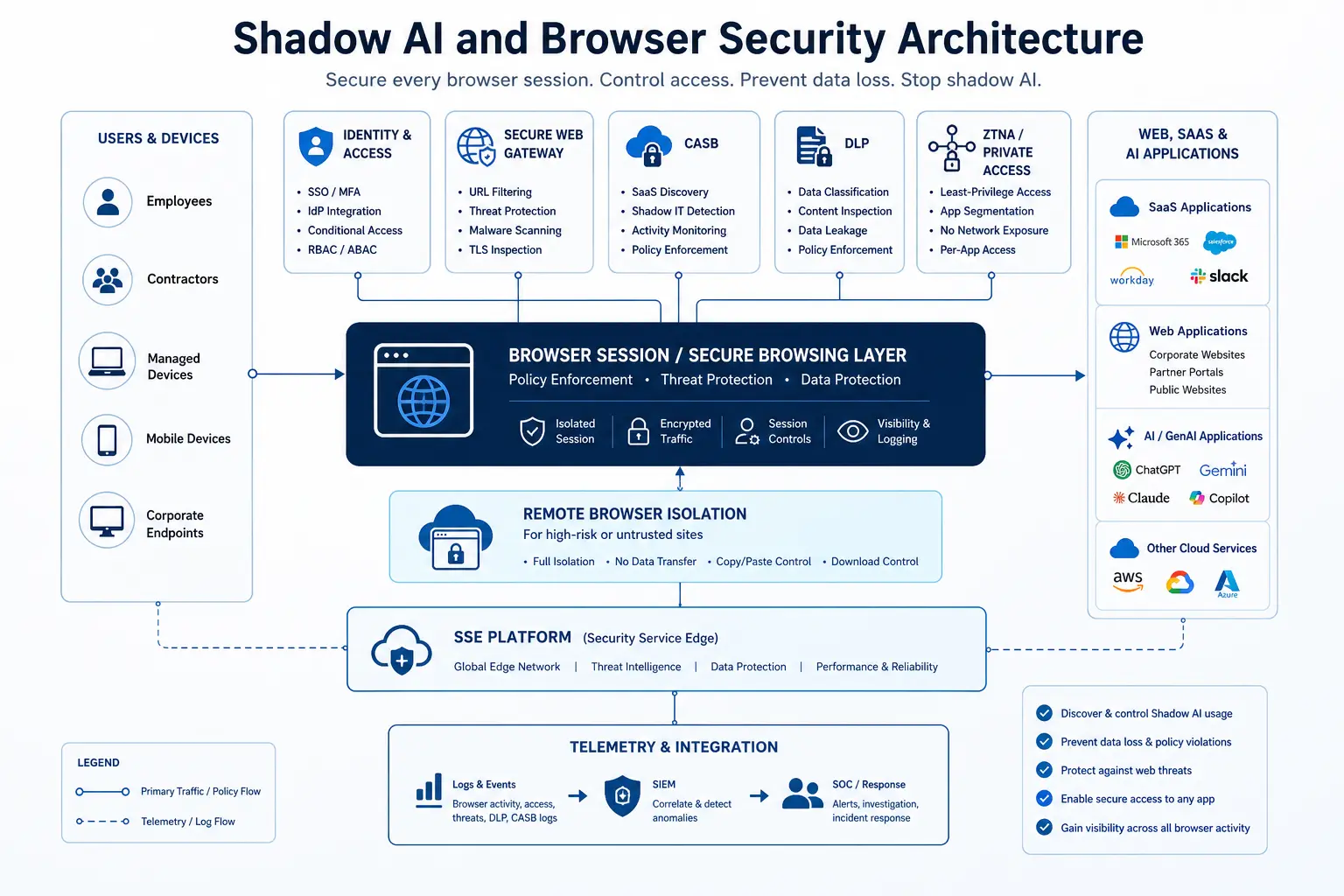
Before enforcing policy, you need visibility. Deploy a secure web gateway with AI aware URL categorization to identify every GenAI domain employees are accessing. Correlate SWG logs with CASB shadow IT discovery to build an inventory: which AI tools are in use, who is using them, how often, and from which device types.
A practical scenario: a security team at a healthcare payer discovers that 12 unapproved AI tools are receiving clipboard data from clinical coordinators summarizing patient case notes for faster triage documentation. Without SWG level discovery, this activity was invisible because the tools are browser based and require no software installation.
Phase 2: Enforce Inline DLP at the Browser (Weeks 3–4)
Once you know which AI tools are in use, apply data loss prevention policies that inspect content at the point of interaction—before data reaches the AI service. Inline DLP deployed through a cloud SWG or SSE platform can inspect paste operations, form field submissions, and file uploads to GenAI URLs. Policy actions should be graduated:
Block uploads of regulated data (PII, PHI, PCI) to any AI tool.
Coach users attempting to paste source code or internal documents with a real time popup explaining the risk and offering an approved alternative.
Allow general queries that contain no sensitive content.
Example: an engineer at a logistics company pastes a shipping manifest with customer addresses into an AI summarization tool. Inline DLP detects the PII pattern, blocks the paste, and displays a notification: "This content contains customer addresses. Use the approved enterprise AI workspace instead." The engineer is redirected, not punished—and the data never leaves the organization.
Phase 3: Isolate High-Risk AI Sessions (Weeks 4–6)
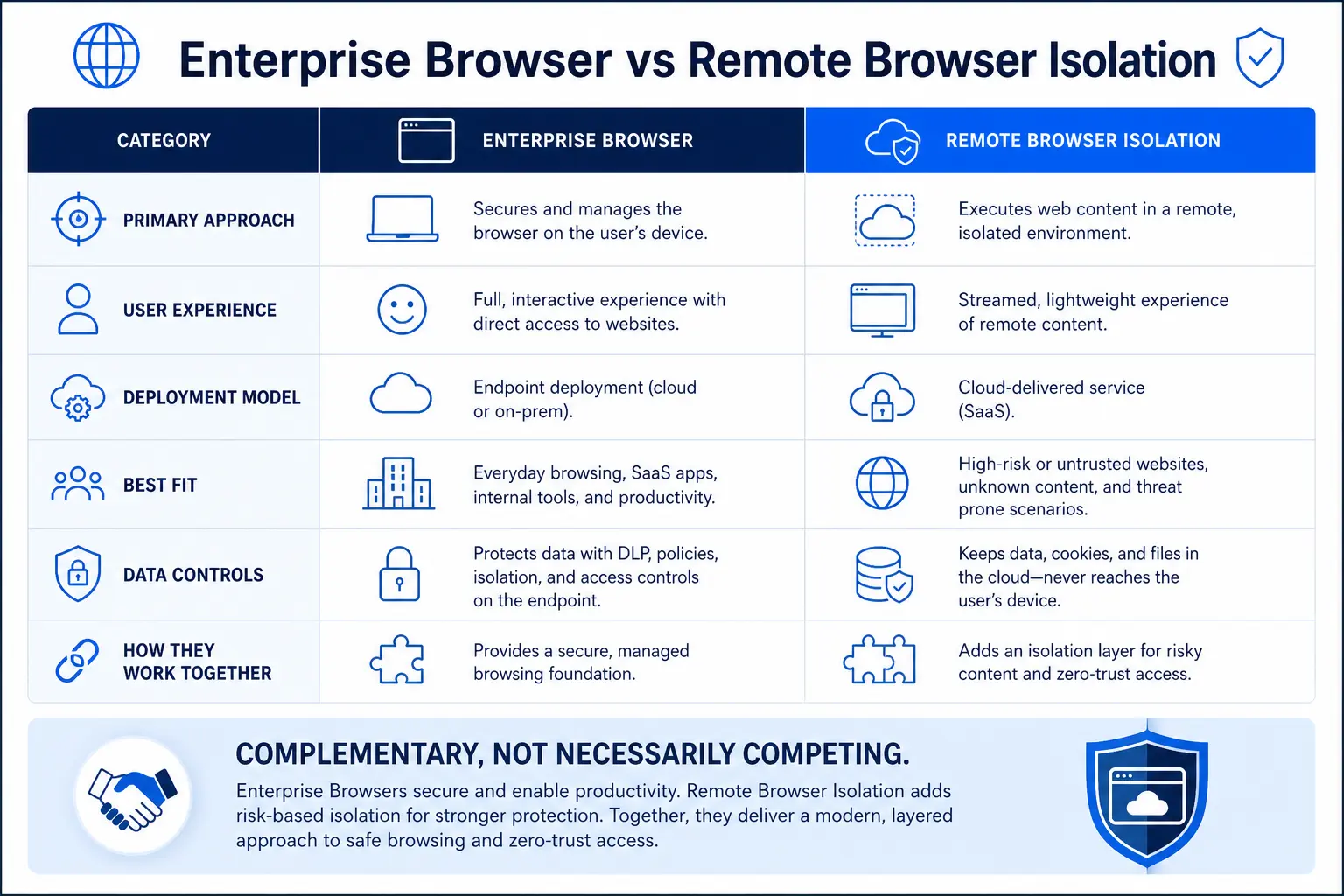
For AI tools that cannot be fully blocked—because business units depend on them—remote browser isolation renders the session on a cloud hosted container. The employee sees and interacts with the AI tool normally, but clipboard operations, downloads, and uploads can be controlled at a granular level. RBI enables a "read but don't leak" posture: employees can consume AI generated content without the ability to paste sensitive data into the tool or download AI outputs to unmanaged endpoints.
Consider an M&A team at a financial services firm that needs to use an AI research tool to summarize public filings. RBI allows them to use the tool freely while blocking paste in of internal deal terms or download of AI generated summaries containing proprietary analysis. The session ends, the container is destroyed, and no data persists on the endpoint.
Phase 4: Govern and Iterate (Ongoing)
Establish an AI governance board that reviews SWG and DLP telemetry monthly. Track which new AI tools appear, which policy violations occur most frequently, and whether approved alternatives are meeting user needs. Adjust policies as the landscape evolves—because the number of GenAI services is growing, not shrinking.
The Urgency: Why Waiting Creates Compounding Risk
Every month of delay compounds the exposure in three ways.
Financial: Shadow AI breaches disproportionately compromised customer PII at 65% versus the 53% global average (IBM, 2025), driving higher per record costs and regulatory penalties. When the data that leaks is the data regulators care about most, the financial exposure escalates far beyond the initial incident response.
Regulatory: GDPR, CCPA, and HIPAA all require organizations to maintain control over personal data processing. When an employee pastes patient records into an unvetted AI tool hosted in a jurisdiction without an adequacy agreement, the organization is the controller and bears the liability. The EU AI Act adds further obligations around transparency and risk assessment for GenAI usage that shadow AI by definition cannot meet.
Operational: A Menlo Security report documented a 68% surge in shadow generative AI usage across enterprises in a single year. Organizations that defer browser level controls today will face a larger, more entrenched shadow AI footprint when enforcement eventually becomes unavoidable—and retraining tens of thousands of employees who have built AI into daily workflows is far harder than steering behavior early.
The Skyhigh Security SSE platform unifies SWG, CASB, DLP, RBI, and ZTNA under a single policy engine—making it possible to discover shadow AI, enforce data protection at the browser level, and govern AI usage across managed and unmanaged devices from one console. That integration matters because security risks from AI copilots and tools span multiple enforcement points, and fragmented controls leave gaps that employees—innocently or otherwise—will find.