


Consistent Security Policies Across Cloud and On Premises
- Hybrid policy management keeps one authored rule set governing both on-premises and cloud enforcement, with documented exceptions only.
- Policy drift is the default when environments are managed separately, so prevention needs an operating model.
- Assign owners, version every change, roll out in stages, and keep rollback ready.
- One exception register and scheduled drift checks keep local and cloud enforcement aligned.
- A single policy engine for all enforcement points removes most synchronization work and translation errors.
Hybrid security policy management is the practice of defining security policy once and applying it consistently to every enforcement point, whether a gateway in a data center, a branch appliance, or a cloud point of presence. The goal is that a user, a device, a data type, or an application is treated the same way regardless of which enforcement point handles the traffic.
This article is part of the Hybrid Cloud Security guide.
Why policies drift in hybrid environments
Drift happens when the same intent is implemented separately in more than one place:
- An on-premises gateway and a cloud service with different rule syntax and category databases
- Exceptions added urgently in one environment and never mirrored in the other
- Different teams owning network, cloud, and data security policy
- DLP dictionaries updated for one channel but not another
- Emergency changes made directly on devices outside the normal process
The result is that security depends on where a user happens to be. Auditors find it, attackers exploit it, and troubleshooting slows because no one is sure which policy applies. The NSA and CISA Top Ten Cloud Security Mitigation Strategies address this directly, with strategies for secure automated deployment through infrastructure as code and for the complexities of hybrid and multi-cloud environments.
Ownership
Consistent policy starts with clear ownership of each policy area, assigned before choosing tools.
| Policy area | Typical owner | Approver |
|---|---|---|
| Web access and categories | Network or web security team | Security leadership, HR for acceptable use |
| Private application access | Identity and access team | Application owners |
| Data protection (DLP) | Data security team | Data owners, privacy, compliance |
| Threat protection | Security operations | Security leadership |
| TLS decryption and bypasses | Web security team | Privacy and legal |
| Exceptions | Requesting business owner | Policy area owner |
Every rule should trace to an owner and a business reason.
Versioning
Treat security policy like code, so every change is reviewed, recorded, and reversible:
- Store policy definitions in version control, or use a platform that keeps full version history.
- Require a description, ticket reference, and approver for every change.
- Review changes before deployment, including a diff against the current version.
- Tag releases so any deployed state can be identified and restored.
NIST SP 800-53 Rev. 5 configuration management controls, including baseline configuration (CM-2) and configuration change control (CM-3), apply to security policy as much as to servers. NIST SP 800-128 describes security-focused configuration management practices that support them.
Rollout
Deploy policy changes in stages so problems surface on a small group before they reach everyone:
- Validate in a test environment or with a policy simulation tool.
- Canary to a small set of users or one site.
- Monitor block rates, errors, and helpdesk tickets against baseline.
- Expand in waves across sites and cloud regions.
- Confirm that every enforcement point reports the new version.
For urgent threat-driven changes, define an expedited path that still records the change and syncs it everywhere.
Exceptions
Exceptions are where consistency erodes fastest.
Maintain a single exception register covering all environments:
- Scope: users, groups, destinations, data classes, and channels
- Environments: which enforcement points the exception applies to
- Justification and owner
- Expiry or review date
- Compensating controls
Exceptions should be created in the central policy and propagated, never configured directly on individual devices.
Drift checks
Drift detection compares intended policy with what is actually deployed.
- Version check: Every enforcement point reports its active policy version; alert on mismatches.
- Configuration diff: Periodically export deployed configuration and compare it with the approved baseline.
- Behavioral test: Run URL and application tests at the local gateway, and run data protection tests against the cloud-applied path that the gateway forwards to, then compare the results with the policy you authored.
- Exception audit: Compare device-level exceptions with the central register.
Schedule drift checks at least weekly and after every change window.
Rollback
Rollback should restore the previous policy version to every enforcement point in one operation.
- Keep the previous policy version ready to redeploy to all enforcement points.
- Define who can authorize rollback and under what conditions.
- Confirm that rollback reaches cloud and on-premises enforcement points in the same operation.
- Record rollbacks with reasons and follow up with a review.
Synchronization models
Four synchronization models exist, and drift risk falls as policy management becomes more unified.
| Model | How it works | Drift risk |
|---|---|---|
| Separate management | Each environment has its own console and rules | High |
| Scripted synchronization | Tools export and import rules between platforms | Medium; translation gaps and sync failures |
| Shared lists | Separate rules, but common allow and block lists synced | Medium |
| Single policy engine | One policy pushed to every enforcement point | Low |
Single policy engines still need drift checks, because devices can fail to update, but they remove translation between rule languages.
Centralized security policy management checklist
Use this checklist to confirm hybrid policy management is under control.
- Every policy area has an owner and approver
- All policy changes are versioned with ticket references
- Changes roll out in stages with monitoring
- One exception register covers all environments
- Enforcement points report active policy versions
- Drift checks run on a schedule and after changes
- Rollback is documented and tested
- Synthetic tests confirm that one authored policy produces the expected outcome for each session, at the enforcement point that handles it
How Skyhigh supports consistent hybrid policy
Skyhigh keeps hybrid policy consistent by pushing one policy set, as code, to every enforcement point.
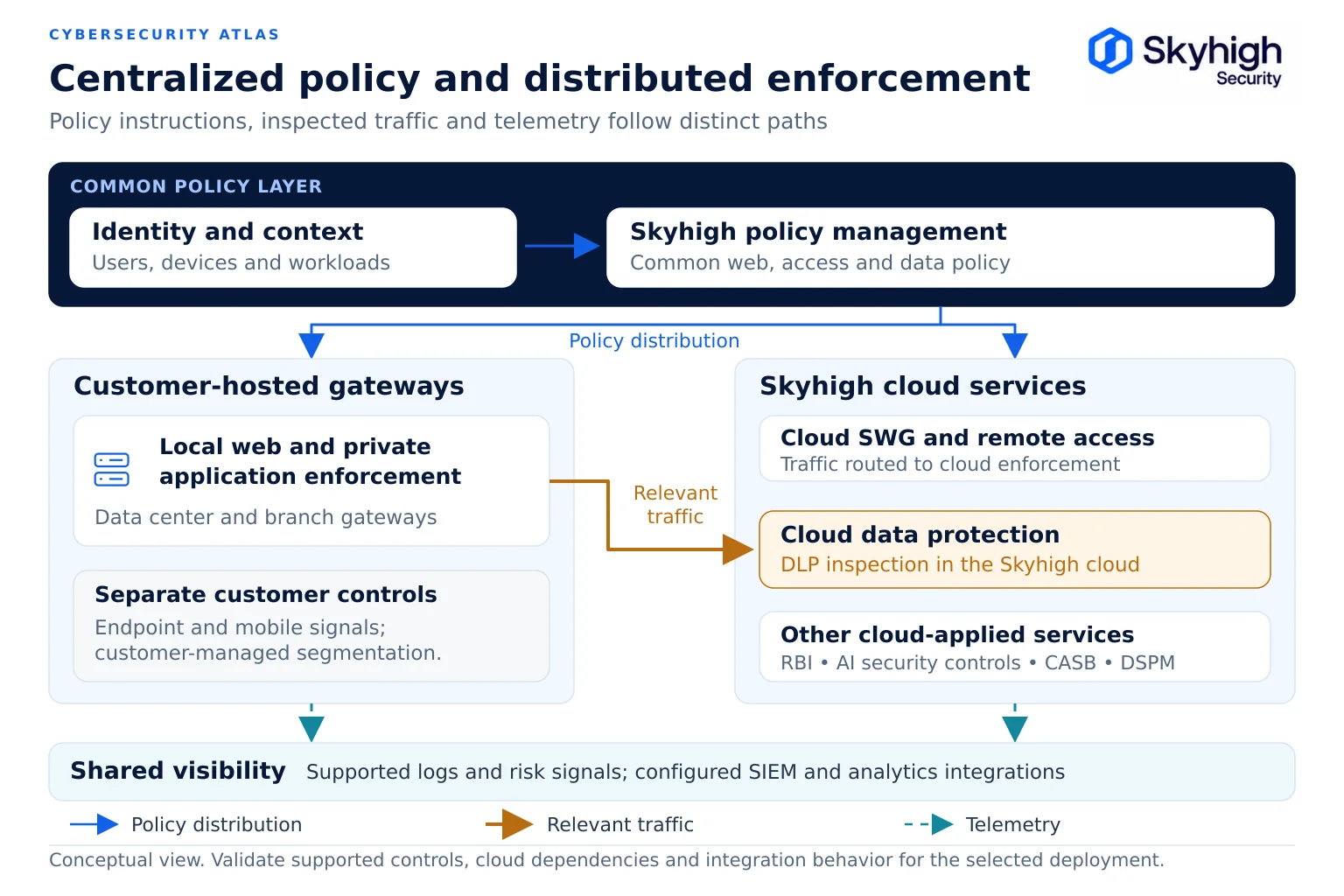
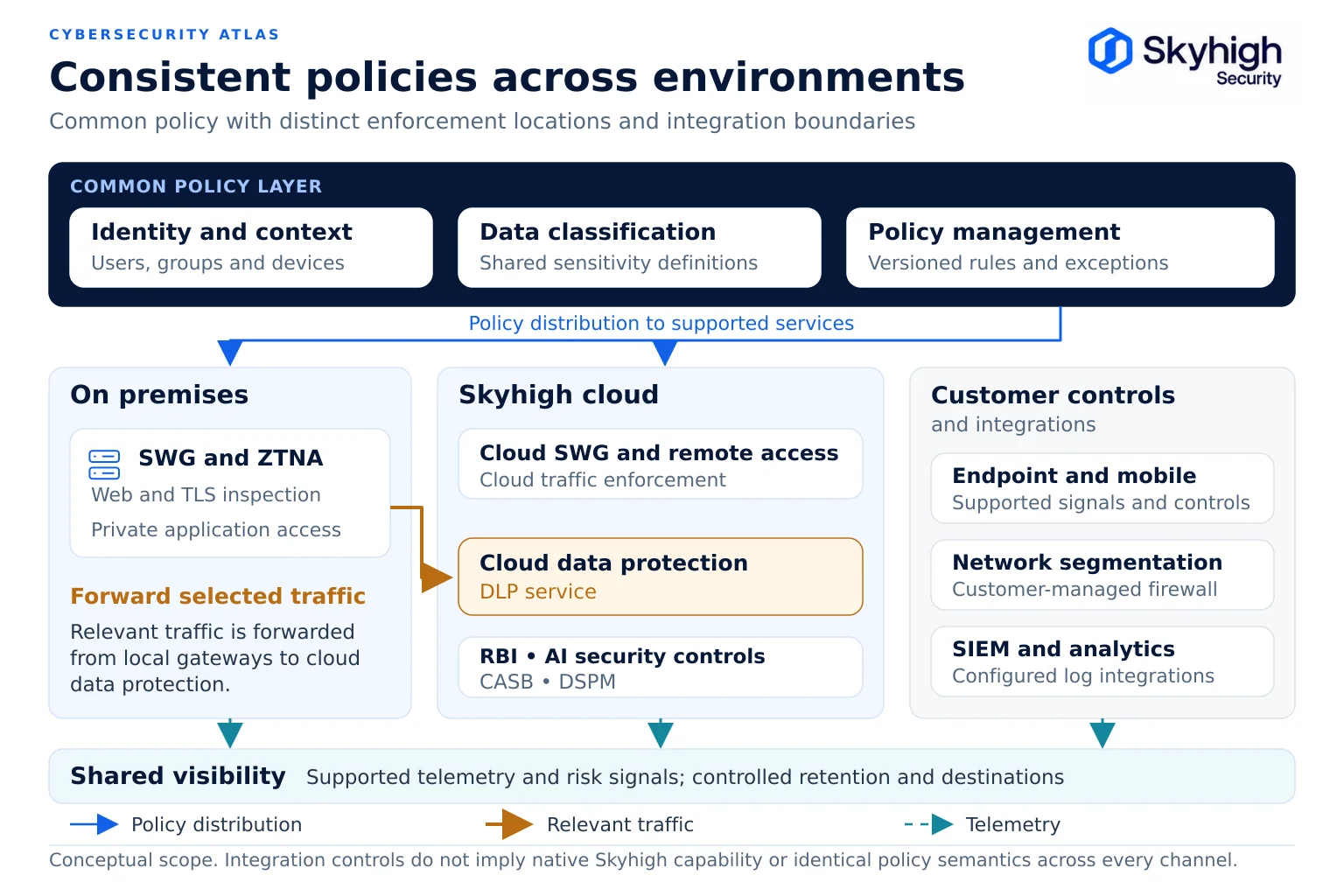
Skyhigh uses a policy-as-code architecture that pushes policies automatically across physical appliances, virtual systems, and cloud nodes, without manual reconciliation between environments (Skyhigh Security). Its hybrid SWG supports one-click migration of on-premises policies to the cloud and real-time synchronization of unified policies, and rule tracing shows which policy affected a given user’s traffic (Skyhigh Security). The March 2026 platform update added location-agnostic unified policy management and a programmable, extensible policy framework. Through Skyhigh Hybrid SSE Mesh, policy is authored once in the cloud console and applies to every session. Secure Web Gateway, Zero Trust Access, and Secure Browser Controls are enforced natively on the on-premises Secure Service Gateway, while DLP, CASB, DSPM, RBI, and AI security controls are applied through the Skyhigh cloud.
Sources
- NSA and CISA. Top Ten Cloud Security Mitigation Strategies (March 7, 2024). https://www.nsa.gov/Press-Room/Press-Releases-Statements/Press-Release-View/Article/3699169/nsa-releases-top-ten-cloud-security-mitigation-strategies/
- NIST. SP 800-53 Rev. 5: Security and Privacy Controls for Information Systems and Organizations. https://csrc.nist.gov/pubs/sp/800/53/r5/upd1/final
- NIST. SP 800-128: Guide for Security-Focused Configuration Management of Information Systems. https://csrc.nist.gov/pubs/sp/800/128/upd1/final
- Skyhigh Security. “Modernizing Your Symantec Edge Secure Web Gateway With Skyhigh Hybrid SSE Mesh” (July 15, 2026). https://www.skyhighsecurity.com/industry-perspectives/modernizing-your-symantec-edge-secure-web-gateway-with-skyhigh-hybrid-sse-mesh.html
- Skyhigh Security. “Adopting Hybrid Just Got Easier With Skyhigh SSE Platform” (October 3, 2024). https://www.skyhighsecurity.com/cloud-security/adopting-hybrid-just-got-easier-with-skyhigh-sse-platform.html
- Skyhigh Security. “Skyhigh Security Announces New Solutions to Strengthen Disruptive Universal SSE Platform” (March 24, 2026). https://www.skyhighsecurity.com/about/newsroom/newswire/skyhigh-security-announces-new-solutions-to-strengthen-disruptive-universal-sse-platform.html