




Beyond CSPM: Closing the Cloud Data Security Gap
- CSPM finds misconfigurations in cloud infrastructure but cannot see the sensitive data inside it.
- CSPM is the infrastructure foundation, not the full cloud data security strategy. DSPM closes the data visibility gap.
- Modern enterprises need integrated approaches combining infrastructure visibility with data-centric protection.
Cloud Security Posture Management (CSPM) has become a foundational control for identifying cloud misconfigurations, policy drift, and insecure control-plane settings, but it does not address all of the data-centric questions security teams need answered.
CSPM is designed to automate posture assessment and detect drift across cloud environments. It can identify exposed services, overprivileged IAM roles, unencrypted storage, public snapshots, and policy violations across AWS, Azure, Google Cloud, and other IaaS platforms. That capability is essential. Verizon's DBIR reporting continues to show that errors and misconfigurations remain important breach contributors; the 2024 DBIR infographic reported that errors accounted for 28% of breaches, with misconfiguration a common error pattern.
But traditional CSPM tools focus on infrastructure configuration and control-plane security, not on data content or sensitivity. They do not deeply examine what data resources contain, how sensitive that data is, or who can actually reach it through various access paths. A storage bucket may be compliant from a configuration perspective while still exposing customer records through overshared access permissions or external links.
That gap matters because cloud data risk is not limited to obvious misconfigurations. Many cloud attack paths involve compromised credentials and valid account abuse, not just technical configuration errors. MITRE ATT&CK documents techniques in which attackers use valid cloud accounts to access resources and exfiltrate data to cloud storage. In those scenarios, the infrastructure may look properly configured while the data remains exposed. Source: https://attack.mitre.org/
Cloud data security posture requires visibility into where sensitive data is stored, how it moves, who can access it, and how exposure changes over time. That means looking beyond posture checks and into discovery, classification, exposure analysis, and continuous monitoring across cloud and SaaS environments – capabilities that define a comprehensive data security posture management (DSPM) approach.
What CSPM does well
CSPM is strong at finding cloud infrastructure issues that create risk at the control-plane level. It continuously monitors cloud configurations against baselines and compliance frameworks. It can surface issues such as:
• Publicly accessible storage
• Overprivileged roles and excessive permissions
• Unencrypted resources / disabled encryption
• Open security groups and exposed services / databases
• Violations of internal policy or regulatory requirements
For cloud teams, that visibility is valuable. It helps identify hardening gaps, enforce policy, and reduce common exposure caused by configuration drift. It also provides repeatable checks across multiple cloud providers, which is difficult to achieve manually at scale.
Where CSPM falls short
The limitation is scope. CSPM validates the environment, but it does not tell you what the environment contains.
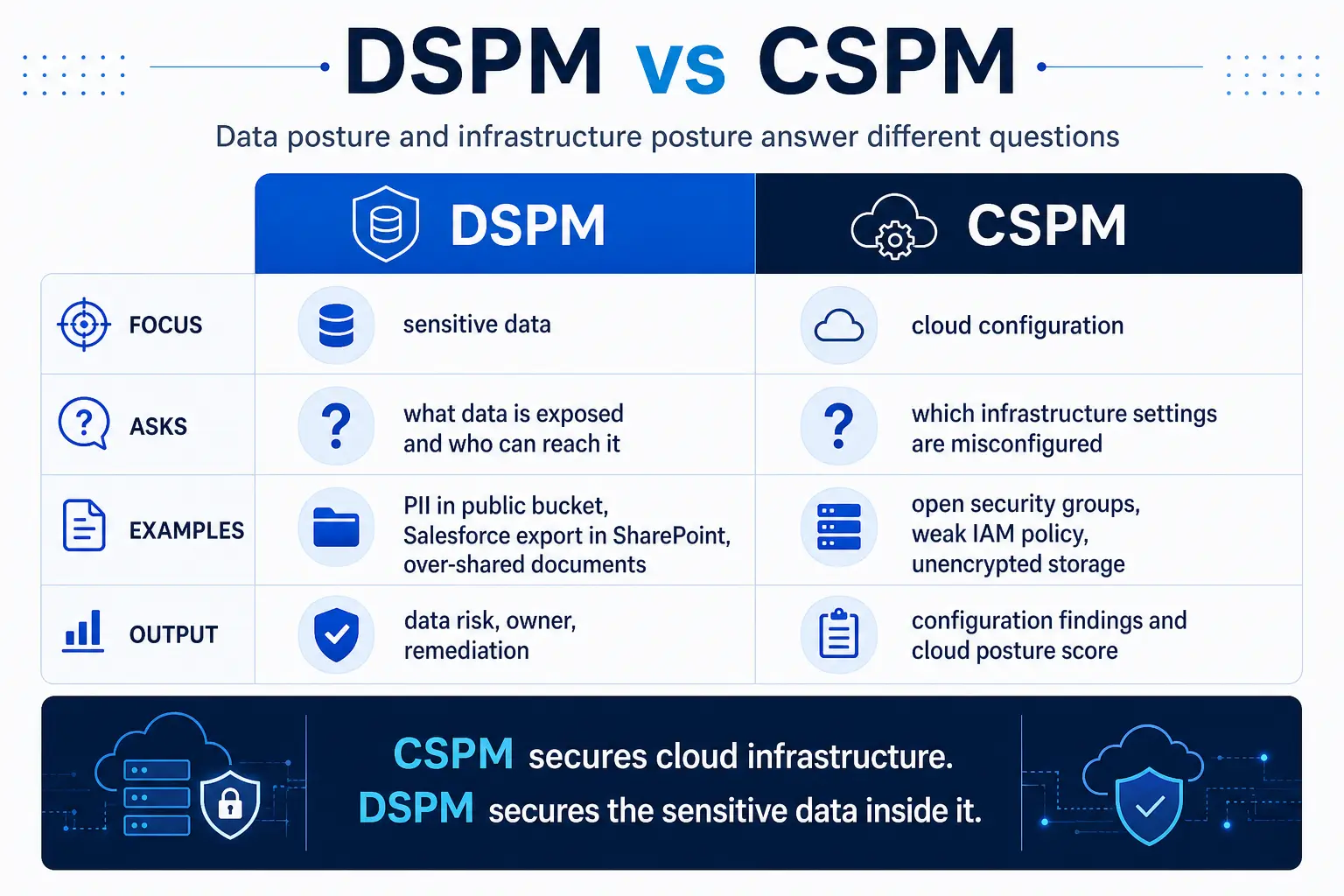
A bucket can pass every configuration control but still house regulated data. A collaboration workspace can follow approved settings while a sensitive file is shared too broadly. A cloud database can be locked down at the network layer while application users, service accounts, or inherited permissions create unexpected exposure.
That is why CSPM alone cannot answer the questions security teams care about most:
• Where is sensitive data located?
• What kind of data is it?
• Who can access it?
• How is it being shared?
• Which exposures create the highest business risk?
Traditional CSPM also has limited visibility into cross-platform data flows. The tool that secures your AWS environment may have no visibility into how data moves between AWS and Microsoft 365, Salesforce, or other cloud services. It may also miss shadow repositories created through personal cloud storage, unsanctioned SaaS use, or exports to external collaboration tools.
Why data context changes prioritization
Security teams can face large volumes of posture findings, but without data context they may struggle to prioritize the highest-impact risks. A low-risk test environment with synthetic data should not receive the same urgency as a production system containing customer financial records.
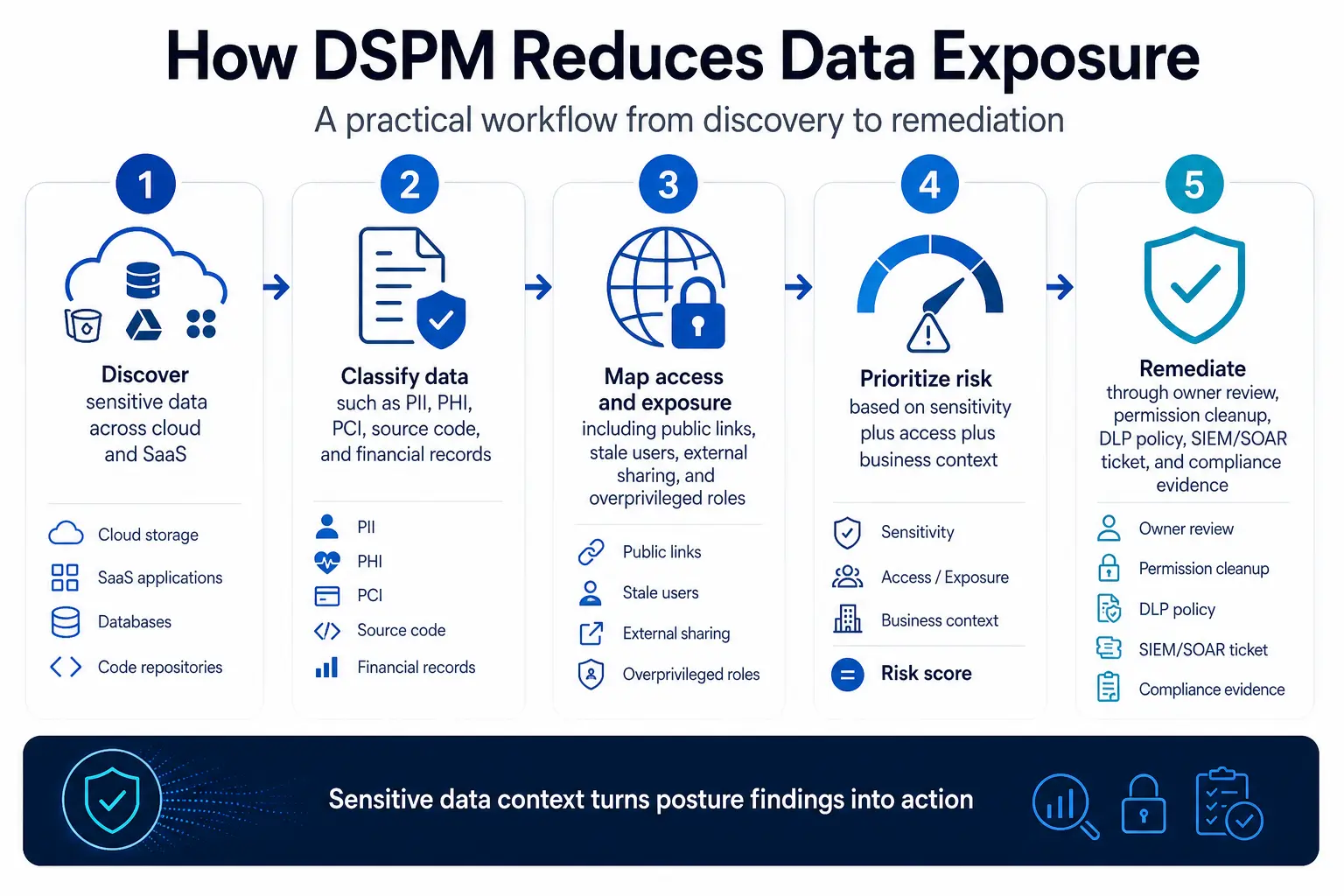
That distinction is why data-aware visibility matters. It helps separate technical issues that are important from those that are truly critical to the business. A public storage alert is serious, but if the asset contains no sensitive information, the response may differ from a similarly exposed repository containing regulated records or intellectual property.
Access governance is another blind spot. CSPM may validate that broad infrastructure policies are in place, but it does not fully map how access accumulates through groups, app permissions, shared resources, token-based access, or third-party integrations. Over time, those relationships can create exposure that basic posture checks do not reveal.
What Data Security Posture Management (DSPM) Adds
Data Security Posture Management (DSPM) extends visibility from infrastructure to data. It focuses on discovering sensitive information, classifying it, understanding how it is exposed, and monitoring how that exposure changes.
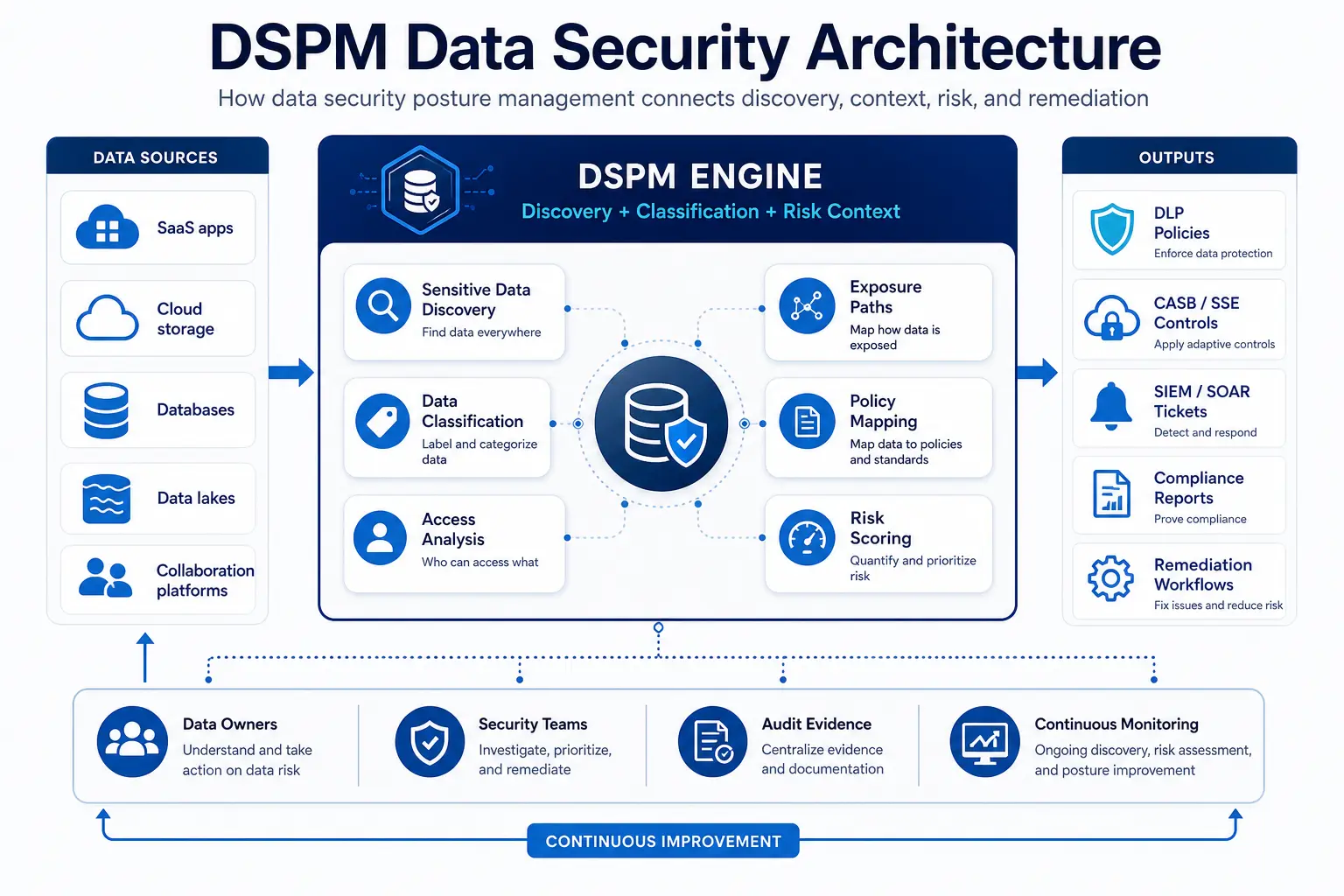
A strong data security posture management starts with discovery across cloud and SaaS estates. It needs to identify where data lives, whether in cloud storage, collaboration tools, or sanctioned and unsanctioned applications.
From there, classification adds business context. Content inspection alone is not enough; the data must be understood in terms of sensitivity and impact. That means distinguishing between ordinary files and regulated records such as PII, PCI data, financial documents, or intellectual property.
Exposure analysis then maps the ways data can be reached. That includes permissions, sharing settings, external links, inherited group access, API exposure, integrations, and user behavior. It also considers how an attacker could reach the data through account compromise or privilege escalation.
Finally, continuous monitoring ensures that changes in data movement, sharing, and access are detected as they happen. In cloud environments, exposure can change quickly as teams collaborate, automate, and connect new services.
CSPM and DSPM are complementary
CSPM and DSPM are not substitutes. They solve different problems and work best together.
CSPM secures the infrastructure layer. It tells you whether cloud resources are configured correctly and whether baseline controls are in place. DSPM extends visibility into the data layer. It tells you what sensitive data exists, where it is stored, who can access it, and how it may be exposed.
That combined view gives security teams a more complete answer to both infrastructure and data questions. It also supports better risk prioritization, because the team can connect a misconfiguration to the assets and data it actually affects.
Organizations that leverage unified platforms, such as Skyhigh Security's comprehensive Security Service Edge (SSE) solution, can integrate both infrastructure and data-centric visibility to address the full spectrum of cloud data / data risk management.
Practical example
Consider a development team that exports source code to cloud storage for collaboration. CSPM may show that the storage account is encrypted, private, and aligned with baseline policies. That looks acceptable from an infrastructure standpoint.
But data-aware visibility may reveal a different picture. The repository may contain proprietary algorithms, stale contractor access, or shared links that were never revoked. In that case, the risk is not the cloud setting alone. It is the combination of the setting, the content, and the access path.
The same applies to SaaS collaboration tools. Files may be stored in approved applications, yet shared with external parties, inherited through group membership, or accessible through connected apps and API integrations. CSPM is not designed to map those data-sharing relationships in detail.
Why modern cloud programs need both views
As cloud usage expands, sensitive data spreads across more services, identities, and collaboration channels. Infrastructure controls remain necessary, but they are no longer sufficient on their own.
A mature cloud security posture requires unified visibility into both control planes and data planes. That means pairing CSPM with data-centric capabilities that can discover sensitive content, map exposure, and support risk-based response.
Organizations that combine these approaches can better answer questions such as:
• Is the cloud resource configured securely?
• Does it contain sensitive data?
• Can the right people access it?
• Is it exposed through sharing, integrations, or external links?
• Which issues should be remediated first?
Those questions define the difference between a secure configuration and a secure data posture.