





Browsersicherheit vs. Endpunktsicherheit: Welche Rolle spielt jeweils welche in modernen Architekturen?
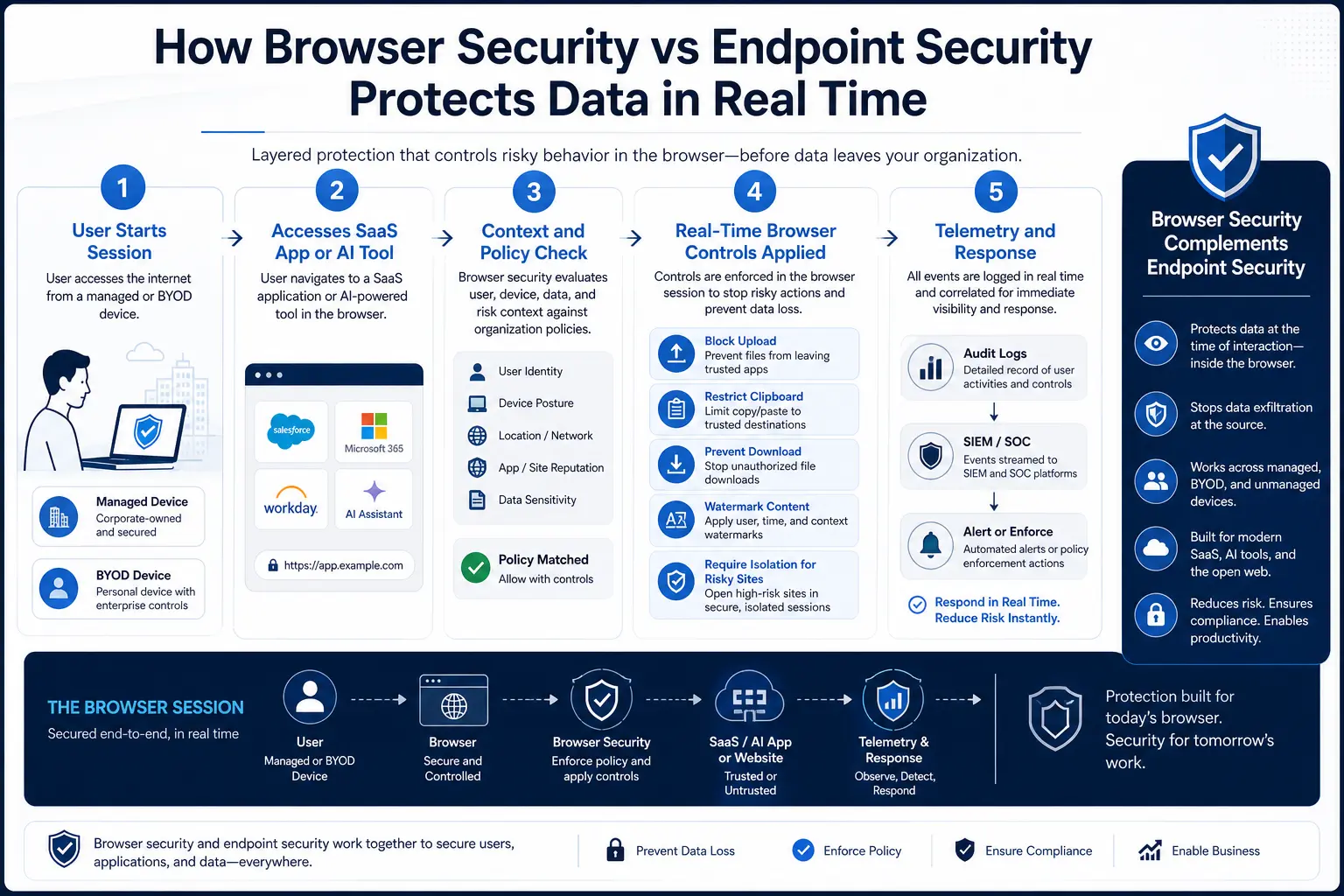
- Browser security and endpoint security protect different stages of the attack chain.
- MITRE ATT&CK documents distinct technique sets for each layer. Drive by Compromise (T1189), Credentials from Web Browsers (T1555.
- Neither layer alone covers the full NIST CSF 2.0 Protect function.
- Threat actors are shifting targets. Browser based zero day exploitation dropped from 17 to 11 between 2023 and 2024, but stolen.
- The practical decision is not "which one" but "how they integrate.
- Adoption of browser layer controls is accelerating. Gartner predicts one in four organizations will deploy secure enterprise.
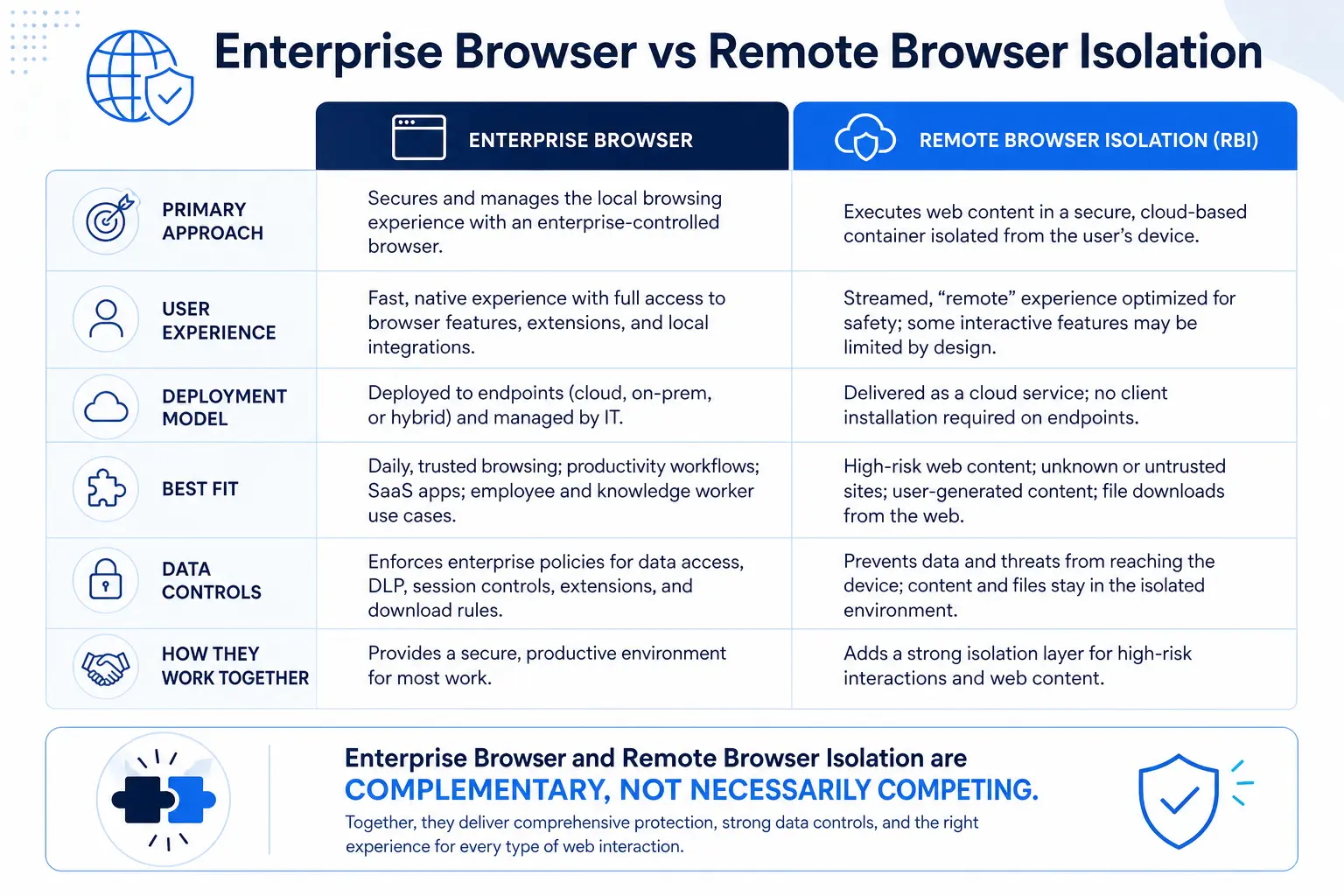
Browser security and endpoint security are not competing layers — they are complementary controls that catch different threats at different points in the attack chain. A zero day exploit delivered through a compromised industry news site bypasses signature based endpoint antivirus entirely, but remote browser isolation (RBI) prevents the malicious code from ever reaching the operating system. Conversely, if an employee downloads a trojanized installer via a personal USB drive, endpoint detection and response (EDR) is the layer that catches the payload after it lands. Security architects who design for only one of these layers leave predictable gaps that adversaries routinely exploit.
What Browser Security Actually Covers
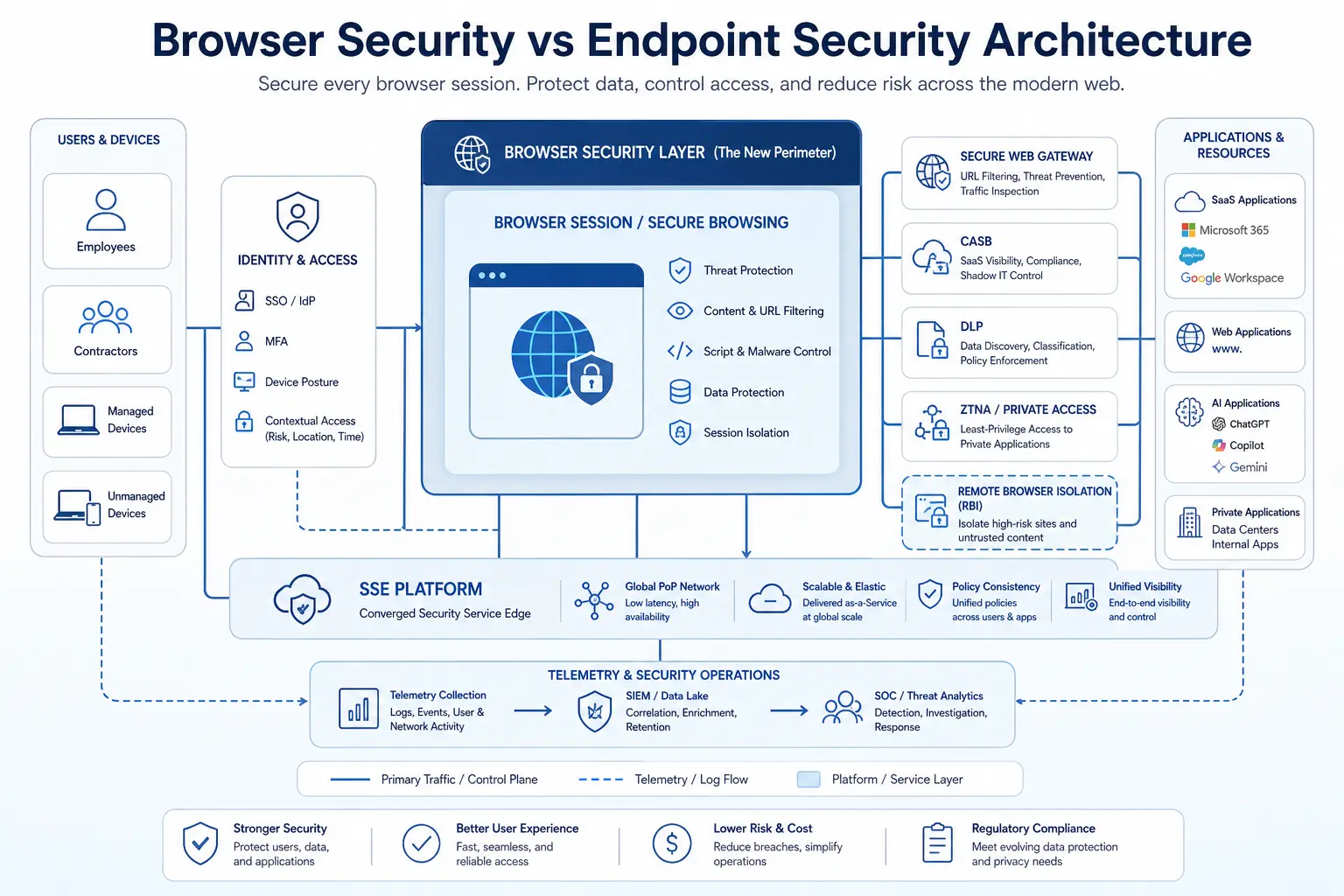
Browser security encompasses controls that operate inside, around, or upstream of the web browser session: remote browser isolation, secure web gateways, inline DLP, CASB proxy enforcement, URL filtering, and policy driven restrictions on copy/paste, upload, download, and printing within browser sessions.
The threat model here is the browser session itself. Consider this scenario: a procurement manager at a manufacturing firm visits a parts supplier portal that has been compromised with a JavaScript injection — a classic watering hole. The website used by the adversary is often one visited by a specific community, such as a particular industry, where the goal is to compromise users based on a shared interest — a pattern MITRE ATT&CK classifies as a strategic web compromise under T1189. The injected script silently probes the browser for exploitable versions and, if found, delivers code execution.
With RBI in place, this entire sequence runs inside an isolated container in the cloud. The malicious JavaScript executes, but never on the user's actual machine — it renders harmlessly in a disposable session. The endpoint never sees the payload.
Browser security also addresses data exfiltration during the session. Picture a contractor who opens a Salesforce dashboard through a browser on an unmanaged personal laptop, selects a list of enterprise customers, and tries to paste the data into an AI chatbot in another tab. Browser layer DLP inspects that clipboard event in real time and blocks the paste before the data leaves the corporate application.
This class of browser based initial access is especially concerning because 41 known threat groups and malware families have been observed using drive by compromise (T1189) in the wild, making it one of the most prevalent initial access methods mapped in MITRE ATT&CK.
What Endpoint Security Actually Covers
Endpoint security includes EDR, next generation antivirus (NGAV), host based firewalls, device posture assessment, disk encryption, application control, and OS level threat detection. These controls operate on the device after content has already arrived — they inspect processes, files, registry changes, memory operations, and network connections originating from the endpoint.
The MITRE ATT&CK framework maps a deep set of post execution endpoint techniques. Process Injection (T1055) remains one of the most prevalent techniques observed in malware analysis, alongside Defense Evasion and Persistence as dominating tactics. Impair Defenses (T1562) — used to disable antivirus, delete logs, and kill EDR agents — ranks consistently among the top observed techniques across recent years.
Here is where endpoint security earns its keep: a finance analyst at a bank downloads what appears to be an Excel template from a colleague's file sharing link. The file actually contains a macro that drops a DLL into the user's temp directory and attempts process injection. The browser had no reason to block the download — it came from a sanctioned cloud storage domain. But EDR detects the suspicious child process spawning from Excel, flags the unsigned DLL, and quarantines the payload before it can establish persistence.
Endpoint security also detects post compromise credential theft. Under MITRE ATT&CK's Credentials from Web Browsers (T1555.003), adversaries acquire credentials from web browsers by reading browser specific files — web browsers commonly save credentials such as usernames and passwords so they do not need to be entered manually. Once malware has gained endpoint access, it targets browser credential stores directly. EDR is the layer that spots a non browser process reading Chrome's Login Data SQLite database at 2 a.m. and raises the alert.
Key Differences: Browser Security vs Endpoint Security
The distinction is not about which is "better" but about where each layer intercepts threats in the kill chain, what telemetry it generates, and which MITRE ATT&CK techniques it is positioned to mitigate.
When Browser Security Catches What Endpoint Security Misses
The clearest case is the zero day delivered through a legitimate website. Google's Threat Intelligence Group tracked 75 zero day vulnerabilities exploited in the wild in 2024, and browser based exploitation dropped from 17 in 2023 to 11 in 2024 (GTIG, April 2025). The decline in browser zero days does not mean the risk disappeared — it means adversaries are more selective, reserving browser exploits for high value targets.
Imagine a legal services firm whose attorneys routinely visit a niche industry regulation website. An adversary compromises that site and injects a zero day exploit targeting a vulnerability in the Chromium rendering engine for which no patch exists yet. The firm's endpoint AV has no signature. Its EDR behavioral engine may eventually detect the post exploitation activity, but only after the exploit has already achieved code execution and begun staging a foothold.
With browser isolation, the exploit runs in an ephemeral container and the endpoint never receives the malicious code. The page renders as a pixel stream. When the attorney closes the tab, the container is destroyed along with whatever the exploit tried to stage. No signature was needed, no behavioral heuristic was invoked — the attack was architecturally neutralized.
Browser security also catches data exposure scenarios that endpoint agents cannot observe. A marketing team member copies a customer segmentation spreadsheet from an internal analytics app and pastes it into an unsanctioned AI tool running in a browser tab. Endpoint DLP has no visibility into clipboard events between browser tabs. A secure web gateway with integrated DLP inspects the content in session and blocks the paste based on data classification.
When Endpoint Security Catches What Browser Security Misses
Browser security controls are limited to web traffic channels. They have no jurisdiction once a file has been written to disk, a USB drive is plugged in, or a non browser application makes a network connection.
Consider a software engineer who downloads a developer tool from a community repository. The download passes SWG URL filtering because the repository is legitimate and widely used. Once installed, the tool sideloads a malicious DLL that uses T1055 Process Injection to embed itself in a trusted system process. It then runs T1555.003 to steal credentials stored in the engineer's browser profile and exfiltrates them over an encrypted C2 channel that mimics legitimate HTTPS traffic.
Every step after the download is invisible to browser security. EDR is the control that detects the unsigned DLL load, the anomalous memory write into a system process, and the unusual outbound connection from a process that normally has no network activity.
Exploits were the most common initial infection vector at 33% of intrusions in 2024, according to Mandiant's M Trends 2025 report, with stolen credentials rising to 16% as the second most common vector. Those stolen credentials frequently originate from infostealer malware running on the endpoint — malware that harvests browser credential databases, session cookies, and autofill data. Endpoint security is the primary line of defense against infostealers because the credential theft happens at the OS/file system level, not in the browser session.
Endpoint controls also enforce device posture. Before a laptop is allowed to connect to corporate resources, the EDR agent confirms the OS is patched, the firewall is enabled, and no known vulnerable software is running. Browser security has no visibility into whether the underlying operating system is compromised by a rootkit.
Why Most Enterprises Need Both — and How to Map Them to NIST CSF 2.0
NIST CSF 2.0 is organized by six Functions — Govern, Identify, Protect, Detect, Respond, and Recover — which together provide a comprehensive view for managing cybersecurity risk. The Protect function alone contains 22 subcategories spanning identity management, authentication, access control, data security, platform security, and technology infrastructure resilience.
No single product category covers all 22 subcategories. Browser security addresses Protect outcomes related to data security in transit (PR.DS), access management for SaaS and web applications (PR.AA), and platform security for browser based work (PR.PS). Endpoint security covers platform security for the operating system, protective technology for host based detection, and identity management for local credential stores.
In practice, a pharmaceutical company's CISO mapping controls to NIST CSF 2.0 would assign browser isolation and SWG to subcategories covering web content filtering and data in transit protection, while assigning EDR to subcategories covering endpoint threat detection and malware prevention. The Protect function is about putting measures in place to safeguard critical assets, minimize risk, and prepare for potential cybersecurity incidents — requiring both layers to avoid systematic blind spots.
The global average cost of a data breach reached $4.88 million in 2024, according to the IBM Cost of a Data Breach Report 2024. Separately, breaches involving stolen or compromised credentials took the longest to identify and contain at 292 days per the same report. A layered architecture that combines browser session DLP (preventing credential paste into phishing pages) with endpoint EDR (detecting infostealer access to browser credential databases) directly addresses this top attack vector from two directions.
Decision Framework: Allocating Investment Between Layers
Not every organization needs identical depth in both layers. Here is a practical framework for security architects:
Prioritize browser security investment when:
A significant portion of the workforce is remote, contractor based, or using unmanaged devices — where no endpoint agent can be installed. RBI and reverse proxy provide security without device control.
SaaS applications are the primary workspace and the main data exfiltration risk is copy/paste, download, or screenshot from browser based apps.
The organization must grant third party access to sensitive applications. A healthcare system allowing external billing partners to access patient records through a browser session uses RBI to ensure data never touches the partner's endpoint.
The threat model prioritizes web borne zero day and phishing attacks. Gartner predicts that by 2028, one in four organizations will deploy at least one secure enterprise browser technology to address specific gaps in remote access and endpoint defense (Gartner, April 2025).
Prioritize endpoint security investment when:
The workforce is primarily on managed, corporate owned devices with full admin visibility.
Threat modeling reveals high risk from malware delivery channels outside the browser: USB, email client attachments, supply chain software installers.
Compliance mandates require on device encryption, host firewall enforcement, and device posture assessment (common in PCI DSS and HIPAA environments).
The SOC needs deep forensic telemetry — process trees, memory artifacts, registry modifications — for incident investigation and threat hunting.
Invest in integration when:
Both layers exist but operate in silos. An SSE platform that unifies SWG, RBI, CASB, and DLP with endpoint telemetry creates a single policy engine. When the SWG detects a user visiting a newly registered domain, it can simultaneously trigger RBI for the session and instruct the endpoint agent to increase behavioral monitoring for that user's device.
In 2024, 44% of zero day exploits targeted enterprise products (GTIG, April 2025), and attackers increasingly chain browser based initial access with endpoint level post exploitation. Detecting a chained attack requires telemetry from both layers correlated in one console.
How Browser-Layer and Endpoint-Layer Telemetry Work Together
The most dangerous attacks span both layers. MITRE ATT&CK's detection guidance for Drive by Compromise illustrates this integration requirement: it calls for correlated evidence of anomalous browser and network behavior — suspicious external resource fetches and script injection patterns — followed by atypical child processes, memory modification or process injection, and unexpected file drops on the endpoint.
This detection chain cannot work if browser telemetry and endpoint telemetry live in separate dashboards with no correlation. A next generation secure web gateway generates the first signal: a user's browser session fetched an obfuscated JavaScript resource from a newly registered domain. The endpoint agent generates the second signal: minutes later, the browser process spawned an unexpected child process that wrote a file to the temp directory. Correlated, these signals confirm a drive by compromise in progress. In isolation, either signal alone might be dismissed as noise.
This is exactly why the industry is converging toward unified SSE architectures that fuse web, cloud, and endpoint policy. When a security architect can write one DLP policy that enforces consistently across a browser session, a SaaS API connection, and a managed endpoint file transfer, coverage gaps shrink dramatically.