संसाधन
Introducing Skyhigh Hybrid Mesh SSE: Built for the Way Modern Enterprises Work
त्याग वासुदेवन - उत्पाद के कार्यकारी उपाध्यक्ष द्वारा
October 26, 2026 6 Minute Read
Work is hybrid. Applications are hybrid. Security should be too.
We are excited to introduce Skyhigh Hybrid Mesh Secure Service Edge (SSE) (link to Press Release) – a major step forward in how we help enterprises connect their users, protect their data, and secure their applications.
This launch reflects countless conversations with customers about what they need from security. They want stronger protection, a better user experience, and better economics. They need control over where their data is inspected. They expect security to work consistently as employees move between home, headquarters, and branch offices.
Those needs shaped Skyhigh Hybrid Mesh SSE: a distributed security architecture that brings cloud and on-premises enforcement together through a unified policy engine.
What customers told us – and why we built it
The enterprise has evolved beyond the assumptions that shaped cloud-only security architectures.
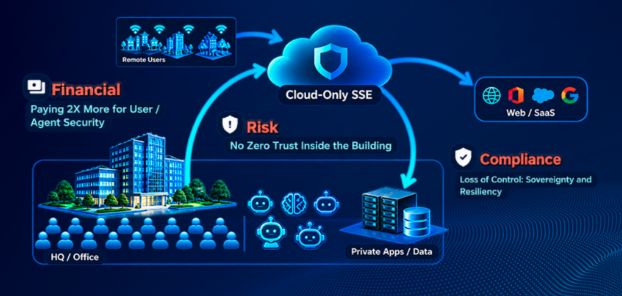
Employees work across all locations, including offices where many applications and significant infrastructure remain local. Sending a local user’s traffic to a distant cloud enforcement point before bringing it back to a local application can add latency, cost, and dependency. This becomes more significant as we consider employees now returning back to offices for work. A May 2026 Gallup survey shows that 74% of employees are in-office/hybrid (22% of employees are in the office full time, 52% are hybrid 2.3 days per week).
At the same time, AI is expanding the ways enterprise data is accessed and used – and changing the threats against it. Agents can inherit user access, invoke tools, query internal systems, and move data faster than human-authored policy review. A recent report from research firm Gartner indicates that 1 in 6 AI prompts include proprietary data (Source: Gartner, Cybersecurity Threat: AI Application Compromise, 2026). If agents run inside the enterprise, enforcement cannot live only outside it.
On the other hand, Anthropic’s Mythos has also demonstrated how increasingly capable models can discover vulnerabilities and develop exploits, adding urgency to the need for stronger defenses for both modern AI applications and legacy applications running within data centers. As such, security teams need to protect sensitive information across web, SaaS, private applications, and emerging AI interactions (e.g: they need to enforce zero trust consistently, including for users, devices and applications inside and outside the corporate network).
Customers also face growing pressure to demonstrate financial value. They are examining the cost of their security architecture, including processing, connectivity, and operational overhead. Expansive user licensing, non-negotiable bundled packages, unused software investments, and routing local traffic through remote cloud inspection infrastructure produce an inefficient financial framework that security executives and finance leaders must reassess. Existing infrastructure represents an investment they want to use intelligently.
In addition, resilience and sovereignty have become architectural priorities. Customers need options when a service or connection becomes unavailable. They also need greater control over where sensitive traffic travels and where inspection takes place. Another Gartner research report indicates 50% of multinationals, including >75% non-US will have Digital Sovereignty by 2028 (Source: Gartner, Forecast Analysis: Sovereign Cloud IaaS, Worldwide, 2025)
Together, these requirements call for security that can adapt to the enterprise’s environment.
The architecture: distributed enforcement, unified policy
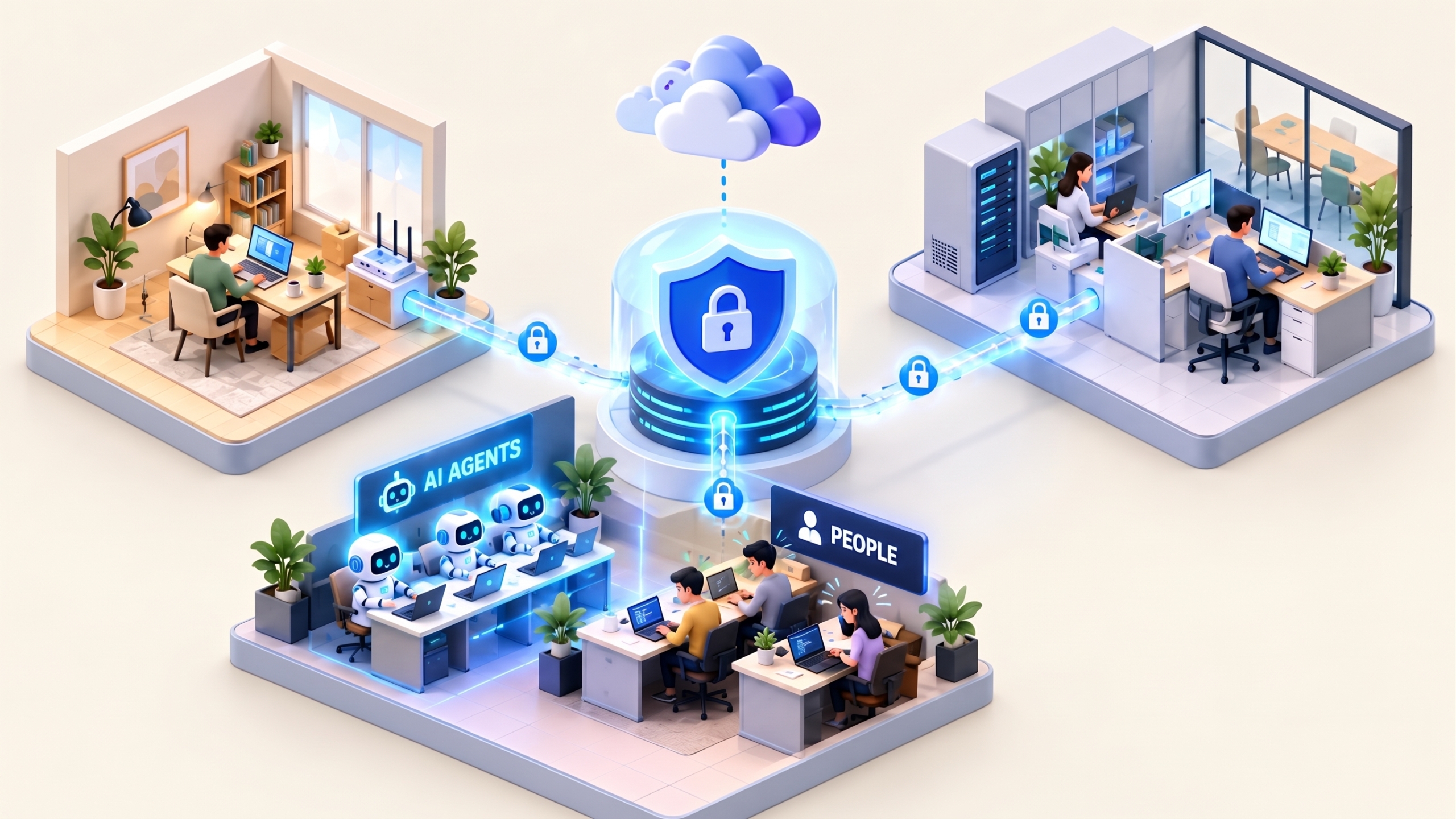
Skyhigh Hybrid Mesh SSE connects cloud and on-premises policy enforcement points into a coordinated security mesh.
Our SSE platform provides cloud-delivered enforcement, while Skyhigh Security Gateways (SSGs) bring enforcement into customer environments, including branches, headquarters, and data centers. The Skyhigh client intelligently steers sessions to the appropriate enforcement point based on location and policy.
An employee working remotely can use cloud enforcement. That same employee in the office can use local enforcement. A local user accessing a local private application can receive zero trust protection without an unnecessary journey through the cloud.
Underpinning this architecture is MOWGLI, our unified Policy-as Code engine, which provides a common foundation for expressing and applying security policy across cloud and on-premises enforcement.
The path can change while the security policy remains consistent.
For enterprises and public sector organizations operating in this AI-forward, hybrid work era, that architecture translates into six benefits.
1. Better economics
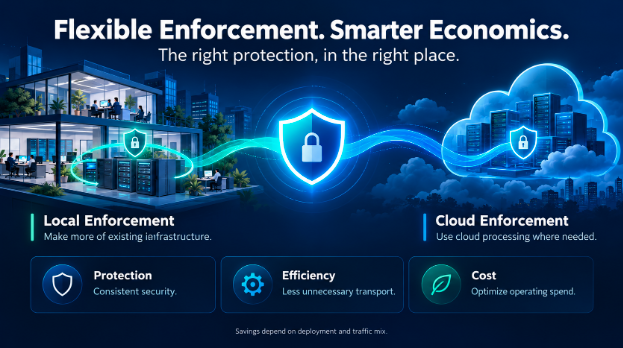
Customers gain flexibility in where traffic is processed and how they use existing infrastructure. Enforcing appropriate traffic locally can reduce reliance on cloud processing and unnecessary transport, creating opportunities to lower operating costs by up to 50%*.
The savings depend on the deployment and traffic mix. The principle is straightforward: place enforcement where it delivers the best combination of protection, efficiency, and cost.
2. Zero trust everywhere—with sensitive data protection
Zero trust must apply inside the office as well as outside it.
Skyhigh Hybrid Mesh SSE extends consistent access and data protection policies across user and application locations. Employees accessing sensitive applications (eg. new AI apps or legacy Apps) should receive appropriate controls whether they are at headquarters, in a branch, or working remotely.
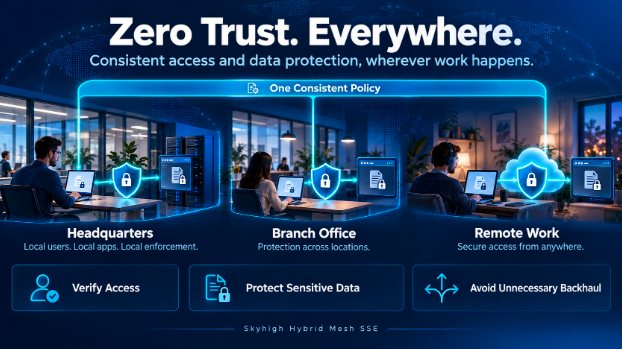
For local users accessing local applications, those controls can be enforced locally. Customers can protect access and sensitive data without introducing unnecessary backhauling.
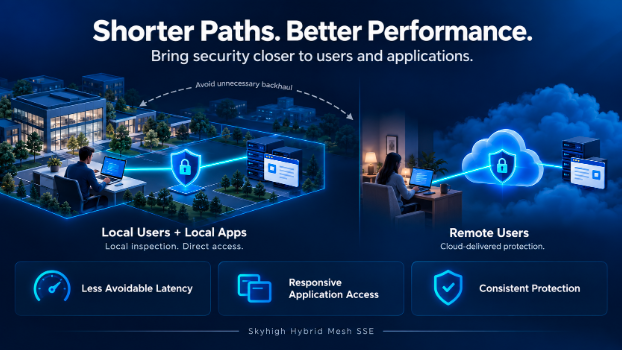
3. Better performance and lower latency
Every unnecessary network detour can affect the user experience.
Hybrid Mesh SSE enables a more direct path to applications by bringing enforcement closer to users and resources. Local traffic can receive local inspection, while remote users benefit from cloud-delivered protection. This helps customers reduce avoidable latency and support responsive access to business applications.
4. Greater resilience
Security is part of the infrastructure that keeps a business running.
Combining cloud and on-premises enforcement gives customers additional options for continuity. With appropriate routing and failover configuration, alternate enforcement paths can help maintain protected access when a primary path becomes unavailable.
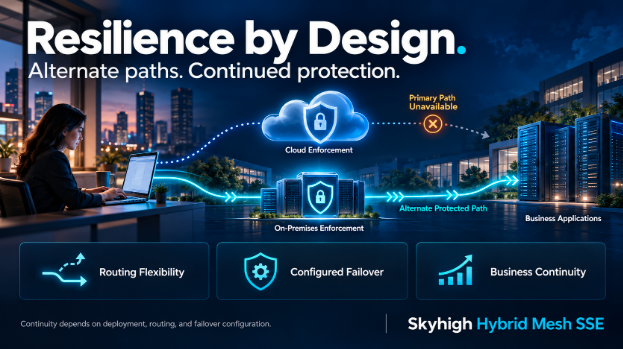
Resilience becomes part of the architecture customers design around their business needs.
5. Greater control over sovereignty
Where inspection happens matters.
Hybrid Mesh SSE gives customers deployment choices that support their data handling, jurisdictional, and regulatory requirements. They can keep designated inspection local and use cloud enforcement where appropriate.
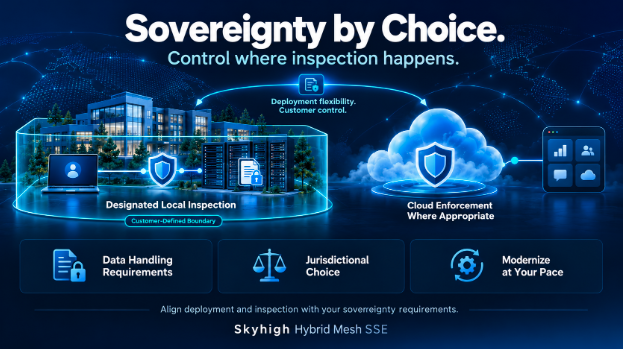
That flexibility helps organizations align security architecture with their sovereignty requirements while continuing to modernize.
6. Unified policy through Policy-as-Code
Distributed enforcement needs a consistent policy foundation.
MOWGLI, our unified Policy-as Code engine, brings that foundation to Hybrid Mesh SSE, helping security teams express their requirements and apply consistent policy across cloud and on-premises environments. Customers can adapt enforcement placement while preserving the policy logic that reflects their business.
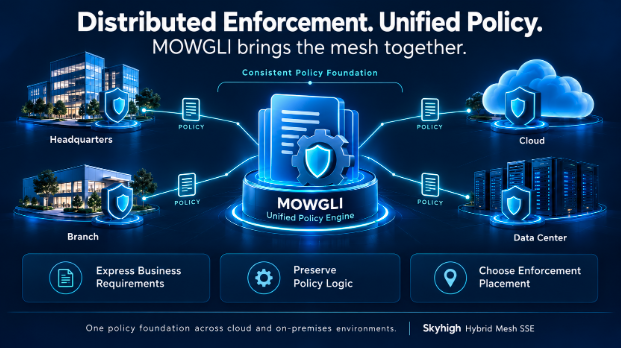
That is what makes the mesh a unified architecture: enforcement is distributed, with policy bringing it together.
Built with our customers for what comes next
What excites me most about this launch is the choice it gives customers: choice in deployment, traffic routing, enforcement location, and how they modernize.
I’m grateful to the customers who challenged our thinking and helped shape this direction, and to the Skyhigh teams whose work brought it to life.
In the coming blogs, we’ll explore each benefit in more detail, including the customer scenarios and architectural decisions behind it.
Welcome to Skyhigh Hybrid Mesh SSE. Security built for the way your enterprise works.
Check out our latest webinar to learn more.
लेखक के बारे में

त्यागा वासुदेवन
उत्पाद के कार्यकारी उपाध्यक्ष
त्याग वासुदेवन एक उच्च ऊर्जा सॉफ्टवेयर पेशेवर हैं, जो वर्तमान में उत्पाद के कार्यकारी उपाध्यक्ष के रूप में कार्यरत हैं। Skyhigh Security , जहां वे उत्पाद प्रबंधन, डिजाइन, उत्पाद विपणन और जीटीएम रणनीतियों का नेतृत्व करते हैं। अनुभव के धन के साथ, उन्होंने SAAS-आधारित एंटरप्राइज़ सॉफ़्टवेयर (ओरेकल, हाईटेल - पूर्व में YouSendIt, WebEx, Vitalect) और उपभोक्ता इंटरनेट (याहू! मैसेंजर - वॉयस और वीडियो) दोनों में उत्पादों के निर्माण में सफलतापूर्वक योगदान दिया है। वे अंतर्निहित अंतिम-उपयोगकर्ता समस्याओं और उपयोग के मामलों की पहचान करने की प्रक्रिया के लिए समर्पित हैं और इन चुनौतियों का समाधान करने के लिए उच्च तकनीक वाले उत्पादों और सेवाओं के विनिर्देशन और विकास का नेतृत्व करने में गर्व महसूस करते हैं, जिसमें संगठनों को जोखिमों और अवसरों के बीच नाजुक संतुलन को नेविगेट करने में मदद करना शामिल है।
संबंधित सामग्री

ट्रेंडिंग ब्लॉग
Introducing Skyhigh Hybrid Mesh SSE: Built for the Way Modern Enterprises Work
Thyaga Vasudevan October 26, 2026
Secure Where Work Happens: Stop Paying Cloud Rates for Local AI
Mike Smart October 16, 2026
Securing the New Normal: Why Universal Zero Trust is Essential in the Age of AI
Sriram Krishnamurthy September 30, 2026
Work is Hybrid. Why Are You Paying Double for a Cloud Tax on the Office?
Mike Smart September 24, 2026
We Can’t Stop the AI Race. We Can Make It Safer and More Secure.
Thyaga Vasudevan September 15, 2026