Recursos
Infraestructura de acceso web resiliente: una necesidad empresarial en un mundo obsesionado con la nube y el código Vibe
Por Ste Nadin - Arquitecto Jefe
23 de abril de 2026 3 minutos de lectura

Si sus fuentes de noticias en línea se parecen en algo a las mías, seguramente estará viendo muchas publicaciones sobre lo que Anthropic es capaz de programar o sobre el último modelo de IA creado por algún influencer tecnológico. Es realmente impresionante, pero ¿es la «programación intuitiva» realmente una prioridad para los responsables de TI y seguridad? Como mencioné en mi último artículo del blog sobre protección de datos, este artículo se centra en ayudar a los profesionales y a los responsables, poniendo de relieve prioridades de seguridad que suelen pasarse por alto.
Para el acceso web seguro en el ámbito empresarial, resiliencia y productividad suelen seguir siendo las principales prioridades para el personal directivo —directores técnicos (CTO), directores de sistemas de información (CIO) y responsables de la toma de decisiones de alto nivel—.
Una infraestructura de acceso web resiliente basada en un modelo híbrido constituye la base para alcanzar estas prioridades y objetivos empresariales. Un acceso web seguro debe consistir en adoptar un enfoque híbrido que aúne lo mejor de estos tres ámbitos: pasarelas web, máquinas virtuales y la nube.
La innovación avanza a gran velocidad, pero la resiliencia no le sigue el ritmo
Los ciclos de desarrollo actuales premian la rapidez. Se incentiva a los equipos para que desarrollen, lancen y mejoren sus productos más rápido que nunca. ¿Cuál es la consecuencia? Aplicaciones extraordinarias que transforman el funcionamiento de las empresas. Sin embargo, bajo la superficie se está produciendo una disyuntiva:
- Las decisiones relativas a la infraestructura se están simplificando
- Los controles de seguridad se externalizan cada vez más a los proveedores de servicios en la nube
- La resiliencia se da por sentada, no se diseña
[Desarrolladores] → [Plataforma en la nube] → [Usuarios] = Confianza implícita
Este modelo funciona… hasta que deja de hacerlo. Cuando se producen interrupciones del servicio o fallan las dependencias de la nube, las organizaciones se dan cuenta rápidamente de que han construido su sistema sobre un único punto de fallo. Mientras escribo estas líneas, la inestabilidad en Oriente Medio puede provocar —y de hecho ya ha provocado— inestabilidad en la nube.
La fragilidad del acceso web seguro exclusivamente en la nube
El acceso seguro a Internet es, sin duda, el punto de control más crítico en materia de ciberseguridad. Regula la forma en que los usuarios interactúan con Internet y filtra los contenidos maliciosos. Tras hablar con nuestros representantes de ventas de primer nivel, tanto sobre el terreno como en las instalaciones de los clientes, los proveedores que ofrecen soluciones exclusivamente en la nube, la resiliencia está directamente vinculada a la disponibilidad de su proveedor de servicios en la nube.
Esto conlleva un riesgo fundamental: si el proveedor de servicios en la nube sufre una interrupción del servicio → su infraestructura de seguridad deja de funcionar. Si se interrumpe la conectividad → la aplicación de las políticas se vuelve inconsistente. Si se producen picos de latencia → la experiencia del usuario se ve afectada
Modelo de dependencias exclusivamente en la nube en Security Service Edge SSE):
[Usuario] → [Internet] → [Cloud Secure Web Gateway Cloud SWG)] → [Aplicación de políticas]
Punto de riesgo: Toda la cadena de acceso a la web depende de la disponibilidad de la nube
Se trata de una limitación arquitectónica que solo puede resolverse mediante inversión. Concretamente, se trata de invertir en una arquitectura de acceso web unificada que ofrezca implementaciones de pasarelas web en la nube, en dispositivos dedicados a pasarelas web o en una variedad de opciones virtuales (¡piense en VMware, Nutanix, OCI!).
Por qué es importante el acceso híbrido y seguro a la web
Un enfoque híbrido de acceso seguro a la web cambia por completo la ecuación. En lugar de basarse en un único modelo de implementación, las organizaciones ganan en flexibilidad y control al distribuir la aplicación de las políticas entre tres entornos:
- Pasarelas web locales para garantizar la residencia de los datos y contar con una copia de seguridad fiable desde la nube
- Máquinas virtuales para una implementación flexible y regional
- Aplicación de políticas en la nube para garantizar la escalabilidad, el alcance global y una plantilla muy dispersa
Modelo híbrido:
Usuario → Capa de gestión del tráfico:
↘ SWG en la nube
↘ Puerta de enlace local
↘ SWG basado en máquina virtual
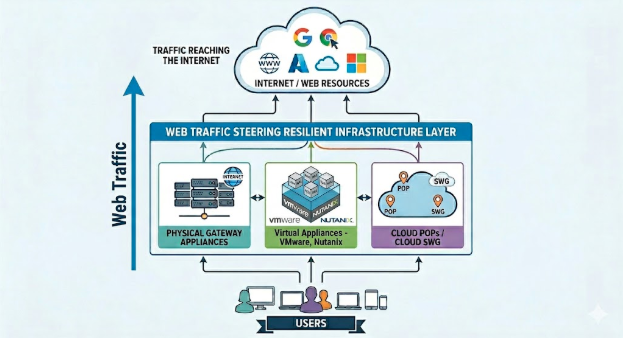
El acceso a la web se mantiene estable aunque se produzca una interrupción en la nube, se averíen los dispositivos o se sobrecargue una máquina virtual.
Los argumentos económicos a favor de la resiliencia
Cuando falla el acceso seguro a Internet, las consecuencias van más allá de las brechas de seguridad:
- La productividad disminuye a medida que los usuarios pierden el acceso
- El riesgo aumenta a medida que se eluden los controles
- Los ingresos se ven afectados durante los periodos de inactividad
Un enfoque híbrido garantiza la continuidad. Si falla una capa, otra toma el relevo sin interrupciones. Esa es la diferencia entre la seguridad reactiva y la resiliencia planificada.
Skyhigh Security en implementaciones híbridas. Nos especializamos en proporcionar dispositivos de puerta de enlace web locales que permiten mantener sus datos en sus propias instalaciones, al tiempo que le ofrecen una opción de respaldo en caso de que se produzca una interrupción en el servicio de la nube. Nos especializamos en la implementación en una amplia gama de entornos virtuales, entre los que se incluyen VMware y OCI. Por último, nos especializamos en soluciones en la nube que mantienen su infraestructura de seguridad actualizada.
Póngase en contacto hoy mismo con ponerse en contacto con un miembro del equipo de ventas o ver una demostración.
Sobre el autor

Ste Nadin
Arquitecto Jefe
Ste es arquitecto empresarial y desempeña las funciones de arquitecto jefe y director técnico, con casi 30 años de experiencia práctica en la implementación de sistemas operativos críticos. Fiel a un enfoque que da prioridad a los resultados empresariales, ha impulsado el éxito en diversos sectores industriales altamente regulados. Entre ellos se incluyen las infraestructuras críticas nacionales, la administración pública, la sanidad y la seguridad. Se le reconoce como uno de los pensadores más destacados del sector, desempeñando funciones como la de presidente de SEMAT.inc, donde trabaja para lograr un consenso en torno al fomento del diseño y la implementación de las mejores prácticas.
Contenido relacionado


Blogs de moda
We Can’t Stop the AI Race. We Can Make It Safer and More Secure.
Thyaga Vasudevan September 15, 2026
AI Is Changing Your Data Risk. DSPM Puts You Back in Control.
Megha Shukla September 4, 2026
Why Customers Love Mowgli: The IKEA Effect in Cybersecurity
Thyaga Vasudevan August 13, 2026
The Future of Security Starts with Data: Why Our Strategy Continues to Gain Momentum
Sanjay Castelino August 6, 2026