ทรัพยากร
Secure Where Work Happens: Stop Paying Cloud Rates for Local AI
By Mike Smart - Director of Product Marketing
October 16, 2026 3 Minute Read
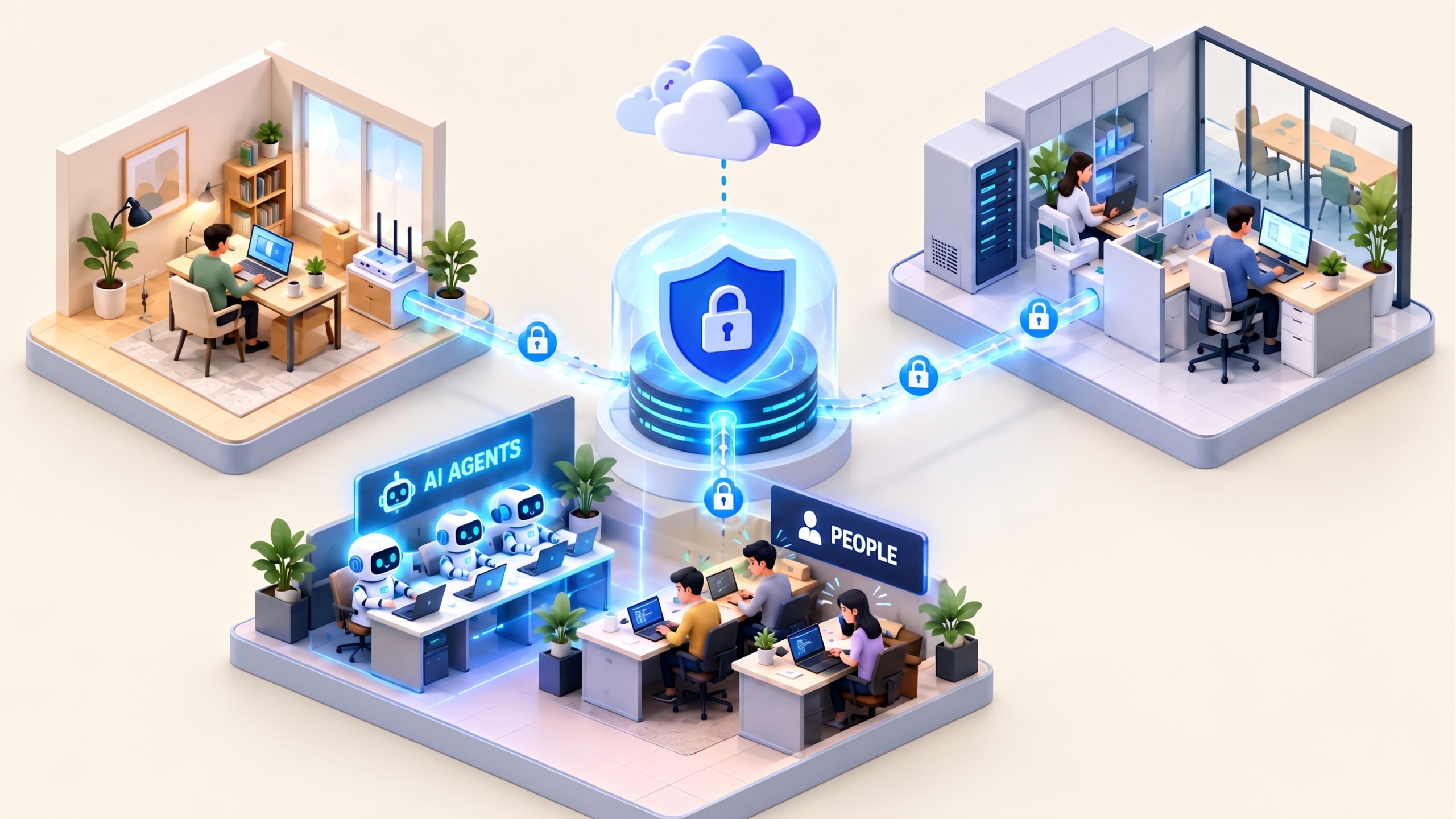
Let’s address the elephant in the server room: why are you still paying premium cloud-processing rates for data that doesn’t need to leave your building? For enterprises with significant in-office or local AI traffic, inspecting that traffic locally can cut web security and SSE OPEX by up to 50%*.
The Rise of Sovereign AI and Local Processing
The operating environment is shifting again. Beyond human workers sitting at corporate desks, enterprises are rapidly building and deploying in-house Generative AI models and LLMs.
The drivers behind this move are pragmatic. Building AI locally keeps high-volume compute costs predictable while giving organizations total digital sovereignty and governance over their IP.
Yet, if you run a cloud-first Secure Service Edge (SSE) architecture, your local users interacting with local AI models and applications are forced into an absurd detour. Their prompts, queries, and data flows are sent out to a third-party cloud PoP for policy inspection and enforcement, only to be routed straight back to the local data center.
Paying a Toll For a Road You Are Not Driving On
Cloud-delivered SSE proxies were designed to inspect remote, internet-bound traffic. To cover public cloud infrastructure, bandwidth, and compute, vendors charge premium cloud rates to process all user, and increasingly, AI traffic.
When you route local office traffic or local AI workflows through those same cloud PoPs, you pay a heavy “Cloud Tax”. You are essentially paying cloud-processing fees for local compute.
Worst of all, if a cloud-only vendor offers a lightweight local appliance, they often force “chained” inspection back to their cloud anyway—effectively charging you twice for the same flow. Vendors should charge fairly based on where inspection should occur.
Minimizing the Tax: Location-Aware Security Economics
The solution isn’t to tear down your cloud security or manage two separate, fragmented stacks. You already have a unified console and policy model; you shouldn’t have to give that up.
Instead, the architecture needs to decouple policy management from policy enforcement.
- Author Once, Enforce Anywhere: You author Zero Trust, DLP, SWG and access rules once centrally in the cloud.
- Intelligent Local Inspection: Local traffic—whether an employee pulling a file from an on-prem server or prompting an internal AI model—is inspected locally at LAN speeds via a local physical or virtual appliance, capable of running SSE services locally, like Zero Trust, SWG and Gateway antimalware.
- Fair Pricing Models: Because local processing leverages on-premises infrastructure, significantly less traffic needs to be routed to your cloud SSE vendor, which in turn means your vendor has much lower cloud processing costs. Why can’t these cost savings be passed back to their customers?
When vendors pass those operational savings back to you through location-aware billing models, the economic impact is immediate. For enterprises with high in-office populations or local AI workloads, inspecting traffic locally could cut web security and SSE OPEX by up to 50%.
What to Demand from Your SSE Partner
If you are evaluating your current cloud-first SSE contract, ask your vendor a direct commercial question: If our traffic stays on our network, why are we paying you public cloud processing rates?
You shouldn’t be penalized for bringing work, data, and AI back local. Demand an adaptable architecture that delivers consistent security posture and high-fidelity security everywhere—and charges you fairly for where it actually runs.
Check out a recent CIO, CISO and CFO panel discussion as they dismantle the cloud-only myth. You’ll learn how to regain control of your data, meet strict regulatory requirements, and avoid paying up to double* by intelligently balancing cloud and local security enforcement.
*Potential savings vary by traffic, deployment, and commercial assumptions, and are modelled against your own in-office and remote user split. Source: Skyhigh location-based licensing model.
เกี่ยวกับผู้เขียน

Mike Smart
Director of Product Marketing
Mike is Director of Product Marketing at Skyhigh Security and brings 30 years of experience in the technology industry, with most of his career spent in product marketing at leading cybersecurity companies including ExtraHop, Cybereason, Forcepoint, Symantec and McAfee. At Cybereason, he received an MVP award for a sales program that helped accelerate pipeline generation and deal velocity.
เนื้อหาที่เกี่ยวข้อง


บล็อกที่กำลังได้รับความนิยม
Secure Where Work Happens: Stop Paying Cloud Rates for Local AI
Mike Smart October 16, 2026
Securing the New Normal: Why Universal Zero Trust is Essential in the Age of AI
Sriram Krishnamurthy September 30, 2026
Work is Hybrid. Why Are You Paying Double for a Cloud Tax on the Office?
Mike Smart September 24, 2026
We Can’t Stop the AI Race. We Can Make It Safer and More Secure.
Thyaga Vasudevan September 15, 2026
AI Is Changing Your Data Risk. DSPM Puts You Back in Control.
Megha Shukla September 4, 2026