





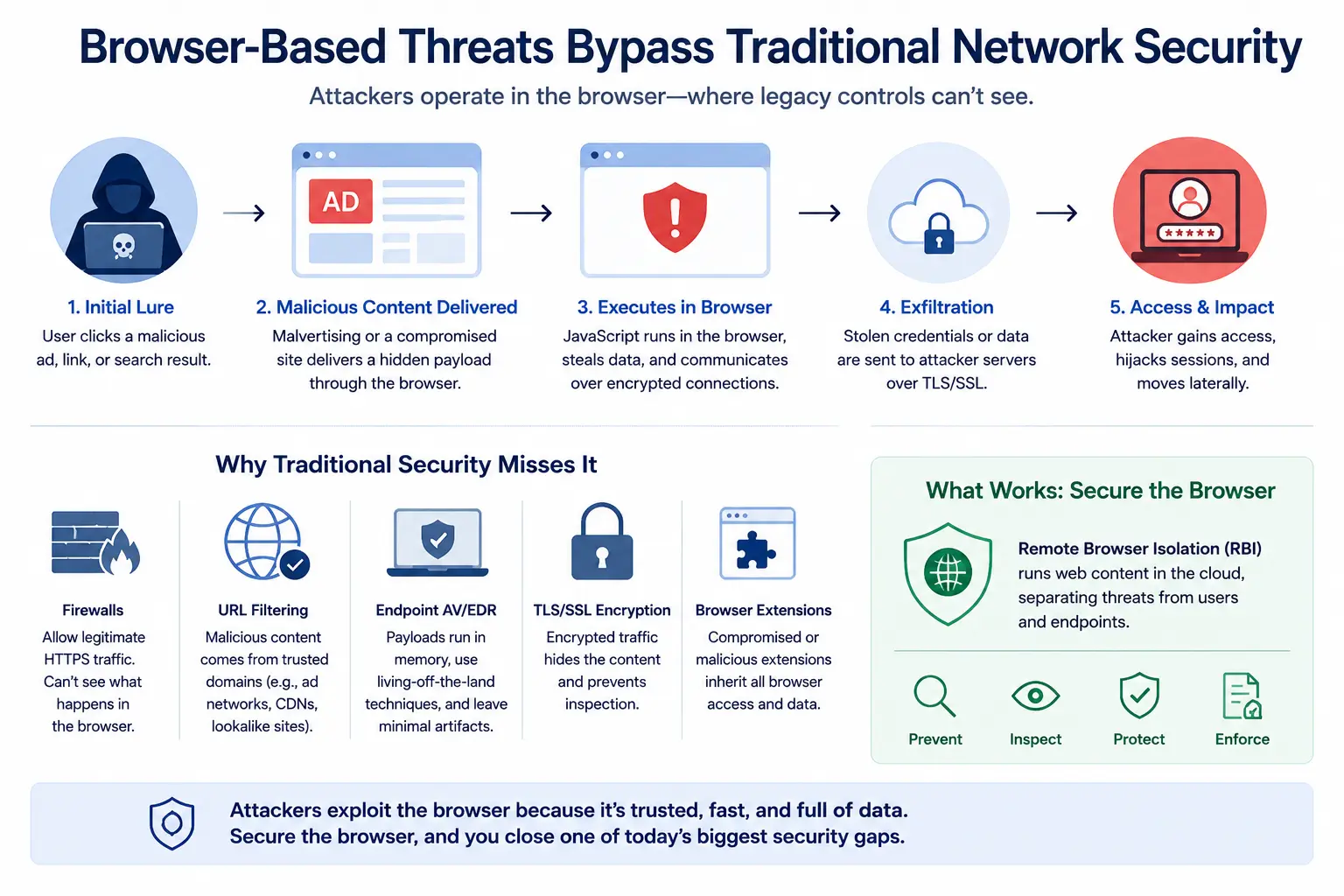
Comment les menaces liées aux navigateurs contournent les systèmes de sécurité réseau traditionnels
- Malvertising through trusted ad networks delivers payloads that URL filtering, reputation systems, and endpoint AV cannot block.
- Encrypted traffic is a blind spot, not a safeguard. With the vast majority of threats now hidden in TLS/SSL traffic, inspection.
- Browser extensions are an overlooked initial access vector. A single compromised extension update can inherit cookies,.
- Credential harvesting through lookalike login pages bypasses network layer defenses entirely because the phishing page renders.
- Session hijacking defeats MFA. Attackers who steal active session tokens do not need to phish a second factor—they inherit the.
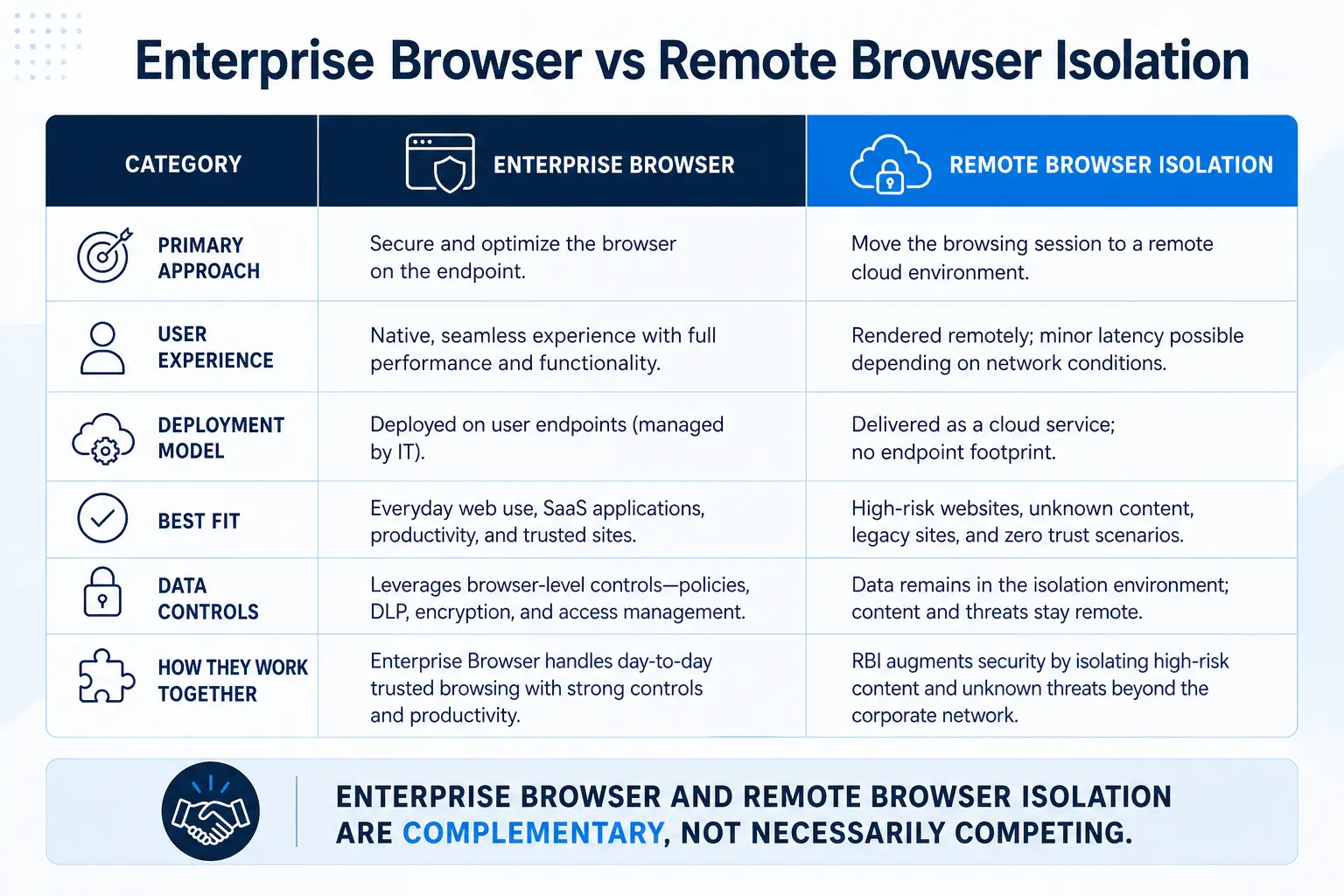
- Remote browser isolation (RBI) is the most direct mitigation for threats that execute inside the rendering engine, because it.
- A unified SSE approach—integrating SWG, CASB, DLP, ZTNA, and RBI—addresses browser threats at the policy layer rather than.
Your firewall logs are clean, your endpoint agent shows no alerts, and the URL reputation feed gave the site a pass. Yet an attacker just harvested a finance manager's session cookies for your company's payroll SaaS, pivoted into your intranet, and exfiltrated a quarter's worth of compensation data—all through a browser tab that never triggered a single detection. Browser based threats are not new, but the gap between how they operate today and what traditional perimeter and endpoint controls were built to catch has never been wider.
This article maps the specific mechanisms attackers use to weaponize the browser, explains why legacy defenses systematically miss them, and outlines what security teams need to prioritize now.
The Anatomy of a Browser-Delivered Attack That Your Stack Missed
Picture this: a procurement analyst at a manufacturing firm searches for a niche industrial supplier. A sponsored search result—served through a major, legitimate ad network—tops the results. The ad domain passes URL filtering; the ad platform's own reputation is clean. The analyst clicks. The landing page fingerprints the browser version, confirms it is not a sandbox, loads a JavaScript payload obfuscated behind three layers of redirect, and drops an infostealer that harvests every credential stored in the browser's password manager. Endpoint AV sees a signed Chromium process doing what browsers do—executing JavaScript—and does nothing.
MITRE ATT&CK documents this pattern as T1189 (Drive by Compromise): adversaries gain access to a system through a user visiting a website over the normal course of browsing. Delivery methods include legitimate websites injected with malicious code, script files served from compromised cloud storage, and malicious ads served through legitimate ad providers (malvertising).
Even Google acknowledges the scale: in 2024 alone, Google stopped 5.1 billion bad ads and suspended 39.2 million advertiser accounts (Google Ads Safety Report, 2025). Those numbers are staggering—and they still represent only what was caught. The ads that make it through form the attack surface your SOC is most blind to, because every control in the chain—DNS, URL category, TLS certificate, endpoint signature—evaluated the ad infrastructure as trustworthy.
Had this analyst's session been routed through remote browser isolation, the JavaScript would have executed in an ephemeral cloud container. The infostealer would have had no local process to hook, no credential store to read, and no persistence path to the endpoint.
Why Traditional Network Security Systematically Fails at the Browser
Legacy perimeter defenses were architected for a world where threats arrived as files on the wire or connections to known bad IPs. The browser has inverted that model. Here is where specific controls break down:
Encrypted traffic inspection gaps
The ThreatLabz 2024 Encrypted Attacks Report found that 87% of threats were hidden in TLS/SSL traffic. Most legacy secure web gateways either cannot decrypt TLS 1.3 at scale or exempt large categories of traffic—banking, healthcare portals, SaaS apps with certificate pinning—from inspection. An attacker who hosts a credential harvesting page behind a valid Let's Encrypt certificate on a freshly registered domain rides cleanly through the gap. A SOC analyst reviewing proxy logs sees an outbound HTTPS connection to a CDN. Nothing looks wrong until it is far too late.
URL filtering and reputation lag
URL reputation databases are reactive. A malvertising campaign that uses a new domain, cloaks its landing page to show benign content to crawlers, and serves the real payload only to victims matching a specific browser fingerprint will not appear in any threat feed until after the first wave of compromises. Consider a typical trojanized software campaign distributed via search ads: the sites promote a legitimate looking application, the download domain passes reputation checks, and the malware remains dormant for weeks before activating—long enough to outlast most retroactive URL blocks.
Endpoint AV and EDR blind spots in the browser
In browser attacks are difficult for endpoint security tools to detect because artifacts are ephemeral, buried inside browser memory, and transmitted almost instantaneously to maintain user experience (GitLab Security Tech Notes, 2025). When a malicious JavaScript payload executes inside the browser's V8 engine, it does not drop a file to disk; it manipulates the DOM, reads form fields, and exfiltrates data over WebSocket connections that look identical to legitimate browser traffic. EDR agents monitoring process trees, file writes, and registry changes see nothing actionable.
What Changed: The Browser Is Now the Enterprise Workspace
Three converging shifts have turned the browser from a secondary concern into the primary attack surface:
First, SaaS has replaced the network as the perimeter. When employees access Salesforce, Workday, ServiceNow, and Microsoft 365 through a browser, the browser session is the access layer. A compromised browser session grants the same access as a compromised VPN—often more, because SaaS sessions frequently persist across devices and lack the network layer logging that VPN connections provide.
Second, web compromise as an initial infection vector is surging. The Mandiant M Trends 2025 report found that web compromise rose from 5% to 9% of initial infection vectors between 2023 and 2024—nearly doubling. Web compromise encompasses drive by compromise, malicious advertisements, SEO poisoning, and compromised websites. This increase is not random noise; it reflects attackers deliberately shifting to browser based delivery because it evades the controls organizations have invested in.
Third, credential theft and session hijacking have industrialized. Stolen credentials were the second most common initial access vector at 16% of investigated incidents according to Mandiant M Trends 2025. The Verizon 2025 DBIR reported that stolen credentials were used in 22% of breaches. Many of those credentials originate from the browser: autofilled passwords, cookies in local storage, and session tokens captured by infostealers running in the rendering context. The convergence of infostealer malware, credential marketplaces, and browser as workspace means that a single compromised browser session can unlock an attacker's entire kill chain.
Browser Extensions: The Supply Chain Attack You Are Not Monitoring
A marketing coordinator installs a popular grammar checking Chrome extension that has 500,000 users and a 4.8 star rating. Six months later, the extension's developer sells it to an unknown buyer. The new owner pushes a silent update that adds code to exfiltrate cookies and session tokens for every site the user visits, including the corporate SSO portal. No alert fires because the extension was already trusted, the update came through the official store, and the exfiltration uses standard HTTPS calls.
In December 2024, a threat actor conducted a software supply chain attack using compromised developer accounts to distribute malicious browser extension updates from the Chrome Web Store (GitLab Security Tech Notes, 2025). The threat actor updated extensions with code that exfiltrated data from HTTP headers and DOM content based on a dynamic configuration—a sophisticated attack impacting at least 3.2 million users.
The operational model is alarmingly simple. The most consistent pattern since late 2024 has been trust hijacking through updates: attackers publish in official stores, compromise developers, or take over established extensions, then push weaponized updates to existing users at scale. "Sleeper" extensions remain benign long enough to build credibility, then activate spyware, token theft, or redirection behaviors through updates.
From a SOC perspective, this attack class is almost invisible. The extension operates inside the browser process, communicates over HTTPS to domains that may be freshly registered or hosted on cloud platforms, and accesses exactly the same page content the user legitimately sees. Endpoint agents do not flag it. Network monitoring sees encrypted traffic to a CDN. The only effective countermeasures are granular extension governance—allowlisting, permission auditing, version pinning—and isolating browser sessions through browser isolation so that even a compromised extension cannot reach the real endpoint.
Credential Harvesting and Session Hijacking: Defeating MFA Through the Browser
A payroll administrator receives an email about a benefits policy update. The link opens a page that looks exactly like the company's identity provider login—same branding, same certificate lock icon, same domain structure if the user does not scrutinize the subdomain. The administrator enters their credentials and MFA token. An adversary in the middle proxy relays the credentials to the real identity provider in real time, captures the session cookie, and replays it from their own browser. The attacker now has an authenticated session. MFA did its job—it authenticated the user—but the attacker stole the output of that authentication.
MITRE ATT&CK T1185 (Browser Session Hijacking) describes how adversaries take advantage of security vulnerabilities and inherent functionality in browser software to change content, modify user behaviors, and intercept information. A specific example is when an adversary injects software into a browser that allows them to inherit cookies, HTTP sessions, and SSL client certificates. With these permissions, an adversary could potentially browse to any resource on an intranet, such as SharePoint or webmail. Browser pivoting may also bypass security provided by 2 factor authentication.
This is not a theoretical concern. Adversary in the middle phishing kits are commoditized. Phishing as a Service toolkits now use "Browser in the Browser" (BitB) techniques that display fake browser windows within a user's actual browser to mimic legitimate login flows. These kits present convincing login screens complete with spoofed address bars and capture both credentials and active session tokens. They employ bot protection checks, conditional loading, rapid domain rotation, and code obfuscation to evade detection.
Traditional network controls—IP reputation, domain age filtering, even certificate transparency monitoring—struggle to keep pace with the rapid rotation of infrastructure. The most effective defense is preventing the phishing page from rendering on the user's actual browser in the first place, which is precisely what a next generation secure web gateway with integrated RBI achieves: even if the user clicks, the page renders in an isolated container where credentials cannot be keylogged and session tokens cannot be intercepted.
JavaScript-Based Exfiltration: Data Loss Through the Rendering Engine
An analyst at a healthcare company opens a research portal that has been compromised via a third party analytics script. The injected JavaScript silently reads the DOM of a tabbed SaaS application the analyst has open—specifically, a patient records dashboard—serializes the visible data into a JSON blob, and POSTs it to an attacker controlled endpoint via a WebSocket connection that looks like telemetry traffic. No file was downloaded. No executable was dropped. DLP rules watching for attachments, USB writes, or cloud uploads never fire.
This scenario illustrates why data loss prevention must extend into the browser session itself. JavaScript running in the browser has read access to everything the user can see. Cross origin restrictions help, but compromised first party scripts, supply chain poisoned libraries, and malicious extensions all operate within the same origin as the legitimate application.
Mandiant was unable to determine an initial infection vector for 34% of 2024 intrusions (M Trends 2025)—a proportion that indicates potential deficiencies in enterprise logging and detection capabilities. Browser based exfiltration is a likely contributor to that gap: when data leaves through the rendering engine rather than the file system, the forensic trail is minimal.
Ce que les équipes de sécurité devraient faire dès maintenant
The structural mismatch between browser delivered threats and network layer controls will not close on its own. Here is a prioritized action plan:
1. Deploy remote browser isolation for high-risk traffic
RBI executes web content in a disposable cloud container and streams only safe visual output to the endpoint. Malvertising payloads, drive by exploits, and JavaScript based exfiltration all terminate in the container. Start with uncategorized URLs and risky categories, then expand to all web traffic for privileged users and sensitive roles. Skyhigh Security's SSE platform with integrated RBI avoids the deployment complexity of standalone isolation products.
2. Enforce TLS inspection without exception carve-outs
If the vast majority of threats hide in encrypted traffic, exempting large swaths of HTTPS from inspection creates a guaranteed blind spot. Modern cloud delivered SWG architectures can inspect TLS 1.3 at scale without the latency and certificate management problems of legacy appliances. As NIST SP 800 207 emphasizes, zero trust assumes there is no implicit trust granted to assets or user accounts based solely on their physical or network location. That principle extends to encrypted sessions: trust the identity and the data, not the protocol wrapper.
3. Lock down browser extensions
Implement an allowlist of approved extensions. Audit permissions aggressively—any extension requesting <all urls host permissions or access to cookies and web requests should require security review. Pin extension versions to prevent silent malicious updates. For organizations that cannot fully restrict extensions, RBI provides a safety net by isolating extension activity from the corporate session.
4. Move DLP into the browser context
File level and network level DLP miss JavaScript based exfiltration. Inline DLP policies enforced through a Skyhigh cloud delivered web and cloud security gateway can inspect content within the browser session, catching copy/paste of sensitive data to unapproved destinations, digitally watermarking screenshots of sensitive browser content, and controlling downloads to unmanaged devices.
5. Adopt phishing-resistant authentication
FIDO2 compliant hardware security keys bind authentication to the legitimate domain, making adversary in the middle phishing structurally impossible even if the user clicks a malicious link. Session token binding and continuous posture assessment further reduce the window of exposure.
The Urgency: Detection Gaps Are Widening, Not Closing
The global median dwell time reached 11 days in 2024 (Mandiant M Trends 2025), and many intrusions are discovered within the first week. That sounds encouraging—until you consider that browser based attacks can complete their entire kill chain in minutes: credential harvest, session hijack, data exfiltration, and cleanup—all within a single browser session that may never appear in endpoint or network logs.
57% of organizations first learned of a 2024 compromise from an external source (Mandiant M Trends 2025). If your own SOC is not the one finding the breach, the question is whether your tooling has any visibility into the browser at all. For most organizations, the honest answer is no. The Verizon 2025 DBIR underscored this reality by finding that human involvement factored into 60% of breaches—and in a browser centric world, the browser is where that human interaction happens.
The browser is where employees authenticate, where sensitive data is viewed and manipulated, and where SaaS workflows execute. It is the single most consequential endpoint surface in the enterprise, and it remains the least instrumented. Every month that passes without extending security controls into the browser is a month of accumulated, unquantified risk.