Recursos
Security in the Age of Machine Speed
Por Ste Nadin - Arquitecto Jefe
July 30, 2026 6 Minute Read

As the ability to identify and exploit vulnerabilities reaches “machine speed,” system defenses must keep pace. This paradigm shift requires a fundamentally different approach to security application.
Skyhigh Security has always been at the forefront of protecting an enterprise’s most critical assets. This commitment is exemplified by our Gateway Anti-Malware (GAM) solution, which leverages AI for machine-speed malware detection, constantly learning and adapting to stay ahead of emerging threats.
Skyhigh Security is a proud member of both the GPT5.5-Cyber program and the Mythos Cyber initiative. Understanding how to leverage these programs, and knowing how to proceed even without direct access to them, is essential for modern security professionals.
The Rise and Rise of AI
While the use of AI has increased steadily over the last few years, 2026 has been unprecedented. The introduction of increasingly advanced AI models is disrupting not only how companies conduct business but how they fundamentally operate. For those who embrace this technology, it promises a world of expanded opportunity and productivity.
Unfortunately, the rise of AI has also empowered malicious actors. They are utilizing the latest AI models to orchestrate sophisticated cross-vector attacks and uncover “sleeping” vulnerabilities in software and services that have remained undetected by traditional security techniques.
This exposes critical software, services, and the systems containing a company’s intellectual property, including customer and employee data, at “machine speed.” This evolution is faster than traditional security, testing, and software development lifecycles can typically match.
Consequently, the way security operates in the “Machine Speed Age” must evolve accordingly.
While this shift may seem daunting, it will ultimately lead to more resilient services and underlying software, provided organizations understand the changing environment and take proactive steps to protect themselves.
What is Driving the Change?
In early April 2026, Anthropic previewed Claude Mythos. During the announcement, they revealed that the model possessed an unprecedented ability to identify and exploit software vulnerabilities. Consequently, they opted to delay the full public release to allow partners to analyze their own systems and remediate vulnerabilities before the tool became widely available.
While this was partly a clever marketing strategy, positioning the model as “too powerful to release,” it underscored a new reality: frontier AI models are challenging the industry’s traditional methods for identifying and fixing software flaws.
Since then, several AI vendors have released models with enhanced security research capabilities. Most vendors have also established dedicated programs for partners to access models without standard security guardrails, specifically to identify and remediate vulnerabilities for legitimate defensive applications.
What Impact is this Having?
The evolutionary war between security defenders and attackers remains constant; the difference now is the speed of the conflict. We are seeing paradigm-shifting multipliers in the pace of discovery and exploitation.
The era when a vulnerability could be detected, scheduled for a future bug fix, and released weeks or months later is over. In a world where vulnerabilities can be exploited at “machine speed,” traditional timelines are no longer viable.
Enterprises can no longer rely on traditional patching strategies like “Patch Tuesday.” The slow governance and validation processes often found in large organizations cannot keep up when suppliers identify critical vulnerabilities that require real-time remediation.
This reality is driving two major shifts in the market:
- The adoption of AI models to identify issues prior to software release.
- The necessity for patching and updating processes to operate at “machine speed.”
Using AI to Build Strength in Depth
While AI frontier models have disrupted code security, general best practices remain essential. The most effective approach is to embed these models into the traditional Solution Development Life Cycle (SDLC) and release processes, while also providing constant scanning for live services.
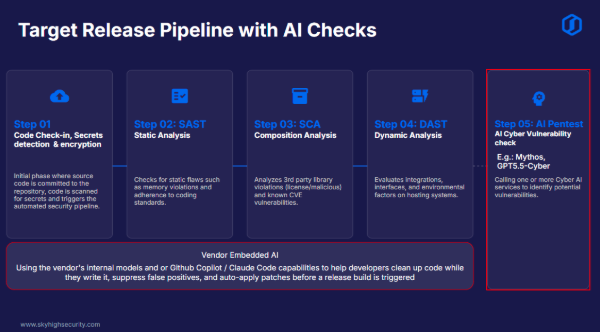
At Skyhigh Security we have done just this by initially extending the SDLC that still uses the traditional SAST and DAST components but looks to extend this out using:
- Embedded AI: We provide our developers with access to AI models that automatically check for security violations before code is even committed to the repository**.
- AI Pentesting: We have added a critical test at the end of the pipeline that utilizes “Cyber” versions of frontier AI models to hunt for vulnerabilities and attack vectors. This allows for resolution before release. Because these tests are run frequently, they can identify newly introduced issues as well as legacy flaws that previous model versions might have missed.
- SAST and DAST Vendor Capabilities: Vendors of Static and Dynamic Application Security Testing software are rapidly integrating AI. By working with these vendors’ tools, we can leverage their increasing accuracy and advanced capabilities.
- AI Remediation: At Skyhigh we believe that humans cannot fix all of these issues fast enough, and therefore to move at “machine speed” we have built an AI powered system at the end of the process that scans and automatically remediates. By combining directly a “Red” agent to identify issues, to a “Green” agent to auto-remediate this allows us not just identify issues for our backlog but ensure software is of high quality.
**Note: Even without access to the latest frontier models, research shows that utilizing smaller models with robust guardrails can still identify significant areas of concern. This is particularly effective when using a combination of different models to catch a wider variety of issues.
Beyond the SDLC pipeline, several security checks should be performed continuously on live systems:
- Implementing CNAPP (Cloud Native Application Protection Platform): These platforms provide continuous visibility into known vulnerabilities and misconfigurations.
- Real-Time Pattern Matching Malware Protection: Capabilities like Skyhigh’s GAM look beyond known signatures to analyze behavioral patterns. By using internal AI to detect suspicious behavior, these systems update themselves at “machine speed,” protecting against new threats as they emerge.
By combining these tools, you can manage vulnerabilities before they are exposed and ensure your organization is equipped to detect and defend against emerging threats in real time.
How Do You Adapt?
To adapt to this changing landscape, I recommend focusing on several key areas:
- Review and Update your SDLC with AI.
Review your SDLC to ensure that robust SAST and DAST capabilities are augmented by AI models to validate code against corporate guardrails. Design this system for flexibility, allowing you to swap AI models as needed—perhaps targeting critical systems with more advanced, high-performance models. - Ensure your vendors are protecting their SDLC.
Since most enterprises rely on third-party vendors, it is vital to verify that your suppliers have implemented modern, AI-enhanced SDLC processes. Integrate these checks into your procurement and vendor review cycles. - Implement “Machine Speed” adaptive detect and protect systems.
Ensure your live environments utilize systems capable of detecting and adapting to machine-level threats as they emerge. Prioritize solutions like Skyhigh Security GAM that offer adaptive protection. - Implement AI Red Teaming
Add AI “red teaming” to your release process to ensure that vulnerabilities are not just looked for within the code but as a production operating system. - Use AI to remediate vulnerabilities.
Identifying more vulnerabilities for an organisation already drowning will not add value unless you have built into your process a means to do machine speed remediation. Look to implement an AI system to suggest fixes and implement alongside your red teaming. - Ensure you can patch on demand.
Move away from fixed patching windows in favor of on-demand patching. Regardless of your other defenses, vulnerabilities will inevitably be detected and will require immediate remediation to prevent “Machine Speed” exploitation.
While this represents a significant shift in approach to security, the benefit for those who adapt will be far more resilient software and services. Success in this new era relies not on hoping vulnerabilities go unnoticed, but on a robust defense-in-depth strategy that operates at the speed of the threat.
For more on the importance of data security in the age of AI, check out our recent market research report: Leveraging DSPM and AI to Solve Data Security Challenges.
Sobre el autor

Ste Nadin
Arquitecto Jefe
Ste es arquitecto empresarial y desempeña funciones de arquitecto jefe y director técnico, con casi 30 años de experiencia práctica en la implementación de sistemas operativos críticos. Fiel a un enfoque que da prioridad a los resultados empresariales, ha impulsado el éxito en diversos sectores industriales altamente regulados. Entre ellos se incluyen las infraestructuras críticas nacionales, la administración pública, la sanidad y la seguridad. Se le reconoce como uno de los pensadores más destacados del sector, desempeñando funciones como la de presidente de SEMAT.inc, donde trabaja para lograr un consenso en torno al fomento del diseño y la implementación de las mejores prácticas.
Contenido relacionado


Securing the New Normal: Why Universal Zero Trust is Essential in the Age of AI

Work is Hybrid. Why Are You Paying Double for a Cloud Tax on the Office?
Blogs de moda
Secure Where Work Happens: Stop Paying Cloud Rates for Local AI
Mike Smart October 16, 2026
Securing the New Normal: Why Universal Zero Trust is Essential in the Age of AI
Sriram Krishnamurthy September 30, 2026
Work is Hybrid. Why Are You Paying Double for a Cloud Tax on the Office?
Mike Smart September 24, 2026
We Can’t Stop the AI Race. We Can Make It Safer and More Secure.
Thyaga Vasudevan September 15, 2026
AI Is Changing Your Data Risk. DSPM Puts You Back in Control.
Megha Shukla September 4, 2026