Ressourcen
What it Means to Apply A Truly Hybrid Security Solution
Von Steve Tait - Vorstand für Technologie
October 29, 2026 4 Minute Read

For several years, and exacerbated by the Covid pandemic, enterprises have been lectured on the inevitable move of all services to the cloud and an almost completely remote workforce. The reality is completely different and most of the cloud-only evangelists from just a few years now recognize that the modern architecture is hybrid.
Virtually no modern enterprise exists either wholly on-premises or in the cloud, instead adopting a hybrid model of work that spans a range of users, devices, teams, offices, and regions. This is driven not just by a post-Covid ‘return to office’ with 75% of companies reporting employees working 2+ days in the office, but also by sovereignty, geopolitics and of course AI.
As a response to this shift, most modern security providers claim that they provide some kind of hybrid solution, or at least a product capable of protecting today’s truly hybrid enterprises. I think they’re wrong.
What others mean when they say “hybrid”
Just because the word hybrid is in a product’s name does not mean that it provides truly hybrid enterprise security capabilities. Some security providers’ idea of hybrid security is simply creating an on-premises extension of their existing cloud-based solution. Sure, the extension may be on-prem, but all traffic and security workloads are still routed through the cloud-based model.
Sending everything back to the cloud is not just inefficient and clunky, but it’s incredibly expensive. It uses enough compute power and bandwidth to justify a higher price tag from the provider, which customers must choose to accept in the pursuit of “effective” hybrid security. Furthermore it hinders an organization’s ability to create a truly universal Zero Trust approach that treats the on-premises network as a first-class citizen along with remote and cloud users.
In many cases, this on-prem extension of a cloud-based product is managed by the solution provider, which massively limits the customer’s deployment flexibility. Most enterprises would rather not let a third party too deep into their network, less they risk additional security complications. This inflexibility not only limits customer choice, but it effectively breaks many of today’s growing data sovereignty requirements by removing data and control from specific regulated regions.
What hybrid security actually means
These types of purportedly “hybrid” solutions are, therefore, nothing but rebranded extensions of purely cloud-based security. That’s all well and good if your enterprise operates mostly in the cloud. But for the modern team that leverages a truly hybrid model of work, it’s not enough.
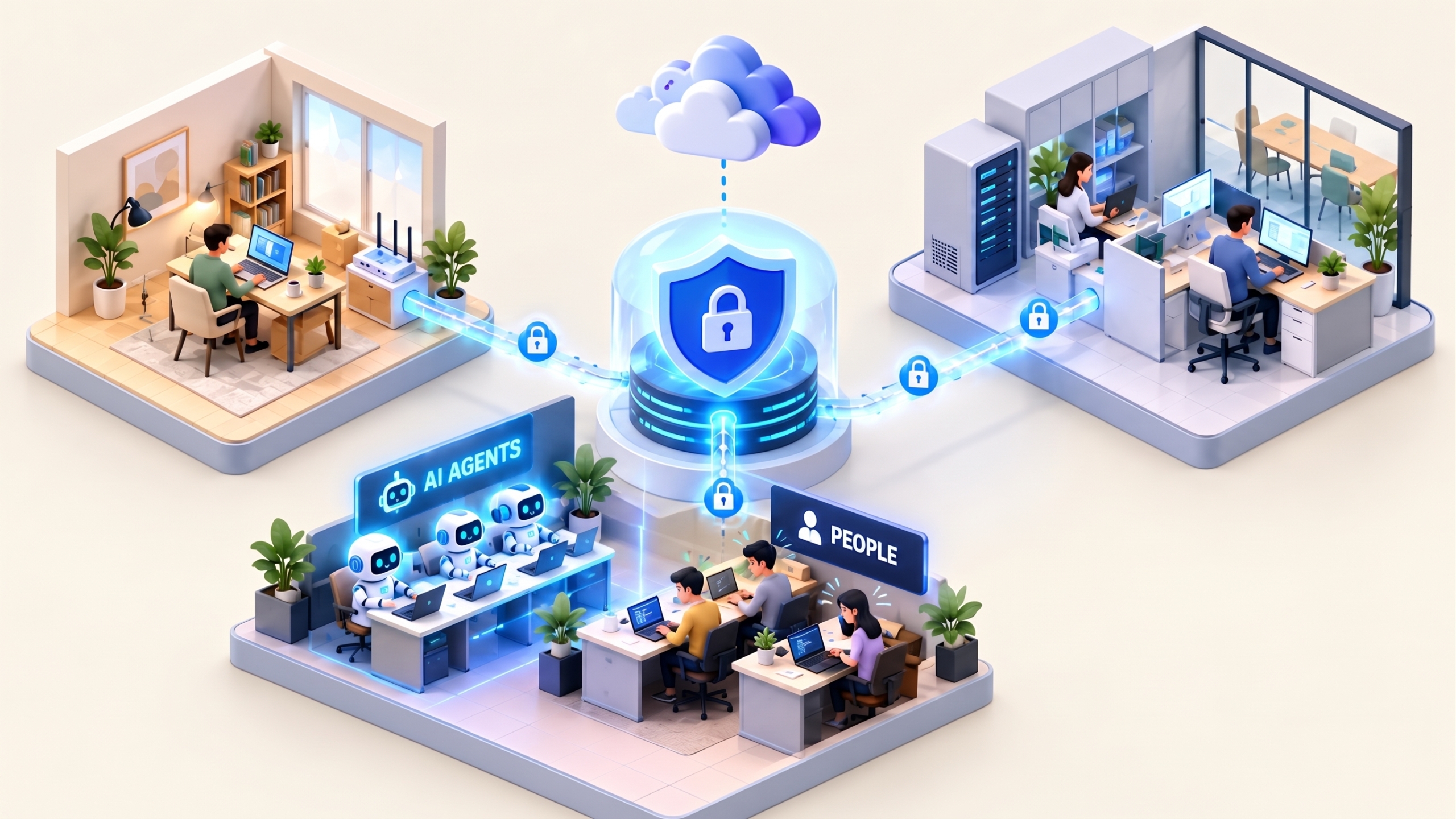
Running a legitimate hybrid mesh security model means providing an actual on-premises deployment that the customer can manage and deploy as needed. It means giving enterprises the flexibility to protect their architecture as designed, not forcing teams to bend to limited cloud-centric offerings. And it means meeting customers where their work actually happens in order to protect their information in offices, in users’ homes, and on-the-go.
That’s why we’ve used our 20+ years of experience running on-premises security service edge (SSE) protections for mission-critical organizations to build a new, hybrid solution designed for the modern AI powered hybrid world: the Skyhigh Hybrid Mesh SSE.
How Hybrid Mesh SSE operationalizes true hybrid security
Our Hybrid Mesh SSE solution was built around the idea that security should adapt to the enterprise, not the other way around. At its core, this solution provides the flexibility to deploy security controls wherever they make the most sense—whether that be in the cloud, on-premises, or otherwise. This new, first-to-market architecture enables enterprises to:
- Protect work wherever it happens. Hybrid Mesh SSE extends Zero Trust protections beyond the cloud edge, applying security controls as close as possible to users, applications, and data, rather than routing everything through a centralized cloud environment.
- Maintain control over sensitive data. Teams can keep inspection and enforcement within their own controlled environments whenever data sovereignty, compliance, or governance requirements demand it, preserving flexibility without sacrificing security.
- Improve resilience and performance. By supporting both local and cloud-based enforcement, Hybrid Mesh SSE reduces unnecessary traffic backhauling, helping teams improve user experience, operational resilience, and overall efficiency. It can even enable full failover from Cloud to on-prem and visa versa to meet increasingly stringent regulatory requirements around resilience.
- Apply one policy everywhere. A unified architecture enables consistent policy enforcement across on-premises environments, SaaS and private applications, cloud services, and AI tools without creating separate security models.
- Deliver flexibility without higher costs. Intelligent enforcement helps organizations apply security where it makes the most sense, reducing unnecessary cloud processing while improving performance and lowering operational costs by up to 50%.
Our Hybrid Mesh SSE doesn’t treat hybrid security as just another extension of the cloud. Nor does it overcomplicate what are already increasingly complex sovereignty and compliance requirements. And it does not force customers to adopt a model that better suits the provider and, conveniently, drives up costs. It delivers comprehensive and consistent security where work actually happens across the modern hybrid enterprise, giving teams greater control, flexibility, and protection throughout their entire work environment.
To learn more about Skyhigh Hybrid Mesh SSE, head over to our product page or request a demo.
Über den Autor

Steve Tait
Leiter der Technologieabteilung
Steve ist eine technologische Führungspersönlichkeit mit über 25 Jahren Erfahrung in der Bereitstellung von Unternehmenssoftwarelösungen in einer Vielzahl von Branchen, darunter Sicherheit, Verteidigung, Finanzdienstleistungen und Gesundheitswesen. Er hat sich auf die Bereitstellung von unternehmenskritischen Anwendungen spezialisiert und war in verschiedenen leitenden Positionen für FTSE 100-Unternehmen und KMUs tätig, die sowohl börsennotiert als auch durch Private Equity finanziert sind.
Verwandter Inhalt
Introducing Skyhigh Hybrid Mesh SSE: Built for the Way Modern Enterprises Work
Laufende Blogs
What it Means to Apply A Truly Hybrid Security Solution
Steve Tait October 29, 2026
Introducing Skyhigh Hybrid Mesh SSE: Built for the Way Modern Enterprises Work
Thyaga Vasudevan October 28, 2026
Secure Where Work Happens: Stop Paying Cloud Rates for Local AI
Mike Smart October 16, 2026
Securing the New Normal: Why Universal Zero Trust is Essential in the Age of AI
Sriram Krishnamurthy September 30, 2026
Work is Hybrid. Why Are You Paying Double for a Cloud Tax on the Office?
Mike Smart September 24, 2026